Saturday, June 23, 2007
Fouling and Reactivity Insertion Accidents
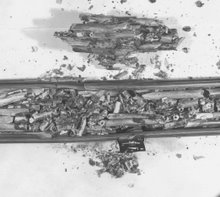
On Tuesday, April 3, 2007, the ACRS Subcommittee on Fuels considered several aspects of Reactivity Insertion Accidents. However, they continued to ignore the impact of heavy fouling (crud). As I've mentioned many times in this blog, fouling is ubiquitous among the worldwide fleet of LWRs. And I've presented the following slide previously; the heavy textured crud is clearly a very significant thermal resistance.


Sunday, June 10, 2007
I've been in this business since 1950
Robert H. Leyse in One Minute
I've been in this business since 1950 on several tasks
including the FLECHT tests that are referenced in
Appendix K. If you check ADAMS under Leyse, you will
find at least 172 entries. These include documents that I
have submitted to the NRC, related public comments, NRC
evaluations, and other matters.
My succinct discussion of fouling in the range of light water reactors over the decades may be found on GOOGLE by entering unmet relap. That is
U-N-M-E-T space R-E-L-A-P. You will find my slide presentation to the 2003 RELAP5 Users Conference under the title Unmet Challenges for SCDAP/RELAP5.
The impact of fouling on LOCAs or reactivity insertion accidents has not been evaluated although extensive fouling of fuel elements is widespread in the U.S.A. and elsewhere. In the U.S.A., ultrasonic fuel cleaning has been applied at some units. In Europe, chemical cleaning has been applied.
The impact of fouling has not been included in the wide range of international test
programs that address reactor accidents. The U.S.A. FLECHT Program never covered this, LOFT did not, and the present day work at Penn State does not.
I may update the 2003 presentation and call it Unmet Challenges for TRACE. Anyway, there are more examples that I would cite in such an update; however,
the bottom line is unchanged.
I've been in this business since 1950 on several tasks
including the FLECHT tests that are referenced in
Appendix K. If you check ADAMS under Leyse, you will
find at least 172 entries. These include documents that I
have submitted to the NRC, related public comments, NRC
evaluations, and other matters.
My succinct discussion of fouling in the range of light water reactors over the decades may be found on GOOGLE by entering unmet relap. That is
U-N-M-E-T space R-E-L-A-P. You will find my slide presentation to the 2003 RELAP5 Users Conference under the title Unmet Challenges for SCDAP/RELAP5.
The impact of fouling on LOCAs or reactivity insertion accidents has not been evaluated although extensive fouling of fuel elements is widespread in the U.S.A. and elsewhere. In the U.S.A., ultrasonic fuel cleaning has been applied at some units. In Europe, chemical cleaning has been applied.
The impact of fouling has not been included in the wide range of international test
programs that address reactor accidents. The U.S.A. FLECHT Program never covered this, LOFT did not, and the present day work at Penn State does not.
I may update the 2003 presentation and call it Unmet Challenges for TRACE. Anyway, there are more examples that I would cite in such an update; however,
the bottom line is unchanged.
Saturday, June 2, 2007
Upper Head Injection: ULTRA HIGH RISK (Update on May 3, 2008)
Following is an old NRC Information Notice. The history and risks of Upper Head Injection is extensive and I'll have a lot to say about this in future entries. Duke did not immediately abandon its UHI, but it did so in due time. TVA kept its system but ultimately got rid of it. The Japanese kept theirs at OHI for a long time, but they also got rid of it.
Upper Head Injection was installed at Westinghouse Ice Condenser Plants to provide a rapid injection of cooling water in the event of a large break LOCA. Ice condenser plants have a lower back pressure and UHI compensates for this. American electric Power never bought into this for its Cook units.
In Simpson's book, "Nuclear Power from Underseas to Outer Space," he spends one line on UHI on apge 199, "Where this couldn't be done or wasn't enough we proposed an upper head injection system,"
This is my opening salvo that will include my close involvement in a long and interesting history, please stay tuned.
PolInformation Notices > 1985 > IN 85-02
SSINS No.: 6835
IN 85-02
UNITED STATES
NUCLEAR REGULATORY COMMISSION
OFFICE OF INSPECTION AND ENFORCEMENT
WASHINGTON, D.C. 20555
January 11, 1985
Information Notice No. 85-02: IMPROPER INSTALLATION AND TESTING OF DIFFERENTIAL PRESSURE TRANSMITTERS
Addressees:
All nuclear power reactor facilities holding an operating license (OL) or a
construction permit (CP).
Purpose:
This information notice provides notification of a potentially significant
problem pertaining to the improper installation and inadequate functional
testing of differential pressure transmitters.
Such conditions occurred at the McGuire Nuclear Station, Unit 1, when the Barton differential pressure switches utilized to control the isolation valves of the upper head injection (UHI) system were replaced with Rosemont differential pressure transmitters. It is expected that recipients will review the information contained in this notice for applicability to their facilities and consider actions, if appropriate, to preclude similar problems from occurring at their facilities. However, suggestions contained in this notice do not constitute NRC requirements; therefore, no specific action or written response is required.
Description of Circumstances:
On November 1, 1984, Duke Power Company informed the NRC that the UHI isolation valves failed to close when the UHI water accumulator was drained at its McGuire Nuclear Station, Unit 1. At that time, the plant was shut down because the nitrogen content of the water in the UHI accumulator exceeded the limit permitted by its technical specifications. Subsequent
investigations revealed that the four differential pressure transmitters used to sense the level of water in the UHI accumulator and initiate automatic closure of the isolation valves on a predetermined level had been improperly installed. As a result, the isolation valves did not automatically close when the water level in the UFII accumulator reached the set point.
The McGuire UHI system design includes a separate nitrogen accumulator that supplies pressurized nitrogen to force the water from the UHI water accumulator into the reactor vessel during the initial phase of a design-basis loss-of-coolant accident (LOCA). Thus, if the UHI isolation valves fail to close during the course of a design-basis LOCA, nitrogen could be injected into the reactor vessel. To prevent such an event, the differential pressure transmitters are designed to initiate automatic closure of the UHI isolation valves when the water in the UHI accumulator reaches a predetermined level.
8501080502
.
IN 85-02
January 11, 1985
Page 2 of 2
During April of 1984, the McGuire Nuclear Station, Unit 1, Barton
reverse-acting differential pressure switches were replaced with Rosemont
direct-acting differential pressure transmitters to improve the accuracy and
repeatability of the UHI water accumulator level sensing system. However,
the Rosemont differential pressure transmitters were not properly installed
in that the impulse lines were not connected to the appropriate transmitter
ports.
Several factors contributed to the improper installation, including
inadequate installation instructions. The major contributor was inadequate
functional testing of the UHI system after it had been modified in that the
post-modification tests were limited to calibration tests of the differential pressure transmitters. These calibration tests were performed with the transmitters isolated from the impulse lines. Consequently, the tests only verified that the transmitters would provide the required output
signal for a given differential pressure, but they lid not demonstrate that
the transmitters sensed the differential pressures associated with water
level changes in the UHI water accumulator. Thus, the differential pressure
transmitters were not only improperly installed, but the error was not
detected until this event. If a design-basis LOCA had occurred during this
period, the UHI system would have been actuated, but the UHI isolation
valves would not have closed when the water in the UHI water accumulator had
been depleted and nitrogen gas could have been injected into the reactor
vessel during the course of the LOCA.
Similar installation errors have been addressed in Information Notice No. No.
84-45, "Reversed-Differential Pressure Instrument Lines." However, the
majority of events described in that information notice occurred in boiling
water reactors during plant construction and were detected by functional
tests performed before commencing power operation.
In contrast, the event described in this infomation notice occurred at a pressurized water reactor and was undetected during approximately 5 months of power operation.
No specific action or written response is required by this information notice; however, if you have any question regarding this notice, please contact the Regional Administrator of the appropriate NRC regional office or the technical contact listed below.
Edward L. Jordan Director
Division of Emergency Preparedness
and Engineering Response
Office of Inspection and Enforcement
Technical Contact: I. Villalva, IE
(301) 492-9007
F. R. McCoy, RII
(404) 221-2689
Attachment:
List of Recently Issued IE Information Notices
Today, May 3, 2008, I found the following via GOOGLE. This is another example of loads of dollars that have gone into useless thermal hydraulic testing. These tests were reported during 1979 and apparently the reporting system caught up with this during 2001. The investigators recommend higher temperature for the UHI water. Of course, UHI has been abandoned, however, the recommendation came in 1979 and was never adopted. It is another matter that could drive plant operators nuts.
ROSA (Rig Of Safety Assessment)
Title
Performance test of the upper head injection system at the ROSA-II test facility
Creator/Author
Tasaka, K. ; Adachi, H. ; Sobajima, M. ; Soda, K. ; Suzuki, M. ; Okazaki, M. ; Shiba, M.
Publication Date
1979 Sep 01
OSTI Identifier
OSTI ID: 5425745
Other Number(s)
CODEN: NUTYB
Resource Type
Journal Article
Resource Relation
Nucl. Technol. ; Vol/Issue: 45:2
Research Org
Japan Atomic Energy Research Inst., Tokai, Ibaraki
Subject
220900 -- Nuclear Reactor Technology-- Reactor Safety ;210200 -- Power Reactors, Nonbreeding, Light-Water Moderated, Nonboiling Water Cooled; ;ECCS-- PERFORMANCE TESTING;PWR TYPE REACTORS-- ECCS; HYDRODYNAMICS;TEST FACILITIES
Related Subject
ENGINEERED SAFETY SYSTEMS;FLUID MECHANICS;MECHANICS;REACTOR PROTECTION SYSTEMS;REACTORS;TESTING;WATER COOLED REACTORS;WATER MODERATED REACTORS
Description/Abstract
To evaluate upper head injection system (UHIS) performance during a postulated loss-of-coolant accident (LOCA) in a pressurized water reactor (PWR), ten UHIS tests were conducted at the ROSA-II test facility.^The experimental results were different from the expected UHIS performance in the following points.^First, flashing took place in the upper head and a mixture level was formed before UHIS actuation.^Second, emptying of the upper head was observed immediately after UHIS shut off.^Third, part of the water which flowed down from the upper head, penetrated into the core and contributed to core cooling at the top part of the core, however, most of the water flowed out through the broken loop hot leg.^In the case of higher injection water temperature (approx.^120/sup 0/C), the fluid behavior in the pressure vessel differed significantly from the results for the low injection water temperature (approx.^20/sup 0/C), and the core cooling was remarkably improved.^Therefore, high-temperature UHIS water is recommended for effective core cooling.^The results described above are due to the following physical phenomena: (1) fluid mixing in the upper head is not good; (2) subcooled water, which flows into places such as the upper plenum where steam exists, causes strong condensation-depressurization which affects the flow behavior and core cooling.^Although the magnitude of the thermal-hydraulic effects observed in the ROSA-II/UHI tests may be unique to this facility, the above two physical phenomena observed are applicable to all PWRs with a UHIS.^Therefore, these two phenomena must be included in a LOCA analysis of a PWR with a UHIS.
Country of Publication
United States
Language
English
Format
Pages: 121-139
System Entry Date
2001 May 13
Upper Head Injection was installed at Westinghouse Ice Condenser Plants to provide a rapid injection of cooling water in the event of a large break LOCA. Ice condenser plants have a lower back pressure and UHI compensates for this. American electric Power never bought into this for its Cook units.
In Simpson's book, "Nuclear Power from Underseas to Outer Space," he spends one line on UHI on apge 199, "Where this couldn't be done or wasn't enough we proposed an upper head injection system,"
This is my opening salvo that will include my close involvement in a long and interesting history, please stay tuned.
PolInformation Notices > 1985 > IN 85-02
SSINS No.: 6835
IN 85-02
UNITED STATES
NUCLEAR REGULATORY COMMISSION
OFFICE OF INSPECTION AND ENFORCEMENT
WASHINGTON, D.C. 20555
January 11, 1985
Information Notice No. 85-02: IMPROPER INSTALLATION AND TESTING OF DIFFERENTIAL PRESSURE TRANSMITTERS
Addressees:
All nuclear power reactor facilities holding an operating license (OL) or a
construction permit (CP).
Purpose:
This information notice provides notification of a potentially significant
problem pertaining to the improper installation and inadequate functional
testing of differential pressure transmitters.
Such conditions occurred at the McGuire Nuclear Station, Unit 1, when the Barton differential pressure switches utilized to control the isolation valves of the upper head injection (UHI) system were replaced with Rosemont differential pressure transmitters. It is expected that recipients will review the information contained in this notice for applicability to their facilities and consider actions, if appropriate, to preclude similar problems from occurring at their facilities. However, suggestions contained in this notice do not constitute NRC requirements; therefore, no specific action or written response is required.
Description of Circumstances:
On November 1, 1984, Duke Power Company informed the NRC that the UHI isolation valves failed to close when the UHI water accumulator was drained at its McGuire Nuclear Station, Unit 1. At that time, the plant was shut down because the nitrogen content of the water in the UHI accumulator exceeded the limit permitted by its technical specifications. Subsequent
investigations revealed that the four differential pressure transmitters used to sense the level of water in the UHI accumulator and initiate automatic closure of the isolation valves on a predetermined level had been improperly installed. As a result, the isolation valves did not automatically close when the water level in the UFII accumulator reached the set point.
The McGuire UHI system design includes a separate nitrogen accumulator that supplies pressurized nitrogen to force the water from the UHI water accumulator into the reactor vessel during the initial phase of a design-basis loss-of-coolant accident (LOCA). Thus, if the UHI isolation valves fail to close during the course of a design-basis LOCA, nitrogen could be injected into the reactor vessel. To prevent such an event, the differential pressure transmitters are designed to initiate automatic closure of the UHI isolation valves when the water in the UHI accumulator reaches a predetermined level.
8501080502
.
IN 85-02
January 11, 1985
Page 2 of 2
During April of 1984, the McGuire Nuclear Station, Unit 1, Barton
reverse-acting differential pressure switches were replaced with Rosemont
direct-acting differential pressure transmitters to improve the accuracy and
repeatability of the UHI water accumulator level sensing system. However,
the Rosemont differential pressure transmitters were not properly installed
in that the impulse lines were not connected to the appropriate transmitter
ports.
Several factors contributed to the improper installation, including
inadequate installation instructions. The major contributor was inadequate
functional testing of the UHI system after it had been modified in that the
post-modification tests were limited to calibration tests of the differential pressure transmitters. These calibration tests were performed with the transmitters isolated from the impulse lines. Consequently, the tests only verified that the transmitters would provide the required output
signal for a given differential pressure, but they lid not demonstrate that
the transmitters sensed the differential pressures associated with water
level changes in the UHI water accumulator. Thus, the differential pressure
transmitters were not only improperly installed, but the error was not
detected until this event. If a design-basis LOCA had occurred during this
period, the UHI system would have been actuated, but the UHI isolation
valves would not have closed when the water in the UHI water accumulator had
been depleted and nitrogen gas could have been injected into the reactor
vessel during the course of the LOCA.
Similar installation errors have been addressed in Information Notice No. No.
84-45, "Reversed-Differential Pressure Instrument Lines." However, the
majority of events described in that information notice occurred in boiling
water reactors during plant construction and were detected by functional
tests performed before commencing power operation.
In contrast, the event described in this infomation notice occurred at a pressurized water reactor and was undetected during approximately 5 months of power operation.
No specific action or written response is required by this information notice; however, if you have any question regarding this notice, please contact the Regional Administrator of the appropriate NRC regional office or the technical contact listed below.
Edward L. Jordan Director
Division of Emergency Preparedness
and Engineering Response
Office of Inspection and Enforcement
Technical Contact: I. Villalva, IE
(301) 492-9007
F. R. McCoy, RII
(404) 221-2689
Attachment:
List of Recently Issued IE Information Notices
Today, May 3, 2008, I found the following via GOOGLE. This is another example of loads of dollars that have gone into useless thermal hydraulic testing. These tests were reported during 1979 and apparently the reporting system caught up with this during 2001. The investigators recommend higher temperature for the UHI water. Of course, UHI has been abandoned, however, the recommendation came in 1979 and was never adopted. It is another matter that could drive plant operators nuts.
ROSA (Rig Of Safety Assessment)
Title
Performance test of the upper head injection system at the ROSA-II test facility
Creator/Author
Tasaka, K. ; Adachi, H. ; Sobajima, M. ; Soda, K. ; Suzuki, M. ; Okazaki, M. ; Shiba, M.
Publication Date
1979 Sep 01
OSTI Identifier
OSTI ID: 5425745
Other Number(s)
CODEN: NUTYB
Resource Type
Journal Article
Resource Relation
Nucl. Technol. ; Vol/Issue: 45:2
Research Org
Japan Atomic Energy Research Inst., Tokai, Ibaraki
Subject
220900 -- Nuclear Reactor Technology-- Reactor Safety ;210200 -- Power Reactors, Nonbreeding, Light-Water Moderated, Nonboiling Water Cooled; ;ECCS-- PERFORMANCE TESTING;PWR TYPE REACTORS-- ECCS; HYDRODYNAMICS;TEST FACILITIES
Related Subject
ENGINEERED SAFETY SYSTEMS;FLUID MECHANICS;MECHANICS;REACTOR PROTECTION SYSTEMS;REACTORS;TESTING;WATER COOLED REACTORS;WATER MODERATED REACTORS
Description/Abstract
To evaluate upper head injection system (UHIS) performance during a postulated loss-of-coolant accident (LOCA) in a pressurized water reactor (PWR), ten UHIS tests were conducted at the ROSA-II test facility.^The experimental results were different from the expected UHIS performance in the following points.^First, flashing took place in the upper head and a mixture level was formed before UHIS actuation.^Second, emptying of the upper head was observed immediately after UHIS shut off.^Third, part of the water which flowed down from the upper head, penetrated into the core and contributed to core cooling at the top part of the core, however, most of the water flowed out through the broken loop hot leg.^In the case of higher injection water temperature (approx.^120/sup 0/C), the fluid behavior in the pressure vessel differed significantly from the results for the low injection water temperature (approx.^20/sup 0/C), and the core cooling was remarkably improved.^Therefore, high-temperature UHIS water is recommended for effective core cooling.^The results described above are due to the following physical phenomena: (1) fluid mixing in the upper head is not good; (2) subcooled water, which flows into places such as the upper plenum where steam exists, causes strong condensation-depressurization which affects the flow behavior and core cooling.^Although the magnitude of the thermal-hydraulic effects observed in the ROSA-II/UHI tests may be unique to this facility, the above two physical phenomena observed are applicable to all PWRs with a UHIS.^Therefore, these two phenomena must be included in a LOCA analysis of a PWR with a UHIS.
Country of Publication
United States
Language
English
Format
Pages: 121-139
System Entry Date
2001 May 13
Friday, June 1, 2007
An adulterated McAdams burnout correlation and the Reactor of Sorts ( Updated May 3, 2008)
I've discussed the Reactor of Sorts (ROS) in today's prior entry. And as I mention there, Orwellian False Memories plague the universe. Nevertheless, please consider the following brief discussion.
It is a fact that McAdams of MIT published a straightforward correlation for burnout heat flux in relatively cold flowing water.
(Q/A)* = [400.000 + 4800(Tsat – Tlocal)] [cube root of V]
Where
(Q/A)*is burnout heat flux Btu/(square foot)(hr)
Tsat is water saturation temperature, degrees Fahrenheit, at local pressure
Tlocal is water temperature, degrees Fahrenheit, at location of burnout
V is water velocity, feet/second, at location of burnout
Now, in my world of false memories I began work at the ROS during January 1960. It was a very interesting machine. However, the corporate heat transfer experts may have published a paper that discussed burnout heat flux for the plate type fuel of the ROS. They might have taken the McAdams correlation and multiplied it by 1/3 to get the burnout heat flux for the ROS. I might have read their report and after a while I could have checked a bit further with one of the corporate heat transfer experts. The paper showed a rectangular heat transfer assembly that was electrically heated. In all cases the burnouts occurred in a corner. Looking at the square geometry of the corner, it became apparent, that the local heat flux was substantially greater than the average around the test section.
If I indeed was promoting a power level increase for the ROS, then I had to expose this error. In my wildest imagination, I succeeded in that, and this obstacle to power level increase was removed. And today, April 27, 2007, I am disclosing that if I succeeded in the power level increase (for which the GEnii would have gotten bonuses if indeed it happened) I would have used the unadulterated McAdams correlation and also posted results using the Bernath correlation, if indeed a licensing report was submitted somewhere.
And now, here are the pages from GETR licensing report, APED-5000-A,Class 1, July 1965. Bernath is there as well as the unadulterated McAdms and also Mirshak. Click these pages for enlargement.


So, that is the documentation added on May 3, 2008. Maybe I'll say more later.
It is a fact that McAdams of MIT published a straightforward correlation for burnout heat flux in relatively cold flowing water.
(Q/A)* = [400.000 + 4800(Tsat – Tlocal)] [cube root of V]
Where
(Q/A)*is burnout heat flux Btu/(square foot)(hr)
Tsat is water saturation temperature, degrees Fahrenheit, at local pressure
Tlocal is water temperature, degrees Fahrenheit, at location of burnout
V is water velocity, feet/second, at location of burnout
Now, in my world of false memories I began work at the ROS during January 1960. It was a very interesting machine. However, the corporate heat transfer experts may have published a paper that discussed burnout heat flux for the plate type fuel of the ROS. They might have taken the McAdams correlation and multiplied it by 1/3 to get the burnout heat flux for the ROS. I might have read their report and after a while I could have checked a bit further with one of the corporate heat transfer experts. The paper showed a rectangular heat transfer assembly that was electrically heated. In all cases the burnouts occurred in a corner. Looking at the square geometry of the corner, it became apparent, that the local heat flux was substantially greater than the average around the test section.
If I indeed was promoting a power level increase for the ROS, then I had to expose this error. In my wildest imagination, I succeeded in that, and this obstacle to power level increase was removed. And today, April 27, 2007, I am disclosing that if I succeeded in the power level increase (for which the GEnii would have gotten bonuses if indeed it happened) I would have used the unadulterated McAdams correlation and also posted results using the Bernath correlation, if indeed a licensing report was submitted somewhere.
And now, here are the pages from GETR licensing report, APED-5000-A,Class 1, July 1965. Bernath is there as well as the unadulterated McAdms and also Mirshak. Click these pages for enlargement.


So, that is the documentation added on May 3, 2008. Maybe I'll say more later.
SL-1, A Ladyfinger
The following is copied from my original blog, http://nuclearenergyblog.blogspot.com/
February 24, 2007
Suppose I had false memories
Of course, one has to be careful about swearing to the truth of lots of stuff. What if I had an imagination, or far worse, some Orwellian false memories? My first entry in this blog briefly mentions the SL-1 explosion and that is pure documented fact.So let us suppose that near the west coast there was a nuclear test reactor of sorts. And the downtown office sends a front man to Idaho to attend some SL-1 explosion briefings. Upon his return, if he went, he comes out in the country and gives us a sanitized briefing at the reactor of sorts (ROS).
He describes the central control rod at SL-1 and before he gets to his next sentence, a sneering commenter might have bellowed out, "It would take a team from Argonne to put a control rod right in the center of that core."
Now we can move ahead a few years. The ROS might have been built with control rods that used boron stainless as structural material as well as poison. The control rod structure could have cracked after moderate use, leading to binding and other bad scenes. So, a cadmium assembly could have been designed that would have superior life and equivalent control strength (with thermal neutrons, black is black).
For a bit of further background, the ROS might have had six control rod assemblies with fuel followers, and if these assemblies existed, they were similar to the assemblies of the Engineering Test Reactor ETR that was in Idaho. The ETR poison sections were about three feet long and they included fuel followers so that fuel was added to the control rod location as control rods were withdrawn.
So, a new cadmium assembly might have been built, but how to test it for worth? The easiest thing would be to place it in the very center position of the ROS, go critical, shut down, remove it, and replace it with an old boron assembly and go critical again. Then a comparison of the positions of criticality would be a great proof test.But there might have been a restriction on such a procedure because the amount of reactivity (plus or minus) that was allowed in the center of ROS might have been limited by its operating license, if it had such.
However, under an AEC rule, 50.59, it might have been stipulated that the restriction on reactivity only applied to long term operations and not a simple field test of only several minutes at the most. So, such a comparison might have proceeded. And if it did proceed, the sneering commentator of the second paragraph above might have had the task of predicting the amount of withdrawal of the six control rods that would yield criticality. And if such a prediction was made, it might have been that criticality would be reached with about half of full withdrawal, about 18 inches.If the test proceeded, it might have been found that criticality was not reached as predicted. And then a guy in the control room might have telephoned the sneering commentator (who could have been elsewhere). The sneering commentator might have provided assurance that the situation was no big deal, that with such an unusual geometry with such a vast amount of poison in the most reactive location in the core, an accurate prediction was likely out of the question.So, the test may have proceeded. And if it did, the careful slow withdrawal of the bank of six control rods might have proceeded with several stops along the way to criticality. And criticality might have been reached with the gang withdrawal at 33 inches out of the maximum 36 inches that was possible with the ETR design. And that would have been very interesting since fuel followers would have added to the reactivity worth of the center of the core. And if the test had proceeded it might have been found that the cadmium section also led to 33 inches of gang withdrawal. After all, black is black.
And so, if in the game of inserting the control rod in location E-5, going critical, shutting down, removing the control rod, placing the new design, going critical, shutting down, removing the new design; if, then it might have been very fortunate that nothing happened that would have made SL-1 look like a ladyfinger.* And maybe, in contrast to SL-1, the ROS, in my wildest false memory could have had targets for isotope production, like cobalt stuff.
*During the mid 1930s, if a kid could get his money onto the counter, he could buy firecrackers. If he saved up, he could buy three ten inchers for a dime. For a nickel he could by a package of zillions of ladyfingers. Ladyfingers were weak little things that would damage nothing even if held held between the kid's fingers.
February 24, 2007
Suppose I had false memories
Of course, one has to be careful about swearing to the truth of lots of stuff. What if I had an imagination, or far worse, some Orwellian false memories? My first entry in this blog briefly mentions the SL-1 explosion and that is pure documented fact.So let us suppose that near the west coast there was a nuclear test reactor of sorts. And the downtown office sends a front man to Idaho to attend some SL-1 explosion briefings. Upon his return, if he went, he comes out in the country and gives us a sanitized briefing at the reactor of sorts (ROS).
He describes the central control rod at SL-1 and before he gets to his next sentence, a sneering commenter might have bellowed out, "It would take a team from Argonne to put a control rod right in the center of that core."
Now we can move ahead a few years. The ROS might have been built with control rods that used boron stainless as structural material as well as poison. The control rod structure could have cracked after moderate use, leading to binding and other bad scenes. So, a cadmium assembly could have been designed that would have superior life and equivalent control strength (with thermal neutrons, black is black).
For a bit of further background, the ROS might have had six control rod assemblies with fuel followers, and if these assemblies existed, they were similar to the assemblies of the Engineering Test Reactor ETR that was in Idaho. The ETR poison sections were about three feet long and they included fuel followers so that fuel was added to the control rod location as control rods were withdrawn.
So, a new cadmium assembly might have been built, but how to test it for worth? The easiest thing would be to place it in the very center position of the ROS, go critical, shut down, remove it, and replace it with an old boron assembly and go critical again. Then a comparison of the positions of criticality would be a great proof test.But there might have been a restriction on such a procedure because the amount of reactivity (plus or minus) that was allowed in the center of ROS might have been limited by its operating license, if it had such.
However, under an AEC rule, 50.59, it might have been stipulated that the restriction on reactivity only applied to long term operations and not a simple field test of only several minutes at the most. So, such a comparison might have proceeded. And if it did proceed, the sneering commentator of the second paragraph above might have had the task of predicting the amount of withdrawal of the six control rods that would yield criticality. And if such a prediction was made, it might have been that criticality would be reached with about half of full withdrawal, about 18 inches.If the test proceeded, it might have been found that criticality was not reached as predicted. And then a guy in the control room might have telephoned the sneering commentator (who could have been elsewhere). The sneering commentator might have provided assurance that the situation was no big deal, that with such an unusual geometry with such a vast amount of poison in the most reactive location in the core, an accurate prediction was likely out of the question.So, the test may have proceeded. And if it did, the careful slow withdrawal of the bank of six control rods might have proceeded with several stops along the way to criticality. And criticality might have been reached with the gang withdrawal at 33 inches out of the maximum 36 inches that was possible with the ETR design. And that would have been very interesting since fuel followers would have added to the reactivity worth of the center of the core. And if the test had proceeded it might have been found that the cadmium section also led to 33 inches of gang withdrawal. After all, black is black.
And so, if in the game of inserting the control rod in location E-5, going critical, shutting down, removing the control rod, placing the new design, going critical, shutting down, removing the new design; if, then it might have been very fortunate that nothing happened that would have made SL-1 look like a ladyfinger.* And maybe, in contrast to SL-1, the ROS, in my wildest false memory could have had targets for isotope production, like cobalt stuff.
*During the mid 1930s, if a kid could get his money onto the counter, he could buy firecrackers. If he saved up, he could buy three ten inchers for a dime. For a nickel he could by a package of zillions of ladyfingers. Ladyfingers were weak little things that would damage nothing even if held held between the kid's fingers.
Saturday, May 26, 2007
Old News: Flooding of Containment at Indian Point Unit 2
This is a very interesting event. On October 17, 1980, with the Indian Point 2 at full power, the containment was flooded very severely and the reactor pressure vessel was partially submerged. On October 24, 1980, the NRC issued Information Notice No. 80-37 that is copied below. The Notice refers to an unanalyzed thermal stress condition of potential safety significance.
However, by April 7, 1981, the technical staff of the N.R.C. said the Indian Point 2 nuclear reactor apparently suffered no damage from the flooding incident, and cleared the way for the unit to be restarted. But one month later, Con Edison announced that it had run another mechanical problem with Indian Point 2 and that if would not be able to put plant back in service until the end of May.
May 26, 1981. Indian Point 2 resumes service.
October 24, 1980
Information Notice No. 80-37:
CONTAINMENT COOLER LEAKS AND REACTOR CAVITY FLOODING AT INDIAN POINT UNIT 2
Description of Circumstances: This Notice contains information regarding multiple service water leaks into containment with resulting damage to reactor instrumentation and potential damage to the reactor pressure vessel.
Upon containment entry on October 17, 1980 at Indian Point Unit 2, to repair a malfunctioning power range nuclear detector, it was discovered that a significant amount of water was collected (approximately 100,000 gal) on the containment floor, in the containment sumps, and in the cavity under the reactor pressure vessel (RPV). This collected water probably caused the detector malfunction, and the water in the cavity under the RPV is believed to have been deep enough to wet several feet of the pressure vessel lower head, causing an unanalyzed thermal stress condition of potential safety significance. This condition resulted from the following combination of conditions: (1) Both containment sump pumps were inoperable, one due to blown fuses from an unknown cause and the other due to binding of its controlling float; (2) The two containment sump level indicating lights which would indicate increasing water level over the water level range present in the containment were stuck(on) and may have been for several days, leaving the operator with no operable instrumentation to measure water level in the containment; (3) The moisture level indicators in the containment did not indicate high moisture levels, apparently because they are designed to detect pressurized hot water or steam leaks (i.e., a LOCA), and are not sensitive to the lower airborne moisture levels resulting from relatively small cold water leaks; (4) The hold-up tanks which ultimately receive water pumped from the containment sump also receive Unit 1 process water, lab drain water, etc. These other water sources masked the effect of cessation of water flows from the Unit 2 sump; (5) There were significant, multiple service water leaks from the containment fan cooling units directly onto the containment floor. These coolers have a history of such leakage, which cannot be detected by supply inventory losses since the supply system (service water system) is not a closed system; (6) The two submersible pumps in the cavity under the Reactor Pressure Vessel were ineffective since they pump onto the containment floor for ultimate removal by the (inoperable) containment sump pumps. There is no water level instrumentation in the cavity under the RPV, nor was there any indication outside the containment when these pumps are running.
The licensee has installed redundant sump level annunciated alarms in the , control room and has installed an annunciated alarm in the control room to indicate if either submersible pump in the reactor cavity activates. The licensee has also repaired the service water leaks, installed guide bushings on the sump pump control floats to prevent their binding, and has repaired the containment sump water level indicators. .
Page 2 0f 2 IN 80-37 October 24, 1980
The licensee plans in the longer term to replace the containment fan unit cooling coils.
It is anticipated that results of a continuing NRC investigation into this incident will result in issuance of an IE Bulletin and/or an NRR Generic Letter in the near future which will recommend or require specific licensees and applicant actions. In the interim, we recommend that all licensee ascertain that the potential does not exist for undetected water accumulation in the containment.
This Information Notice is provided to inform licensees of a possibly significant matter. No written response to this Information Notice is required.
However, by April 7, 1981, the technical staff of the N.R.C. said the Indian Point 2 nuclear reactor apparently suffered no damage from the flooding incident, and cleared the way for the unit to be restarted. But one month later, Con Edison announced that it had run another mechanical problem with Indian Point 2 and that if would not be able to put plant back in service until the end of May.
May 26, 1981. Indian Point 2 resumes service.
Here is the Information Notice of October 24, 1980:
UNITED STATES NUCLEAR REGULATORY COMMISSION
OFFICE OF INSPECTION AND ENFORCEMENT
October 24, 1980
Information Notice No. 80-37:
CONTAINMENT COOLER LEAKS AND REACTOR CAVITY FLOODING AT INDIAN POINT UNIT 2
Description of Circumstances: This Notice contains information regarding multiple service water leaks into containment with resulting damage to reactor instrumentation and potential damage to the reactor pressure vessel.
Upon containment entry on October 17, 1980 at Indian Point Unit 2, to repair a malfunctioning power range nuclear detector, it was discovered that a significant amount of water was collected (approximately 100,000 gal) on the containment floor, in the containment sumps, and in the cavity under the reactor pressure vessel (RPV). This collected water probably caused the detector malfunction, and the water in the cavity under the RPV is believed to have been deep enough to wet several feet of the pressure vessel lower head, causing an unanalyzed thermal stress condition of potential safety significance. This condition resulted from the following combination of conditions: (1) Both containment sump pumps were inoperable, one due to blown fuses from an unknown cause and the other due to binding of its controlling float; (2) The two containment sump level indicating lights which would indicate increasing water level over the water level range present in the containment were stuck(on) and may have been for several days, leaving the operator with no operable instrumentation to measure water level in the containment; (3) The moisture level indicators in the containment did not indicate high moisture levels, apparently because they are designed to detect pressurized hot water or steam leaks (i.e., a LOCA), and are not sensitive to the lower airborne moisture levels resulting from relatively small cold water leaks; (4) The hold-up tanks which ultimately receive water pumped from the containment sump also receive Unit 1 process water, lab drain water, etc. These other water sources masked the effect of cessation of water flows from the Unit 2 sump; (5) There were significant, multiple service water leaks from the containment fan cooling units directly onto the containment floor. These coolers have a history of such leakage, which cannot be detected by supply inventory losses since the supply system (service water system) is not a closed system; (6) The two submersible pumps in the cavity under the Reactor Pressure Vessel were ineffective since they pump onto the containment floor for ultimate removal by the (inoperable) containment sump pumps. There is no water level instrumentation in the cavity under the RPV, nor was there any indication outside the containment when these pumps are running.
The licensee has installed redundant sump level annunciated alarms in the , control room and has installed an annunciated alarm in the control room to indicate if either submersible pump in the reactor cavity activates. The licensee has also repaired the service water leaks, installed guide bushings on the sump pump control floats to prevent their binding, and has repaired the containment sump water level indicators. .
Page 2 0f 2 IN 80-37 October 24, 1980
The licensee plans in the longer term to replace the containment fan unit cooling coils.
It is anticipated that results of a continuing NRC investigation into this incident will result in issuance of an IE Bulletin and/or an NRR Generic Letter in the near future which will recommend or require specific licensees and applicant actions. In the interim, we recommend that all licensee ascertain that the potential does not exist for undetected water accumulation in the containment.
This Information Notice is provided to inform licensees of a possibly significant matter. No written response to this Information Notice is required.
Friday, May 25, 2007
America's first private nuclear power plant.
The Indian Point Reactors: a revealing list of events through January 10, 2003.
Here is the prime event from the list:
Oct. 17, 1980. A major water leak in a joint of a pipe carrying nonradioactive water at Indian Point 2 releases about 100,000 gallons of water, flooding a containment building of Indian Point 2.
Oct. 24, 1980. The N.R.C. orders Indian Point 2 shut down until Con Edison determines how the leak went unnoticed. Five days later, the commission initiates an investigation to determine why Con Edison failed to notify the commission about the leak.
Dec. 10, 1980. The N.R.C. fines Con Edison $210,000 for the flooding in October.
April 7, 1981. The technical staff of the N.R.C. says the Indian Point 2 nuclear reactor apparently suffered no damage from the flooding incident, clearing the way for the unit to be restarted. But one month later, Con Edison announces it has run into still another mechanical problem with Indian Point 2 and will not be able to put plant back in service until the end of May.
May 26, 1981. Indian Point 2 resumes service.
And here is the list copied from the New York Times.
Indian Point: From Amusement Park to Power Plant
NY TIMES 8apr03
Consolidated Edison built the first privately financed, commercial nuclear power plant in the United States in Buchanan, N.Y. That plant and the two others eventually built on the site have had troubled histories.
Oct. 8, 1954. Con Edison announces the purchase of a 260-acre site in Buchanan, the former Indian Point amusement park and adjacent land, 35 miles north of midtown Manhattan, to construct an atomic power plant.
Sept. 16, 1962. The reactor that would become known as Indian Point 1 begins generating power.
Dec. 10, 1962. Con Edison applies for a permit to build another reactor, in Ravenswood, Queens. The application is withdrawn on Jan. 6, 1964, after public protests.
May 27, 1965. Seven Congressmen from New York State accuse state officials of covering up the killing of fish in the Hudson River near the Indian Point power plant. The fish kills are blamed on hot water the plant discharges into the river from its cooling systems.
Nov. 23, 1965. Con Edison's directors approve plans to build a second nuclear reactor at Indian Point. Gov. Nelson A. Rockefeller calls the move "of major importance to our state and its expanding atomic industry."
April 1967. Con Edison applies for permission to build a third nuclear plant at Indian Point. Permission is granted in August 1969.
May 13, 1970. The state charges Con Edison with serious violations of state conservation laws in the operation of its nuclear generating plant and asks that the plant be closed until "suitable methods" to protect the Hudson River can be developed. State seeks $5 million in damages for the loss of fish.
June 30, 1970. Indian Point 1 is shut down because of defects in the stainless steel piping used to help keep the reactor cool. Meanwhile, the plant is fined $1.6 million for fish kills in Hudson caused by its hot water discharge.
May 1972. The state levies $1.5 million in fines against Con Edison for "massive" fish kills in the Hudson. The total fine is based on a civil penalty of $500 plus $10 for each fish killed.
June 26, 1973. In a test, Indian Point 2 produces power for the first time. It goes into full operation more than a year later in October 1974, after repairs to the steel liner in the reinforced concrete dome protecting the reactor.
Dec. 1, 1973. Con Edison acknowledges that its new power plant, Indian Point 2, has significant problems, after an accident forced it to shut down. Con Edison officials says the problems centered around a buckling and bulging of the steel liner in the reinforced concrete dome in which the nuclear plant is housed.
Sept. 18, 1974. The State Legislature votes to allow the Power Authority of the State of New York to take over Con Edison's Indian Point 3 plant, which is still under construction, to help save the financially ailing Con Edison.
Oct. 14, 1974. Indian Point 1 is permanently shut down, 12 years after going into operation, because it lacks an emergency cooling system for the reactor core, which the Nuclear Regulatory Commission insists be added. The plant is retired but not decommissioned.
Dec. 30, 1975. Under pressure from Gov. Hugh L. Carey, Con Edison agrees to sell Indian Point 3 to the State Power Authority. The action disappoints environmentalists who hoped the sale could be blocked and the plant closed down as a threat to the Hudson River and adjacent areas of Westchester County.
Jan. 20, 1976. William N. Anders, chairman of the N.R.C., orders two separate investigations of two Indian Point reactors a week after Robert D. Pollard, the commission's project manager for Indian Point 3, questioned plant safety and resigned from the N.R.C. staff. After hearings in Washington, the N.R.C. decided to take no action.
Aug. 30, 1976. Indian Point 3 goes into operation.
October 1979. An accident occurs at the Three Mile Island power plant in Middletown, Pa. President Carter appoints a commission to investigate, and to consider whether any of the nation's existing reactors should be shut down.
Dec. 18, 1979. The N.R.C. says that emergency evacuation plans for Indian Point are "lacking." The commission gives Con Edison and the State Power Authority two months to submit revisions.
Jan. 29, 1980. The two nuclear plants at Indian Point have been shut down for five months for refueling, maintenance and repairs, and the N.R.C. says safety improvements must be completed before they can resume operation. Indian Point 2 is restarted in early February and Indian Point 3 returns to service on Feb. 16.
Feb. 27, 1980. Con Edison accedes to the wishes of the N.R.C. and retires Indian Point 1 permanently.
Oct. 17, 1980. A major water leak in a joint of a pipe carrying nonradioactive water at Indian Point 2 releases about 100,000 gallons of water, flooding a containment building of Indian Point 2.
Oct. 24, 1980. The N.R.C. orders Indian Point 2 shut down until Con Edison determines how the leak went unnoticed. Five days later, the commission initiates an investigation to determine why Con Edison failed to notify the commission about the leak.
Dec. 10, 1980. The N.R.C. fines Con Edison $210,000 for the flooding in October.
Jan. 31, 1981. The State Power Authority shuts down Indian Point 3 because of malfunction in the plant's steam turbine section. Meanwhile, officials from the four-county area within 10 miles of Indian Point testify that an emergency evacuation plan presented by the utilities contains major flaws and urges that they not be approved.
April 7, 1981. The technical staff of the N.R.C. says the Indian Point 2 nuclear reactor apparently suffered no damage from the flooding incident, clearing the way for the unit to be restarted. But one month later, Con Edison announces it has run into still another mechanical problem with Indian Point 2 and will not be able to put plant back in service until the end of May.
May 26, 1981. Indian Point 2 resumes service.
Dec. 11, 1981. Con Edison is fined $40,000 by the N.R.C. for not protecting workers from radiation at its Indian Point 2 plant.
March 3, 1982. Indian Point simulates a major accident to test emergency evacuation plans. Federal officials say later that the drill was "generally good," although there were areas that need strengthening.
Aug. 2, 1982. The N.R.C. threatens to close Indian Point unless flaws in the emergency evacuation plans for the area surrounding the plant are corrected within four months. The commission cites deficiencies in provisions for notifying residents in the area, for educating the public in advance about what to do, for making agreements with bus companies to provide emergency service and for limiting exposure of emergency workers to radiation.
Sept. 2, 1982. The chairman of a three-judge panel conducting hearings on safety of the two Indian Point plant resigns, saying the N.R.C. was not giving opponents of the plant a fair chance to state their case. The chairman, Administrative Law Judge Louis J. Carter, had been presiding at hearings ordered by the commission.
Dec. 17, 1982. The Federal Emergency Management Agency, which is charged with evaluating preparations to cope with an accident at Indian Point, says the emergency plants were "not feasible" because of significant deficiencies. The agency says it will decide whether to fine the utility operators, suspend the plant's operating licenses or take other action.
Dec. 22, 1982. The N.R.C. votes 3 to 2 to permit the Indian Point nuclear reactors to operate and to wait until an accident drill in March to determine whether deficiencies in emergency planning had been corrected.
March 9, 1983. Two thousand people, from bus drivers to county executives, test their ability to respond to a major accident at the Indian Point plants, under the observation of 55 Federal inspectors and one of the five members of N.R.C.
April 15, 1983. FEMA issues a report based on the March drill that concludes the area around Indian Point is not prepared for a possible accident at the nuclear reactors, and the safety for the 288,000 people living in the area cannot be assured.
Aug. 26, 1983. FEMA says officials had remedied deficiencies in the plans for coping with an accident at Indian Point and prepares a report for the N.R.C., ending what was then the plant's most serious threat to its license.
Dec. 30, 1993. Ten months after Indian Point 3 was shut down because of mismanagement and safety problems, Federal regulators tell plant managers they are concerned that personnel there cannot handle the plant safely even when it is shut down. It does not reopen until July 1995.
Feb. 14, 2000. In the most serious incident since the plant opened in 1974, a rupture in a steam generator tube at Indian Point 2 releases a minute amount of radioactive steam, though federal regulators and company officials say public health was not threatened. The reactor is shut until December.
Jan. 10, 2003. With anxiety about the the plant growing in the aftermath of the Sept. 11, 2001 terrorist attacks, a consultant hired by Gov. George E. Pataki calls emergency plans inadequate to protect the public from a disastrous leak of radiation at Indian Point. The consultant, James Lee Witt, former director of FEMA, says the plans fail to take into account the possibility of a terrorist attack.
Here is the prime event from the list:
Oct. 17, 1980. A major water leak in a joint of a pipe carrying nonradioactive water at Indian Point 2 releases about 100,000 gallons of water, flooding a containment building of Indian Point 2.
Oct. 24, 1980. The N.R.C. orders Indian Point 2 shut down until Con Edison determines how the leak went unnoticed. Five days later, the commission initiates an investigation to determine why Con Edison failed to notify the commission about the leak.
Dec. 10, 1980. The N.R.C. fines Con Edison $210,000 for the flooding in October.
April 7, 1981. The technical staff of the N.R.C. says the Indian Point 2 nuclear reactor apparently suffered no damage from the flooding incident, clearing the way for the unit to be restarted. But one month later, Con Edison announces it has run into still another mechanical problem with Indian Point 2 and will not be able to put plant back in service until the end of May.
May 26, 1981. Indian Point 2 resumes service.
And here is the list copied from the New York Times.
Indian Point: From Amusement Park to Power Plant
NY TIMES 8apr03
Consolidated Edison built the first privately financed, commercial nuclear power plant in the United States in Buchanan, N.Y. That plant and the two others eventually built on the site have had troubled histories.
Oct. 8, 1954. Con Edison announces the purchase of a 260-acre site in Buchanan, the former Indian Point amusement park and adjacent land, 35 miles north of midtown Manhattan, to construct an atomic power plant.
Sept. 16, 1962. The reactor that would become known as Indian Point 1 begins generating power.
Dec. 10, 1962. Con Edison applies for a permit to build another reactor, in Ravenswood, Queens. The application is withdrawn on Jan. 6, 1964, after public protests.
May 27, 1965. Seven Congressmen from New York State accuse state officials of covering up the killing of fish in the Hudson River near the Indian Point power plant. The fish kills are blamed on hot water the plant discharges into the river from its cooling systems.
Nov. 23, 1965. Con Edison's directors approve plans to build a second nuclear reactor at Indian Point. Gov. Nelson A. Rockefeller calls the move "of major importance to our state and its expanding atomic industry."
April 1967. Con Edison applies for permission to build a third nuclear plant at Indian Point. Permission is granted in August 1969.
May 13, 1970. The state charges Con Edison with serious violations of state conservation laws in the operation of its nuclear generating plant and asks that the plant be closed until "suitable methods" to protect the Hudson River can be developed. State seeks $5 million in damages for the loss of fish.
June 30, 1970. Indian Point 1 is shut down because of defects in the stainless steel piping used to help keep the reactor cool. Meanwhile, the plant is fined $1.6 million for fish kills in Hudson caused by its hot water discharge.
May 1972. The state levies $1.5 million in fines against Con Edison for "massive" fish kills in the Hudson. The total fine is based on a civil penalty of $500 plus $10 for each fish killed.
June 26, 1973. In a test, Indian Point 2 produces power for the first time. It goes into full operation more than a year later in October 1974, after repairs to the steel liner in the reinforced concrete dome protecting the reactor.
Dec. 1, 1973. Con Edison acknowledges that its new power plant, Indian Point 2, has significant problems, after an accident forced it to shut down. Con Edison officials says the problems centered around a buckling and bulging of the steel liner in the reinforced concrete dome in which the nuclear plant is housed.
Sept. 18, 1974. The State Legislature votes to allow the Power Authority of the State of New York to take over Con Edison's Indian Point 3 plant, which is still under construction, to help save the financially ailing Con Edison.
Oct. 14, 1974. Indian Point 1 is permanently shut down, 12 years after going into operation, because it lacks an emergency cooling system for the reactor core, which the Nuclear Regulatory Commission insists be added. The plant is retired but not decommissioned.
Dec. 30, 1975. Under pressure from Gov. Hugh L. Carey, Con Edison agrees to sell Indian Point 3 to the State Power Authority. The action disappoints environmentalists who hoped the sale could be blocked and the plant closed down as a threat to the Hudson River and adjacent areas of Westchester County.
Jan. 20, 1976. William N. Anders, chairman of the N.R.C., orders two separate investigations of two Indian Point reactors a week after Robert D. Pollard, the commission's project manager for Indian Point 3, questioned plant safety and resigned from the N.R.C. staff. After hearings in Washington, the N.R.C. decided to take no action.
Aug. 30, 1976. Indian Point 3 goes into operation.
October 1979. An accident occurs at the Three Mile Island power plant in Middletown, Pa. President Carter appoints a commission to investigate, and to consider whether any of the nation's existing reactors should be shut down.
Dec. 18, 1979. The N.R.C. says that emergency evacuation plans for Indian Point are "lacking." The commission gives Con Edison and the State Power Authority two months to submit revisions.
Jan. 29, 1980. The two nuclear plants at Indian Point have been shut down for five months for refueling, maintenance and repairs, and the N.R.C. says safety improvements must be completed before they can resume operation. Indian Point 2 is restarted in early February and Indian Point 3 returns to service on Feb. 16.
Feb. 27, 1980. Con Edison accedes to the wishes of the N.R.C. and retires Indian Point 1 permanently.
Oct. 17, 1980. A major water leak in a joint of a pipe carrying nonradioactive water at Indian Point 2 releases about 100,000 gallons of water, flooding a containment building of Indian Point 2.
Oct. 24, 1980. The N.R.C. orders Indian Point 2 shut down until Con Edison determines how the leak went unnoticed. Five days later, the commission initiates an investigation to determine why Con Edison failed to notify the commission about the leak.
Dec. 10, 1980. The N.R.C. fines Con Edison $210,000 for the flooding in October.
Jan. 31, 1981. The State Power Authority shuts down Indian Point 3 because of malfunction in the plant's steam turbine section. Meanwhile, officials from the four-county area within 10 miles of Indian Point testify that an emergency evacuation plan presented by the utilities contains major flaws and urges that they not be approved.
April 7, 1981. The technical staff of the N.R.C. says the Indian Point 2 nuclear reactor apparently suffered no damage from the flooding incident, clearing the way for the unit to be restarted. But one month later, Con Edison announces it has run into still another mechanical problem with Indian Point 2 and will not be able to put plant back in service until the end of May.
May 26, 1981. Indian Point 2 resumes service.
Dec. 11, 1981. Con Edison is fined $40,000 by the N.R.C. for not protecting workers from radiation at its Indian Point 2 plant.
March 3, 1982. Indian Point simulates a major accident to test emergency evacuation plans. Federal officials say later that the drill was "generally good," although there were areas that need strengthening.
Aug. 2, 1982. The N.R.C. threatens to close Indian Point unless flaws in the emergency evacuation plans for the area surrounding the plant are corrected within four months. The commission cites deficiencies in provisions for notifying residents in the area, for educating the public in advance about what to do, for making agreements with bus companies to provide emergency service and for limiting exposure of emergency workers to radiation.
Sept. 2, 1982. The chairman of a three-judge panel conducting hearings on safety of the two Indian Point plant resigns, saying the N.R.C. was not giving opponents of the plant a fair chance to state their case. The chairman, Administrative Law Judge Louis J. Carter, had been presiding at hearings ordered by the commission.
Dec. 17, 1982. The Federal Emergency Management Agency, which is charged with evaluating preparations to cope with an accident at Indian Point, says the emergency plants were "not feasible" because of significant deficiencies. The agency says it will decide whether to fine the utility operators, suspend the plant's operating licenses or take other action.
Dec. 22, 1982. The N.R.C. votes 3 to 2 to permit the Indian Point nuclear reactors to operate and to wait until an accident drill in March to determine whether deficiencies in emergency planning had been corrected.
March 9, 1983. Two thousand people, from bus drivers to county executives, test their ability to respond to a major accident at the Indian Point plants, under the observation of 55 Federal inspectors and one of the five members of N.R.C.
April 15, 1983. FEMA issues a report based on the March drill that concludes the area around Indian Point is not prepared for a possible accident at the nuclear reactors, and the safety for the 288,000 people living in the area cannot be assured.
Aug. 26, 1983. FEMA says officials had remedied deficiencies in the plans for coping with an accident at Indian Point and prepares a report for the N.R.C., ending what was then the plant's most serious threat to its license.
Dec. 30, 1993. Ten months after Indian Point 3 was shut down because of mismanagement and safety problems, Federal regulators tell plant managers they are concerned that personnel there cannot handle the plant safely even when it is shut down. It does not reopen until July 1995.
Feb. 14, 2000. In the most serious incident since the plant opened in 1974, a rupture in a steam generator tube at Indian Point 2 releases a minute amount of radioactive steam, though federal regulators and company officials say public health was not threatened. The reactor is shut until December.
Jan. 10, 2003. With anxiety about the the plant growing in the aftermath of the Sept. 11, 2001 terrorist attacks, a consultant hired by Gov. George E. Pataki calls emergency plans inadequate to protect the public from a disastrous leak of radiation at Indian Point. The consultant, James Lee Witt, former director of FEMA, says the plans fail to take into account the possibility of a terrorist attack.
Subscribe to:
Posts (Atom)