Of course, I have not been to bed yet. But I am in a sweat to get this into my blog because a few hours ago a sharp lady promised to go to my blog and even enter a comment. But that is not what I am laughing about. Anyway, back in the early 1950s, Andrei Vishinsky had the following response to one of Harry Truman's favorite proposals related to disarmament:
"I could hardly sleep at all last night. . . . I could not sleep because I kept laughing."
Now, so far I have not been a Red, but I never forgot Vishinsky's remark.
What is making me laugh so hard? OK, let's start out with some kind of analogy, and really, analogies have shortcomings. Suppose somebody proposed a law that required federal inspections of ice cream stands. And then suppose that the ice cream stand lobbyists told the feds that such a proposal was absurd and that it should not even be reviewed. So, go to the next step, the guy who proposed the law for inspections finds out that a few years earlier, the ice cream lobby had given its top award to an ice cream stand operator who devised an ingenious system for inspecting ice cream stands. At this point the somebody who proposed the law for inspections begins laughing, and remarks, "I could hardly sleep at all last night. . . . I could not sleep because I kept laughing."
The ice cream stand is a nuclear power plant that operates with a lot of dirt in its system and the proposal is to require attention to that problem via federal regulations. The lobbyist, the Nuclear Energy Institute, declares on August 6, 2007, "The industry position is that the petition for rulemaking submitted by Mr. Leyse is not needed and should not be considered for action by the Nuclear Regulatory Commission." However, back in 2005, the Nuclear Energy Institute issued the following press release:
Nuclear Energy Institute FOR IMMEDIATE RELEASE
Contact:202-739-8000
For Release:May 18, 2005
Employees at Entergy’s River Bend Station Earn Top Industry Practice 'Best of the Best’ Award
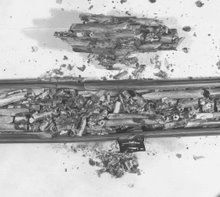
The River Bend Station entry was selected from 94 nominations for the team’s innovative technique to obtain pieces, or “flakes,” of residue from fuel rods while submerged in coolant water. This examination was necessary because workers had identified significant residue buildup as the primary cause for fuel failures.“Such examinations were previously only possible through use of shielded enclosures known as hot cells, an expensive and time-consuming technique that requires two to three years from start to finish and an investment of $2 million to $3 million. Entergy’s innovative method can be completed in six months, at a substantial cost saving. More importantly, worker radiation exposure is reduced three rem to 300 millirem,” said Skip Bowman, NEI’s president and chief executive officer.“All U.S. power reactors can use this technique. Indeed, River Bend’s efforts are now serving as a basis for additional incentives that will further the entire industry’s knowledge of residue formation and behavior,” Bowman said.
Of course, analogies are never precise, and this one has flaws. Nevertheless, I am laughing and that is too bad because I need all of the good sleep that I can get!
Saturday, August 11, 2007

Thursday, August 9, 2007
CRUD STUFF
Leyse analyzed BWR crud during 1959 including thermal conductivity
Document
7 Mb View Document or Access Individual Pages - search, view and/or download individual pages
Title
WATER CHEMISTRY AND FUEL ELEMENT SCALE IN EBWR
Creator/Author
Breden, C.R. ; Charak, I. ; Leyse, R.H.
Publication Date
1960 Nov 01
OSTI Identifier
OSTI ID: 4081362
Report Number(s)
ANL-6136
DOE Contract Number
W-31-109-ENG-38
Resource Type
Technical Report
Resource Relation
Other Information: Orig. Receipt Date: 31-DEC-61
Research Org
Argonne National Lab., Ill.
Sponsoring Org
USDOE
Subject
REACTOR TECHNOLOGY; CANNING; CHEMICAL REACTIONS; CONTAMINATION; CORROSION; DECOMPOSITION; DEPOSITS; DISTRIBUTION; EBWR; FAILURES; FISSION PRODUCTS; FUEL CANS; FUEL ELEMENTS; HEAT TRANSFER; HEATING; HIGH TEMPERATURE; LEAKS; MATHEMATICS; MEASURED VALUES; PLATES; QUALITATIVE ANALYSIS; RADIOACTIVITY; RADIOCHEMISTRY; REACTOR CORE; REACTORS; TEMPERATURE; THERMAL CONDUCTIVITY; VOLUME; WATER
Description/Abstract
The first two sections summarize investigations in EBWR concenced with some aspects of water chemistry. The results of many of these investigations have not been previously published in a form given wide distribution. Included are studies of water conditions, corrosion products (composition, activities, transportation, deposition, and distribution), water dissociation, water activity, fission-product release, and build-up of plant activity. The last two sections of the report give the results of studies of the heat tansfer characteristics of fuel-element scale and effects of high-temperature heating on scale removal and fuel element growth. The maximum scale thickness measured was about 0.008 in. Heat-transfer calculations based on scale thermal conductivity measurements indicate the possibility of maximum fuel temperatures as high at 1692/sup o/F at 100-Mw operation of the core. This temperature is in a range where fuel growth, with resulting fuel element distortion and damage, is expected. Observed trends that may alleviate damage are the tendency of scale to flake off in high-heat transfer areas and the restraining effect of cladding on growth of fuel. No satisfactory means has been found to descale the fuel plates. (auth)
Country of Publication
United States
Language
English
Format
Size: Pages: 105
Availability
NTIS
System Entry Date
2007 May 21
See the complete report at
http://www.osti.gov/energycitations/servlets/purl/4081362-fmbN3r/4081362.PDF
Nuclear Energy Institute discloses the following
http://www.nei.org/newsandevents/riverbendaward/
and the Nuclear Power Journal has this
www.npjonline.com/NPJMain.nsf/504ca249c786e20f85256284006da7ab/89609e291af0b7b286257194007576c1?OpenDocument
Following is a Bob Leyse presentation
www.inl.gov/relap5/rius/yellowstone/leyse.pdf
Following is Letter to NRC: PRM-50-84 and MELLLA+
Robert H. Leyse
P. O. Box 2850
Sun Valley, ID 83353
July 27, 2007
Ms. Annette L. Vietti Cook
Secretary
U. S. Nuclear Regulatory Commission
Washington, D. C. 20555-0001
Attention: Rulemaking and Adjudications Staff
Public Comment on PRM-50-84:
PRM-50-84 and MELLLA+
Dear Ms. Vietti Cook
The need to implement PRM-50-84 is clearly illustrated by the NRC’s incomplete evaluations of GENERAL ELECTRIC (GE) LICENSING TOPICAL REPORTS ON MAXIMUM EXTENDED LOAD LINE LIMIT ANALYSIS PLUS (MELLLA+) ANDAPPLICABILITY OF GE METHODS TO EXPANDED OPERATING DOMAINS.
The NRC’s evaluators of MELLLA+ completely overlooked the impact of crud deposits on fuel elements. The reviewers of PRM-50-84 should study the ACRS letter of June 22, 2007, Shack to Reyes, ML071760346. Following are quotations from that letter.
A number of design developments enable operation in the MELLLA+ domain. The most important are: (1) fuel design features that accommodate operation at the higher power / lower flow conditions while maintaining acceptable fuel performance; and (2) a new detect and suppress system that provides protection against power and flow oscillations, which may arise more easily at higher powers and lower flows.The Safety Evaluations were very demanding tasks for which the staff should be commended.
The staff performed thorough evaluations and carried out convincing confirmatory analyses where tools were available, such as for the reactor physics and fuel related issues. Unfortunately, the staff did not have the thermal-hydraulic code capability that would have been needed to independently confirm some important parts of the evaluation such as ATWS instability. The TRACE thermal-hydraulic system analysis code has the capabilities needed to address such issues.
As recommended in our March 22, 2007 report, the TRACE code developmental work should be completed expeditiously to enable its incorporation into the regulatory process.
The reviewers of PRM-50-84 may note that among the fuel design features that accommodate operation at the higher power / lower flow conditions there is no allowance for the impact of crud deposits.
The reviewers may further note that the so-called thorough evaluations of MELLA+ by the NRC staff did not include any attention to the impact of crud deposits on fuel related issues. Regarding TRACE, even if it becomes operational, it has no specifications that incorporate the impact of crud deposits.
This letter cites the lack of allowances for crud deposits in the NRC’s evaluations of MELLLA+. Crud deposits are ubiquitous among the worldwide fleet of LWRs, and the issues are of very high safety significance.
Robert H. Leyse
Widespread coverage of tenacious crud: Another Leyse Letter to NRC
July 27, 2007
Ms. Annette L. Vietti Cook
Secretary
U. S. Nuclear Regulatory Commission
Washington, D. C. 20555-0001
Attention: Rulemaking and Adjudications Staff
Public Comment on PRM-50-84
Dear Ms. Vietti Cook
The need to implement PRM-50-84 is clearly illustrated by analysis of the following reference that includes discussions of the wide spread coverage of tenacious crud and the consequent excessively high cladding temperatures and fuel damage:
NRC, "River Bend Station - NRC Problem Identification and Resolution Inspection Report 0500458/2005008," 02/28/06, Report Details, located at: www.nrc.gov, Electronic Reading Room, ADAMS Documents, Accession Number: ML060600503.
This reference discloses that for cycle 8 at River Bend, “General Electric (the fuel vendor) calculated that the cladding surface temperatures approached 1200 oF in localized areas.”
This reference also discloses that during cycle 11 at River Bend, “Rod Bowing: The licensee identified one problem that was unique to the Cycle 11 failures - significant bowing of the failed fuel pins. This was caused by high temperatures over a larger area of the fuel pins. The cladding temperature had been sufficiently high to anneal the metal, change the micro structure of the zircaloy material. The minimum temperature for annealing zircaloy is about 930 oF. The team determined that the wide spread coverage of the tenacious crud likely caused this phenomena.”
However, even with all of its awareness of the excessively high cladding temperatures and rod bowing caused by the wide spread coverage of tenacious crud, the NRC reported that the issue was of very low safety significance, “… during Operating Cycles 8 and 11, the licensee operated the core outside of the specified MCPR limits, as evidence by excessively high cladding temperatures and fuel damage. Because this issue is of very low safety significance …”
Of course, the NRC evaluators of PRM-50-84 should study ML060600503, and track the path to the determination that this issue is of very low safety significance. If the NRC evaluators do that, they will find the following interesting paragraph:
“The team reviewed one technical study that discussed the behavior of crud on the surface of boiler tubes (“Two-Phase Flow and Heat Transfer,” D. Butterworth and G.F. Hewitt, Oxford University Press, 1977). The team noted that the thermal resistance of crud is not normally sufficient to cause cladding temperature increases consistent with those observed during Cycle 8. In most circumstances, "wick boiling" occurs within the crud. That is, capillary coolant channels within the crud deliver coolant to the cladding surface. Steam then escapes from the cladding surface in chimney type plumes. This is a fairly effective method of heat transfer. However, in some instances the capillary coolant channels can become clogged, creating a static steam blanket on the cladding surface. Steam is an exceptionally good thermal insulator. This is the process that caused the very high cladding surface temperatures and ultimately resulted in fuel cladding failure.”
Now, it is a gross exaggeration to assert that in most circumstances, "wick boiling" occurs within the crud of LWRs. And it is clearly erroneous to assert that in the absence of wick boiling a static steam blanket forms on the cladding surface beneath the crud. I have studied the Butterworth report, and it is a compendium of reports; Chapter 15 is a report by R. V. Macbeth, Fouling in Boiling Water Systems. Macbeth is a recognized expert in the field. The conditions at River Bend and other LWRs are far from the relatively pure magnetite deposits that yield effective wick boiling. Indeed, Macbeth reports, “The risk of an excessive temperature occurs when porous magnetite becomes impregnated with compounds other than iron, and this is shown by the results for rod number 33 ICL in Fig. 15.4. In this rod the magnetite structure was extensively blocked or infilled with calcium and silicon compounds. Consequently, the wick boiling process must have been severely restricted and the transfer of heat was mainly by normal conduction.”
River Bend Station issued License Event Report, Thermally-Induced Accelerated Corrosion of BWR Fuel, (ML003692155) that addresses the unusually heavy deposition of crud on fuel bundles during cycle 8. The following is copied from page 4 of the LER:
“Cycle Differences
A synergy among various parameters related to plant chemistry and core operation is required, in conjunction with the iron deposits, to adequately explain the corrosion phenomenon. A review of parameters that changedin any significant way between Cycle 7 and Cycle 8 was performed.
The amount of iron input to the reactor vessel increased by 70% in Cycle 8, versus Cycle 7, due in part to the removal of low cross-linked resins from service in the condensate demineralizers (*SF*). This removal was done because of sulfate bleed-through associated with this particular resin type. An iron oxide crud layer on the fuel provides a means to concentrate soluble elements such as copper.
The amount of copper input to the reactor vessel increased by -30% in Cycle 8 versus Cycle 7, again due to the removal of low cross-linked resins from service in the condensate demineralizers. An additional source of increasing copper is the "blinding" effect of higher iron on the demineralizers copper removal efficiency. Copper has been previously implicated as an agent of local cladding corrosion in the BWR fleet. Analysis of the crud layers indicated that copper had concentrated in the crud layer adjacent to the cladding.
Zinc was injected into the feedwater system in significant quantities for the first time in Cycle 8. However, the amount of zinc injected and ultimately deposited on the fuel was unremarkable, as compared to the BWR fleet experience. There is no known corrosion or corrosive agent concentration mechanism associated with zinc injection. This is not believed to be a factor in the crud formation.
The plant operated in the Maximum Extended Load Line Limit Analysis (MELLLA) domain for the first time following RF-7. While this allowed plant operation at lower overall core flows, the locations of the fuel failures were not the locations of lowest flow. The failure locations show a strong correlation to peak nodal powers (as expected for a duty-related failure mechanism such as corrosion), but do not show such a correlation to low bundle flow. The lower flows due to MELLLA would only be a minor aggravating factor for crud deposition. Bundle inspections at other BWRs with high feedwater iron concentrations and MELLLA operation do not indicate any significant increases in crud levels due to MELLLA operation.”
Now, the LER was issued on May 30, 2000, and the severe crud deposits were discovered more than one year earlier on April 20, 1999. Clearly, the LER was not written without time for substantial reflection and analysis by River Bend staff and perhaps its consultants. It is apparent that with the large copper content, the crud at River Bend was deposited without any significant duration, if any duration, of wick boiling.
Returning to Macbeth, his chapter also discusses the effect of crud deposits on frictional pressure drop. He reported that the effect of crud deposits on frictional pressure drop in single phase adiabatic water flow is surprisingly large, with a friction factor for a crudded surface more than twice that of a clean surface. He added that with boiling, the impact of crud on the friction factor becomes less as the quality increases. However, at River Bend, the crud was so thick that the impact on the friction factor was must have been substantially greater than anything Macbeth considered. The reviewers of PRM-50-84 must recognize the implications of the change in flow distribution throughout the River Bend core as fouling progressed during cycle 8. Certainly, the flow in the very heavily fouled regions was substantially less than calculated for the MELLLA domain.
Returning next to the matter of a steam blanket on the cladding surface, Macbeth did not report that mechanism and I believe his statement is correct; that without wick boiling heat transfer is by normal conduction. So where did the NRC’s Inspection Team get that idea? It turns out that the team also had access to an EPRI proprietary report, BWR Fuel Deposit Sample Evaluation, River Bend Cycle 11 Crud Flakes. I have been told, “This was an analysis of the fuel crud performed by the Electric Power Research Institute (EPRI). The EPRI analysis evaluated a sample of crud taken directly from the River Bend Station failed fuel. This document was marked proprietary. As such, the inspectors were restricted from disclosing sensitive information contained in the analysis to the general public. Instead, the inspectors sought other available information to provide a description of fuel crud cooling characteristics. The referenced document, Two-Phase Flow and Heat Transfer, D. Butterworth and G. F. Hewitt, Oxford University Press, 1977, suited this purpose.” Of course, the NRC evaluators of PRM-50-84 must study that EPRI report and include their findings in their evaluation of PRM-50-84. Perhaps the EPRI report does not address the matter of a steam blanket on the cladding surface, however, the idea came from somewhere and the reviewers must address this.
This letter cites only two of the references in PRM-50-84. Crud deposits are ubiquitous among the worldwide fleet of LWRs, and the issues are of very high safety significance.
Robert H. Leyse
Nuclear Energy Institure Opposes PRM-50-84
James H. Riley
DIRECTOR
ENGINEERING
NUCLEAR GENERATION DIVISION
August 3, 2007
Ms. Annette L. Vietti-Cook, Secretary
Rulemaking and Adjudications Staff
U.S. Nuclear Regulatory Commission
Washington, DC 20555-0001
DOCKETED USMRC
August 3,2007 (4:16pm)
OFFICE OF SECRETARY RULEMAKINGS AND
ADJUDICATIONS STAFF
Subject: Leyse Petition for Rulemaking: PRM-50-84
Project Number: 689
On May 23, 2007, the Federal Register published for comment a petition for rulemaking by Mr. Mark Edward Leyse who submitted this petition pursuant to Title 10 of the Code of Federal Regulations (10CFR) Section 2.802. It requests new regulations to effectively limit the thickness of crud and/or oxide layers on fuel rod cladding surfaces during normal operations, so that compliance with 10CFR50.46 is ensured. The petition also requests that the IVRC amend Appendix K to Part 50 Emergency Core Cooling System (ECCS) Evaluation Models to require that the steady-state temperature distribution and stored energy in the fuel at the onset of a postulated Loss of Coolant Accident (LOCA) be calculated by including the thermal resistance effects of crud and/or oxide layers on the cladding surface. The petition further specifes that these requirements should also apply to any NRC approved best-estimate ECCS evaluation model. Finally, the petition requests that the NRC amend 10CFR50.46 to include a regulation stipulating a maximum allowable percentage of hydrogen content in the cladding.
The Nuclear Energy Institute (NEI) offers the following comments on the petition for rulemaking.
1. It should be noted that the petitioner relies heavily on four abnormal operating experiences at River Bend (1998-99 and 2001-03), Three Mile Island Unit 1 (1995), Palo Verde Unit 2 (1997), and Seabrook Nuclear Operating Unit (1997). These units all experienced localized sections of thick crud formation during normal operation. The Industry has taken corrective actions to mitigate both general and localized crud formation during operation. These actions include developing revisions to existing water chemistry guidelines.
2. It is well recognized that the effects of corrosion on the cladding and grid spacer surfaces and other fuel system structural components need to be considered to ensure that fuel system dimensions remain within operational tolerances and that functional capabilities are not reduced below those assumed in the safety analyses. Guidelines in NUREG-0800, "Standard Review Plan for the Review of Safety Analysis Reports for Nuclear Power Plants" (SRP), Section 4.2, "Fuel System Design" do not specify an explicit limit on the maximum allowable corrosion thickness. The guidance contained in SRP Section 4.2 does require that the impact of corrosion on the thermal and mechanical performance be considered in the fuel design analysis, when comparing to the design stress and strain limits. For the fuel rod cladding, the effects include:
(I) The heat transfer resistance provided by the cladding oxide and crud layers, thereby increasing cladding and fuel pellet temperatures,
(11) The metal loss as a result of the corrosion reaction, thereby reducing the cladding load carrying ability.
These effects are already considered in the design analyses to ensure that the cladding does not exceed the mechanical design limits e.g. design stress and design strain.
3. Approved fuel performance models are used to determine fuel rod conditions at the start of a postulated LOCA. The impact of crud and oxidation on fuel temperatures and pressures may be determined explicitly or implicitly in the system of models used. 'the impact of crud and oxidation is addressed, since the system of approved models is benchmarked to temperature and fission gas release data which inherently include corrosion up to high burnup levels.
4. For those Pressurized Water Reactor (PWR) cases cited in the petition in which unusual crud patterns and deposits where observed, post-cycle fuel inspection has shown that there was no significant increase in over-all cladding corrosion compared to existing approved corrosion models. Thus, the cladding temperature was not significantly affected by the presence of the crud with the exception of a very limited number of localized damage sites. These localized damage sites are limited both axially and azimuthally such that their thermal resistance effect on the overall fuel temperature and stored energy is small. Furthermore, any damage on the limited surface area of the cladding affected by unusual crud patterns is no different than other types of cladding damage such as fretting wear or secondary
hydriding of leaking rods. Thus, assuming that cladding with localized crud damage has failed using existing fuel acceptance criteria (e.g. SRP 4.2), consequences associated with unusual crud patterns and deposits are no different than the other types of fuel rod failure modes already accounted for in the plant Technical Specification limits. The Reactor Coolant System (RCS) iodine levels in plant Technical Specification limits inherently restrict the number of damaged rods in a core. Crud-affected fuel rods are not expected to have any significant effects on initial core conditions that could affect LOCA consequences. Any impact on LOCA analyses would be negligible.
5. For the one Boiling Water Reactor (BWR) case cited, in River Bend Cycle 8 significant increases in cladding corrosion were observed only in conjunction with unusually heavy tenacious crud formation. Such crud formation occurred only at lower elevations and thus would have had an impact on the initial stored energy in the fuel only for these locations. Whereas it is true that flow through the affected bundles would be reduced leading to higher initial voiding in the upper part of these bundles, this effect is of secondary importance for a postulated LOCA and is within the envelope determined for core operations with reduced core flow. The calculated Peak Clad Temperature (PCT) in a BWR LOCA event is relatively insensitive to the initial stored energy because PCT values that can challenge the licensing limit occur later in the event and are dominated by the balance between the decay heat and the amount of steam cooling after the initial stored energy difference has been mitigated. It is true that a very early peak in the calculated PCT is sensitive to stored energy but this value is seldom the most limiting value and when it is, this peak is far from the licensing limit of 2200 OF. The similar crud anomaly that occurred for River Bend Cycle 11 was generally considered to be less severe than the Cycle 8 occurrence in that the heavier crud deposition was even more localized. Both events were operational experiences and would not have been prevented or mitigated by the imposition of specific licensing limits on crud thickness. After the second event, River Bend implemented specific hardware changes to prevent further high-crud events based on the root cause determination for these anomalies. These changes have been effective to date.
6. It is true that cladding hydrogen content can have an adverse effect on ductile/brittle behavior of zirconium alloy material heated into the beta phase and quenched (as would occur during a typical LOCA scenario). The hydrogen impact on post-quench cladding ductility is a complex function of the oxidation temperature and pre-quench cooling path. The potential impact of hydrogen on the fuel acceptance criteria specified in 10CFR50.46(b) has been recognized for several years and experimental programs are currently underway to assess this impact on current cladding alloys as well as on newer alloys developed to minimize hydrogen build-up during irradiation. Based on the data being generated from several experimental programs, NRC-RES is in the process of preparing the technical basisfor performance-based fuel acceptance criteria in 10CFR50.46 that include the effects of hydrogen.
In summary, the Industry opinion is that the requirement to consider the impact of crud and/or corrosion layers resident on the fuel rod cladding surface is adequately specified within the current regulations and Staff guidance documents used to prepare and review fuel design and plant safety analyses. The specific incidents referenced by Mr. Leyse in his petition were isolated operational events and would not have been prevented by imposition of specific limits on crud thickness. The Industry is actively pursuing root cause evaluations and has developed corrective actions, including specific hardware changes, to mitigate further cases of excessive crud formation. Any effects of cladding hydrogen content will be addressed in upcoming revisions to criteria under preparation by the NRC Staff.
The Industry position is that the petition for rulemaking submitted by Mr. Leyse is not needed and should not be considered for action by the Nuclear Regulatory Commission. If any further discussion is desired, please contact me at (202) 739-8137; jhr@nei.org or Gordon Clefton at (202) 739-8086; gac@nei.org .
Sincerely,
James H. Riley
c: Mr. Michael T. Lesar, Chief, Rulemaking, Directives and Editing Branch, NRC
Mr. Odelli Ozer, Manager, LWR Fuel Reliability and Storage, EPRI
Saturday, July 21, 2007
Speaks for Itself
 Of course, in today's world it would not be allowed to drive up in the family car and take pictures. In those days (1992) this spot was also on the access to the launching ramp for recreational boats into Lake Michigan.
Sunday, July 8, 2007
Software terrorists are everywhere!
Forget about TRACE until the last example of this brief note.
Example 1. Engineer Accused of Taking Codes to Iran (Copied from AOL)
Engineer Accused of Taking Codes to IranAP April 21, 2007PHOENIX (AP) - A former engineer at the nation's largest nuclear power plant has been charged with taking computer access codes and software to Iran and using it to download details of plant control rooms and reactors, authorities said. The FBI said there's no indication the plant employee had any terrorist connections.Mohammad Alavi, who worked at the triple-reactor Palo Verde power plant west of Phoenix, was arrested April 9 at Los Angeles International Airport when he arrived on a flight from Iran, authorities said.
Alavi, 49, is a U.S. citizen and denies any wrongdoing, said his attorney, Milagros Cisneros of the Federal Defender's Office in Phoenix.He is charged with a single count of violating a trade embargo that prohibits Americans from exporting goods and services to Iran. If convicted, he would face up to 21 months in prison.According to court records, the software is used only for training plant employees, but allowed users access to details on the Palo Verde control rooms and the plant layout.
In October, authorities alleged, the software was used to download training materials from Tehran, using a Palo Verde user identification.The FBI said there was no evidence to suggest the software access was linked to the Iranian government, which has clashed with the West over attempts to develop its own nuclear program. "The investigation has not led us to believe this information was taken for the purpose of being used by a foreign government or terrorists to attack us," said Deborah McCarley, a spokeswoman for the FBI in Phoenix.Officials of Arizona Public Service Co., the Phoenix-based utility company that operates the Palo Verde Nuclear Generation Station, said the software does not pose a security risk because it doesn't control any of the nuclear plant's operating systems.
However, the utility said it has changed software security procedures since Alavi quit in August after working there for 16 years. "The health and safety of the public was never compromised and there was no threat to the security of Palo Verde," APS spokesman Jim McDonald said Saturday.
A federal judge in Phoenix denied him bail at a hearing on Friday, saying Alavi had more ties to Iran than the United States and could easily flee. Alavi, who was born in Tehran, has family, a house and a job lined up in Iran, Judge Neil Wake said.Palo Verde has been plagued by outages and equipment problems for the past several years. The plant, located about 50 miles west of downtown Phoenix, supplies electricity to some 4 million customers in Arizona, New Mexico, Texas and California.
Example 2. Of course, the first example is not trivial. It is hardcore stuff, but here is more. Quoting from THE LEX COLUMN in the July 2, 2007, Financial Times, "Add to this the anxiety over the widely expected ratings downgrades and the fact that no one can vouch for the relevance of computer models that value so many CDOs." Very interesting, NO ONE CAN VOUCH FOR THE RELEVANCE.
Example 3. The supreme software terrorists serve the rackets of licensing nuclear power reactors. These are the countless "experts" who repeatedly vouch for the relevance of their rigged computer models. These real culprits are free to spread their wares while relatively innocent men like Bernie Ebbers will die in prison! TRACE is only one of their games.
Wednesday, June 27, 2007
The NRC's Mythologists are well entrenched. Look out!
And even more are in the pipeline!
"Possessing a cadre of new, well-trained judges, we are far more prepared to handle new license applications than we were just a few short years ago."
NRC Commissioner Jeffrey S. Merrifield
Presentation at NRC's Regulatory Information Conference
March 13-15, 2007
Merrifield asserted, "... I believe our mandatory hearing process is broken. ... I believe Congress should repeal the requirement for a mandatory hearing. Absent this change, the commission should take direct responsibility for these reviews. ... I believe the requirements for a mandatory hearing could be fulfilled by a single three to four hour meeting of the commission."
Saturday, June 23, 2007
Fouling and Reactivity Insertion Accidents
On Tuesday, April 3, 2007, the ACRS Subcommittee on Fuels considered several aspects of Reactivity Insertion Accidents. However, they continued to ignore the impact of heavy fouling (crud). As I've mentioned many times in this blog, fouling is ubiquitous among the worldwide fleet of LWRs. And I've presented the following slide previously; the heavy textured crud is clearly a very significant thermal resistance.


Sunday, June 10, 2007
I've been in this business since 1950
Robert H. Leyse in One Minute
I've been in this business since 1950 on several tasks
including the FLECHT tests that are referenced in
Appendix K. If you check ADAMS under Leyse, you will
find at least 172 entries. These include documents that I
have submitted to the NRC, related public comments, NRC
evaluations, and other matters.
My succinct discussion of fouling in the range of light water reactors over the decades may be found on GOOGLE by entering unmet relap. That is
U-N-M-E-T space R-E-L-A-P. You will find my slide presentation to the 2003 RELAP5 Users Conference under the title Unmet Challenges for SCDAP/RELAP5.
The impact of fouling on LOCAs or reactivity insertion accidents has not been evaluated although extensive fouling of fuel elements is widespread in the U.S.A. and elsewhere. In the U.S.A., ultrasonic fuel cleaning has been applied at some units. In Europe, chemical cleaning has been applied.
The impact of fouling has not been included in the wide range of international test
programs that address reactor accidents. The U.S.A. FLECHT Program never covered this, LOFT did not, and the present day work at Penn State does not.
I may update the 2003 presentation and call it Unmet Challenges for TRACE. Anyway, there are more examples that I would cite in such an update; however,
the bottom line is unchanged.
Subscribe to:
Posts (Atom)