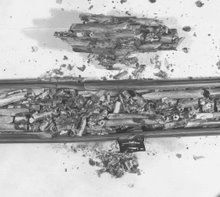
Below is an old (2004) NRC interpretation of the Paks game. The NRC states that the Paks incident was under conditions "... more severe than a traditionally analyzed loss of coolant accident ..." That is not only false, it is very, very false. The power density of the Paks fuel, many days after reactor shutdown, was minuscule in comparison to a traditionally analyzed loss of coolant accident.
Office of Nuclear Regulatory Research
Items of Interest
Week Ending November 19, 2004
Meetings on Fuel-related Projects: Studsvik and Paks
The Studsvik Cladding Integrity Project was organized by Organization of Economic Cooperation and Development (OECD) to better understand the fundamental mechanisms of cladding failure during normal operation and anticipated transients. The first formal meetings of this project were held at the Studsvik laboratory on November 8-10, 2004, and were attended by a representative from the Office of Nuclear Regulatory Research. Although this project was originally designed to serve industry needs, the mechanisms being studied involve hydrogen embrittlement and delayed hydride cracking. These mechanisms play an equal role in cladding behavior under accident conditions of safety significance, so the project is also of interest to NRC.
In addition, OECD is organizing a small international project to examine the damaged fuel from the cleaning incident at the Paks-2 nuclear power plant in Hungary. A meeting of fuel experts was held at the Studsvik laboratory immediately following the other meetings, and NRC's representative attended the Paks meeting as well. Because the Paks incident resulted in conditions more severe than a traditionally analyzed loss-of-coolant accident, yet the fuel remained well below any melting temperature (i.e., it was coolable), this project appears to have the potential to provide significant insights to fuel behavior under accident conditions.
Friday, September 7, 2007

Saturday, September 1, 2007
Leyse docs PRM-50-84, etc in ADAMS
5.
(82)
2007/08/03-Comment (5) of James H. Riley on Behalf of the Nuclear Energy Institute on Leyse's PRM-50-84 re Addressing Corrosion of Fuel Rod Cladding Surfaces and a Change in the Calculations for a Loss-of-Coolant Accident.
ML072150609
2007-08-03
7
PROJ0689 72FR28902 00005 PRM-50-84 2007-08-03 2007-08-06 2007-08-03 N U C L E A R E N E R G Y I N S T I T U T E James H. Riley DIREC~OR ENGINEERING NUCLEAR GENERATION DIVISION August 3, 2007 Ms. Annette L. Vietti-Cook Secretary Rulemaking and Adjudications
6.
(82)
G20070273 - Mark Edward Leyse Petition for an Enforcement Action Re: 10 CFR 2.206 - Indian Point, Units 2 and 3
ML071150299
2007-04-25
44
05000247 05000286 2.206 G20070273 2007-04-25 2007-05-10 ML071500267+ EDO Principal Correspondence Control FROM: DUE: 05/30/07 EDO CONTROL: G20070273 DOC DT: 04/25/07 FINAL REPLY: Mark Edward Leyse TO: Reyes, EDO FOR SIGNATURE OF : ** GRN ** CRC NO: Dyer, N
1.
(99)
G20070273 - Mark Leyse Ltr from Jennifer Golder Re.: Petition for an Enforcement Action Re: 10 CFR 2.206 - Indian Point, Units 2 and 3
ML071500238
2007-05-31
35
05000247 05000286 DPR-026 DPR-064 2.206 G20070273 PRM-50-84 2007-05-31 2007-06-07 ML071500267+ May 31, 2007 Mr. Mark E. Leyse P.O. Box 1314 New York, NY 10025 Dear Mr. Leyse: In an email addressed to Mr. Reyes, the Executive Director for Operations at the
21.
(81)
2007/03/15-Petition for Rulemaking PRM-50-84 Submitted by Mark Edward Leyse re adddressing corrosion of fuel rod cladding surfaces and a change in the calculations for a loss-of-coolant accident.
ML070871368
2007-03-15
45
PRM-50-84 2007-03-15 2007-03-29 2007-03-27 Annette L. Vietti-Cook Secretary U.S. Nuclear Regulatory Commission Washington, DC 20555-000 1 PETITION FOR RULE MAKING DOCKETED USNRC March 27,2007 (8:55am) OFFICE OF SECRETARY RULEMAKINGS AND ADJUDICATIONS STAFF
22.
(81)
G20070508 - Mark E. Leyse Ltr Re: Overrule Decision of the Petition Review Board.
ML072140819
2007-08-21
5
05000247 05000286 DPR-026 DPR-064 G20070508 Tac MD6074 Tac MD6075 2007-08-21 2007-08-29 August 21, 2007 Mr. Mark E. Leyse P.O. Box 1314 New York, NY 10025 Dear Mr. Leyse: On behalf of the U.S. Nuclear Regulatory Commission (NRC), I am responding to your le
24.
(81)
2007/08/15-Comment (9) of Robert H. Leyse on Leyse's PRM-50-84 re Addressing Corrosion of Fuel Rod Cladding Surfaces and a Change in the Calculations for a Loss-of-Coolant Accident.
ML072320368
2007-08-15
4
05000458 72FR28902 00009 PRM-50-84 2007-08-15 2007-08-23 2007-08-16 Robert H. Leyse P. 0. Box 2850 Sun Valley, ID 83353 August 15,2007 August 16,2007 (2:33pm) OFF ICE OF SECRETARY RULEMAKINGS AND ADJUDICATIONS STAFF Ms. Annette L. Vietti Cook Secretary U.
25.
(81)
2007/08/17-Comment (10) of Robert H. Leyse on Leyse's PRM-50-84 regarding Addressing Corrosion of Fuel Rod Cladding Surfaces and a Change in the Calculations for a Loss-of-Coolant Accident.
ML072330060
2007-08-17
4
72FR28902 00010 PRM-50-84 2007-08-17 2007-08-23 2007-08-20 DOCKETED USNRC Robert H. Leyse P. 0. Box 2850 Sun Valley, ID 83353 OFFICE OF SECRETARY RULEMAKINGS AND ADJUDICATIONS STAFF Ms. Annette L. Vietti Cook Secretary U. S. Nuclear Regulatory Commission W
36.
(81)
2007/08/14-Comment (8) of Robert H. Leyse on Leyse's PRM-50-84 re Addressing Corrosion of Fuel Rod Cladding Surfaces and a Change in the Calculations for a Loss-of-Coolant Accident.
ML072260544
2007-08-14
7
72FR28902 00008 PRM-50-84 2007-08-14 2007-08-15 2007-08-14 Robert H. Leyse P. 0. Box 2850 Sun Valley, ID 83353 August 14,2007 Ms. Annette L. Vietti Cook Secretary U. S. Nuclear Regulatory Commission Washington, D. C. 20555-0001 DOCKETED USNRC August 14,200
37.
(81)
2007/07/27-Comment (2) of Robert Leyse on Leyse's PRM-50-84 re addressing corrosion of fuel rod cladding surfaces and a change in the calculations for a loss-of-coolant accident.
ML072110410
2007-07-27
6
05000458 72FR28902 00002 IR-05-008 PRM-50-84 2007-07-27 2007-07-31 2007-07-30 Robert H. Leyse P. 0. Box 2850 Sun Valley, ID 83353 July 27, 2007 Ms. Annette L. Vietti Cook Secretary U. S. Nuclear Regulatory Commission Washington, D. C. 20555-0001 DOCKETED U
63.
(81)
2007/08/05-Comment (7) of Mark Edward Leyse on Leyse's PRM-50-84 regarding Addressing Corrosion of Fuel Rod Cladding Surfaces and a Change in the Calculations for a Loss-of-Coolant Accident.
ML072180472
2007-08-05
11
72FR28902 00007 PRM-50-84 2007-08-05 2007-08-07 2007-08-06 USNRC August 5,2007 Annette L. Vietti-Cook Secretary U.S. Nuclear Regulatory Commission Washington, DC 20555-0001 August 6,2007 (2:07pm) OFFICE OF SECRETARY RULEMAKINGS AND ADJUDICATIONS STAFF Atte
64.
(81)
2007/08/05-Comment (6) of Mark Edward Leyse on Leyse's PRM-50-84 Regarding Addressing Corrosion of Fuel Rod Cladding Surfaces and a Change in the Calculations for a Loss-of-Coolant Accident.
ML072180434
2007-08-05
8
72FR28902 00006 PRM-50-84 2007-08-05 2007-08-07 2007-08-06 DOCKETED @ USNRC August 5,2007 Annette L. Vietti-Cook Secretary U.S. Nuclear Regulatory Commission Washington, DC 20555-0001 August 6,2007 (2:07pm) OFFICE OF SECRETARY RULEMAKINGS AND ADJUDICATIONS
65.
(81)
2007/07/31-Comment (3) of David Lochbaum on Behalf of Union of Concerned Scientists on Leyse PRM-50-84 re Addressing Corrosion of Fuel Rod Cladding Surfaces and a Change in the Calculations for a Loss-of-Coolant Accident.
ML072130342
2007-07-31
5
72FR28902 00003 PRM-50-84 2007-07-31 2007-08-01 2007-08-01 Union of Concerned Scientists Citizens and Scientists for Environmental Solutions July 3 1, 2007 Annette Vietti-Cook, Secretary U.S. Nuclear Regulatory Commission Washington, DC 20555-0001 DOCKETED
78.
(81)
2007/08/15-Comment (11) of T. Moser on Behalf of Strategic Teaming and Resource Sharing (STARS), on Leyse's PRM-50-84 re Addressing Corrosion of Fuel Rod Cladding Surfaces and a Change in the Calculations for a Loss-of-Coolant Accident.
ML072360363
2007-08-15
81.
(81)
Federal Register Notice re: Mark Edward Leyse, Receipt of Petition for Rulemaking (PRM-50-84).
ML071290466
2007-05-15
14
7590-01-P FR Citation: 05/23/2007 72 FR 28902 PRM-50-84 2007-05-15 2007-06-05 [7590-01-P] NUCLEAR REGULATORY COMMISSION 10 CFR Part 50 [Docket No. PRM-50-84] Mark Edward Leyse; Receipt of Petition for Rulemaking AGENCY: Nuclear Regulatory Commission. ACTIO
82.
(81)
2007/07/27-Comment (1) of Robert H.Leyse on PRM-50-84 re Addressing Corrosion of Fuel Rod Cladding Surfaces and a Change in the Calculations for a Loss-of-Coolant Accident.
ML072080298
2007-07-27
4
72FR28902 00001 PRM-50-84 2007-07-27 2007-07-31 2007-07-27 Robert H. Leyse P. 0. Box 2850 Sun Valley, ID 83353 July 27,2007 July 27, 2007 (12:58prn) OFFICE OF SECRETARY RULEMAKINGS AND ADJUDICATIONS STAFF Ms. Annette L. Vietti Cook Secretary U. S. Nuclear
140.
(80)
2007/08/03-Comment (4) of C.C. Lin on Leyse's PRM-50-84 re Addressing Corrosion of Fuel Rod Cladding Surfaces and a Change in the Calculations for a Loss-of-Coolant Accident.
ML072150603
2007-08-03
2
72FR28902 00004 PRM-50-84 2007-08-03 2007-08-06 2007-08-03 SECY - Comments on Petition to amend 10 CFR Part 50 (PRM-50-84) Page I I PRM-50-84 (72FR28902) From: "C.C. Lin" TO: DOCKETED USNRC Date: Fri, Aug 3, 2007 1 :59
181.
(80)
G20070273 - Mark Leyse Ltr from Jennifer Golder Re.: Petition for an Enforcement Action Re: 10 CFR 2.206 - Indian Point, Units 2 and 3.
ML071500267
NRC's Current Rulemakings Website Does Not Respond
For the record: the following has not been accessible since at least August 30, 2007. I'll keep checking on this beginning September 4 (after labor day). Other aspects of the NRC's website respond very well.
For the record: it is still not accessible on September 7, 2007.
For the record: it is still not accessible on September 12, 2007.
http://ruleforum.lnl.gov/cgi-bin/rulelist?type=all
Internet Explorer cannot display the webpage
Most likely causes:
You are not connected to the Internet.
The website is encountering problems.
There might be a typing error in the address.
What you can try:
Friday, August 31, 2007
Hot Off The Press From EPRI
News the EPRI bulletin
Mike Howard said, "This is a tremendous accomplishment for the Nuclear Sector and the Materials Group. The savings to the nuclear industry is worth more than the total annual dues to EPRI’s Nuclear Sector."
August 31, 2007
NRC Approves EPRI Pressurizer Weld Crack Growth Analysis, Maintaining Spring Outage Schedule for Nine PWRs through Efforts of EPRI's Materials Reliability Program
By Christine King
Nine reactors will maintain their scheduled spring 2008 plant outages after receiving Nuclear Regulatory Commission’s notification last week that an accelerated schedule is not required to address potential pressurizer pipe weld cracking. The NRC based their decision on the results of the EPRI Materials Reliability Program’s (MRP) analysis of hypothetical circumferential cracking in welds located in the pressurizer spray, surge and safety/relief lines. The NRC considered moving these outages to some time this year for inspection or mitigation of these weld locations. NRC concerns arose from the discovery of indications of possible circumferential cracks at the Wolf Creek plant during its fall 2006 outage. The NRC had issued Confirmatory Action Letters to the nine utilities that confirmed their individual commitments to accelerate their outages if MRP’s analysis did not provide reasonable assurance that current inspection schedules were sufficient.
On the industry’s behalf, MRP performed finite element analyses to determine if such indications would show detectable leakage prior to structural failure given the potential concern for growing circumferential stress corrosion cracks. Leakage would alert operators to the condition, enabling them to take effective corrective action prior to structural failure of the piping. The investigation reconsidered the typical assumption of maintaining a semi-elliptical flaw shape as the flaw grows in the finite element model. In the MRP analysis, the crack was allowed to grow at each point along the crack front to the degree dictated by the local stress conditions producing an evolving crack shape as the crack penetrates through the pipe wall. This crack shape evolution is protypical to what happens in the field. The results demonstrated that the semi-elliptical flaw shape assumption is overly conservative and that a realistic crack will locally penetrate the pipe wall producing leakage without resulting in total pipe failure.
On August 23, the NRC confirmed that by their evaluation, reasonable assurance of safe operation until the next scheduled refueling outage has been demonstrated. This project has been a excellent opportunity for EPRI's MRP to show how we can work well with the NRC to support both NRC and industry when faced with difficult decisions associated with aging degradation in operating nuclear power plants.
Mike Howard said, "This is a tremendous accomplishment for the Nuclear Sector and the Materials Group. The savings to the nuclear industry is worth more than the total annual dues to EPRI’s Nuclear Sector."
Mike Howard said, "This is a tremendous accomplishment for the Nuclear Sector and the Materials Group. The savings to the nuclear industry is worth more than the total annual dues to EPRI’s Nuclear Sector."
August 31, 2007
NRC Approves EPRI Pressurizer Weld Crack Growth Analysis, Maintaining Spring Outage Schedule for Nine PWRs through Efforts of EPRI's Materials Reliability Program
By Christine King
Nine reactors will maintain their scheduled spring 2008 plant outages after receiving Nuclear Regulatory Commission’s notification last week that an accelerated schedule is not required to address potential pressurizer pipe weld cracking. The NRC based their decision on the results of the EPRI Materials Reliability Program’s (MRP) analysis of hypothetical circumferential cracking in welds located in the pressurizer spray, surge and safety/relief lines. The NRC considered moving these outages to some time this year for inspection or mitigation of these weld locations. NRC concerns arose from the discovery of indications of possible circumferential cracks at the Wolf Creek plant during its fall 2006 outage. The NRC had issued Confirmatory Action Letters to the nine utilities that confirmed their individual commitments to accelerate their outages if MRP’s analysis did not provide reasonable assurance that current inspection schedules were sufficient.
On the industry’s behalf, MRP performed finite element analyses to determine if such indications would show detectable leakage prior to structural failure given the potential concern for growing circumferential stress corrosion cracks. Leakage would alert operators to the condition, enabling them to take effective corrective action prior to structural failure of the piping. The investigation reconsidered the typical assumption of maintaining a semi-elliptical flaw shape as the flaw grows in the finite element model. In the MRP analysis, the crack was allowed to grow at each point along the crack front to the degree dictated by the local stress conditions producing an evolving crack shape as the crack penetrates through the pipe wall. This crack shape evolution is protypical to what happens in the field. The results demonstrated that the semi-elliptical flaw shape assumption is overly conservative and that a realistic crack will locally penetrate the pipe wall producing leakage without resulting in total pipe failure.
On August 23, the NRC confirmed that by their evaluation, reasonable assurance of safe operation until the next scheduled refueling outage has been demonstrated. This project has been a excellent opportunity for EPRI's MRP to show how we can work well with the NRC to support both NRC and industry when faced with difficult decisions associated with aging degradation in operating nuclear power plants.
Mike Howard said, "This is a tremendous accomplishment for the Nuclear Sector and the Materials Group. The savings to the nuclear industry is worth more than the total annual dues to EPRI’s Nuclear Sector."
Saturday, August 25, 2007
Petition for Rulemaking filed by Robert H. Leyse
Secretary
U.S. Nuclear Regulatory Commission
Washington, DC, 20555-0001
Attn: Rulemakings and Adjudications Staff
E-mail: secy@nrc.gov
PETITION FOR RULEMAKING
Mandatory Sharing of Information that is of Potential Regulatory Interest
This petition for rulemaking is submitted by Robert H. Leyse. Petitioner requests that the United States Nuclear Regulatory Commission require all of its resident inspectors at each nuclear power plant site to promptly share information with the agency that is of potential regulatory interest to the agency. This petition is at least partially inspired by the NRC press release of August 15, 2007, portions of which are copied below:
No. 07-102 August 15, 2007
NRC ISSUES ORDER TO FIRST ENERGY REGARDINGINFORMATION RELEVANT TO REGULATORY ACTIVITIES
The Nuclear Regulatory Commission has issued a Confirmatory Order to FirstEnergy Nuclear Operating Company (FENOC), regarding the company’s actions to ensure the prompt sharing of information of potential regulatory interest to the agency.
The Order is based on commitments FENOC made following the NRC’s Demand for Information earlier this year. The demand dealt with documents and analyses the company commissioned for non-regulatory purposes, along with delays between FENOC’s receipt of the information and its subsequent submittal to the agency. The analyses include the “Exponent Report,” which discussed corrosion that severely weakened the Davis-Besse reactor vessel’s head in 2002. The report provided conclusions that could have affected NRC-required activities at U.S. commercial reactors.
The Order requires FENOC to take several actions, including:
* Train selected employees by Nov. 30 to recognize and communicate information that could have a regulatory impact;
* Use an outside consultant to review FENOC staff’s sensitivity to potentially important information in January 2008 and 2009, reporting the results and any follow-on actions to the NRC, and;
* Develop a formal review procedure for technical reports created for non-regulatory uses, to ensure recognition of the reports’ possible regulatory impacts.
Following are examples of cases in which at least some resident inspectors either were aware of, or should have been aware of, the need to insure prompt sharing of information of potential regulatory interest to the agency. Apparently the resident inspectors did not promptly share that information with the agency.
1. A proprietary EPRI report, BWR Fuel Deposit Sample Evaluation, River Bend Cycle 11 Crud Flakes was reviewed by NRC inspectors. I have been told, “This was an analysis of the fuel crud performed by the Electric Power Research Institute (EPRI). The EPRI analysis evaluated a sample of crud taken directly from the River Bend Station failed fuel. This document was marked proprietary. As such, the inspectors were restricted from disclosing sensitive information contained in the analysis to the general public. Instead, the inspectors sought other available information to provide a description of fuel crud cooling characteristics. The referenced document, Two-Phase Flow and Heat Transfer, D. Butterworth and G. F. Hewitt, Oxford University Press, 1977, suited this purpose.”
Now, it is evident that the proprietary EPRI report, BWR Fuel Deposit Sample Evaluation, River Bend Cycle 11 Crud Flakes, that was (apparently temporarily) available to NRC inspectors, has information that is of potential regulatory interest to the agency. It is also evident that the resident inspectors did not share this information with the agency. Therefore, the resident inspectors or other involved NRC personnel must become subject to requirements that are comparable to FENOC’s as is illustrated in the above press release No. 07-102.
2. Ultrasonic Fuel Cleaning has been deployed at several sites and the NRC resident inspectors should have been aware of the equipment and procedures and the relevance of that information as of potential regulatory interest to the agency. There is no evidence that the resident inspectors were aware of the practice, and if they were aware of the practice, there is no evidence that they recognized ultrasonic fuel cleaning and the reasons therefore as being of potential regulatory interest to the agency.
The following disclosures by industry groups NEI and EPRI to NRC were well after the implementation of ultrasonic fuel cleaning at several licensed nuclear power reactors. To date there has been no documented NRC review and approval of the equipment and procedures, although the equipment and procedures have been applied at several nuclear power reactors in addition to those cited below.
Transcript of ACRS Reactor Fuels Subcommittee - Open Session, September 30, 2003, pages 1-152/229-281.
ML032940295
2003-09-30
Ultrasonic Fuel Cleaning was discussed at the above meeting.
10/01/2003 Summary of Meeting With Nuclear Energy Institute Regarding High Burnup Fuel Issues.
ML032930358
2003-10-16
Following is from the above document:
Mr. J. Deshon made a presentation on “Ultrasonic Fuel Cleaning Technology.” He described the current “single channel” and more advanced “dual channel” fuel cleaners. He indicated that these ultrasonic fuel cleaning technologies have been successfully tested at Callaway and South Texas Project, respectively. The use of these fuel cleaners could reduce fuel crud, avoid axial offset anomaly related operational problems, and minimize personnel radiation exposure during refueling outages.
Robust Fuel Program (Slides) Presented at 10/01/2003 Meeting with Nuclear Energy Institute regarding High Burnup Fuel Issues.
ML032810635
2003-10-01
Here are portions of slides from the above set.
PWRs that have now ultrasonically cleaned fuel:
Callaway
Purpose: AOA avoidance
Callaway experienced varying degrees of AOA from Cycle 4 through 11. In combination with reducing fuel duty, CY12 was free of AOA and CY13 has had no indications through 7500 MWD/MTU
South Texas Project Unit I
Purpose: AOA avoidance, allowed a reduction in fuel assembly purchases
* First cleaning performed in October 2002
South Texas Project Unit 2
Purpose: AOA avoidance following SG replacement & up-rate, allowed a reduction in fuel assembly purchases
* First cleaning performed in April 2003
Next PWR planning to ultrasonically clean fuel:
Vogtle Unit I
Planned Date: October 2003
Purpose: AOA avoidance (in anticipation of Injecting Zn) and dose rate reduction
First BWR planning to ultrasonically clean fuel:
Quad Cities Unit 2
Planned Date: Spring 2004
Purpose: Dose rate reduction
* Mock-up testing taking place at Vallecitos, 16 discharged assemblies will be cleaned on a pre-trial basis in Fall 2003. Anticipate cleaning first reload assemblies in Spring 2004.
3. Reports of main condenser performance and fuel element crud at Energy Northwest
This section illustrates information that is available to the public (on a delayed basis). The point is that reactor inspectors never shared the following with the agency as information of potential regulatory interest. Indeed, the reactor inspectors may not have been aware of these reports.
These reports, dated June 2006, are partially buried on the web site for Energy Northwest and are indexed under News and Information, Columbia Generating Station Information, and they may be found as follows:
http://www.energy-northwest.com/downloads/Main%20Condenser.pdf
http://www.energy-northwest.com/downloads/Main%20Condenser%20Addendum%201.pdf
Here is part of the first page of the interesting report on the main condenser that covers events that took place during a decade. The events include fouling (crud build-up) on the nuclear fuel elements.
Columbia Generating Station
Main Condenser
By W. Scott Oxenford, VP Technical Services
This document summarizes longstanding performance issues related to the design and operation of the Main Condenser at Columbia Generating Station and solutions to those challenges.
The following categories summarize the issues in introductory level detail:
1. System Components Overview
2. Condenser Leakage
3. Columbia’s Condenser
4. Columbia Historical Actions
5. Can Columbia Eliminate Condenser Leakage by Eliminating Debris?
6. Industry Data and Experience
7. Solutions
The following paragraph is copied from page 5 of the Main Condenser report:
Columbia’s management has thoroughly reviewed options for managing ongoing condenser challenges. On each occasion, continued operating risks were accepted instead of taking action, primarily to avoid costs and extended outage length.
The photograph that follows is from page 16 of the Main Condenser report. It shows the crud that has formed on the fuel rods. The crud layers are a heat transfer barrier that is not considered in the nuclear plant design or licensing process. Furthermore, with the crud layers, the fuel element has an increased friction factor that is also not considered in the design and licensing process. This is information of potential regulatory interest.
Note: Photograph has not been copied to this blog. It may be viewed at
http://www.energy-northwest.com/downloads/Main%20Condenser.pdf
There is a lot of depth to this reporting by Energy Northwest, but the reporting was never directed to the Nuclear Regulatory Commission.
Of course, there are undoubtedly additional situations that resident inspectors have encountered and have not reported to the agency even though those situations have been of potential regulatory interest to the agency. Clearly, the NRC must train all of its resident inspectors at each nuclear power plant site to recognize information that is of potential regulatory interest to the agency. The resident inspectors must be required to promptly report that information to the agency.
__________________________________
Robert H. Leyse
P.O. Box 2850
Sun Valley, ID 83353
Dated: August 24, 2007
Monday, August 20, 2007
INFORMATION RELEVANT TO REGULATORY ACTIVITIES
Now, here is a fantastic press release from our NRC!
No. 07-102
August 15, 2007
NRC ISSUES ORDER TO FIRSTENERGY REGARDING INFORMATION RELEVANT TO REGULATORY ACTIVITIES
The Nuclear Regulatory Commission has issued a Confirmatory Order to FirstEnergy Nuclear Operating Company (FENOC), regarding the company’s actions to ensure the prompt sharing of information of potential regulatory interest to the agency.
The Order is based on commitments FENOC made following the NRC’s Demand for Information earlier this year. The demand dealt with documents and analyses the company commissioned for non-regulatory purposes, along with delays between FENOC’s receipt of the information and its subsequent submittal to the agency. The analyses include the “Exponent Report,” which discussed corrosion that severely weakened the Davis-Besse reactor vessel’s head in 2002. The report provided conclusions that could have affected NRC-required activities at U.S. commercial reactors.
The Order requires FENOC to take several actions, including:
Train selected employees by Nov. 30 to recognize and communicate information that could have a regulatory impact;
Use an outside consultant to review FENOC staff’s sensitivity to potentially important information in January 2008 and 2009, reporting the results and any follow-on actions to the NRC, and;
Develop a formal review procedure for technical reports created for non-regulatory uses, to ensure recognition of the reports’ possible regulatory impacts.
The Order will be published shortly in the Federal Register and will be available on the NRC’s Web site at http://www.nrc.gov/reading-rm/doc-collections/enforcement/actions/reactors/. Anyone adversely affected by the Order, other than FENOC, may request a hearing within 20 days of publication. Any request for a hearing must be submitted to the Secretary, U.S. Nuclear Regulatory Commission, ATTN: Chief, Rulemakings and Adjudications Staff, Washington, DC, 20555. Copies of the hearing request must also be sent to the Director, Office of Enforcement and the Assistant General Counsel for Materials Litigation and Enforcement at the same address, to the Regional Administrator for NRC Region III, 801 Warrenville Road, Lisle, IL, 60532-4351, and to FENOC. Hearing requests may also be faxed to 301-415-1101 or e-mailed to hearingdocket@nrc.gov and to OGCMailCenter@nrc.gov.
Saturday, August 18, 2007
A Few $Billion is Trivial, however there is TERROR in TRACE!
The impacts of software terrorism are everywhere. The NRC game of converting rigged experiments such as LOFT, FLECHT and countless others, into fake software that is applied to the licensing of nuclear power plants is a very interesting game. It is a game that legalizes nuclear power accidents with the potential for damages in the $Trillions.
So, the recent $3billion bailout of the hedge fund, Global Equity Opportunities, that is reported in the Financial Times on August 14, 2007, is trivial. The Times reports, "Goldman Sachs is to inject $2bn of its own money to bail out its Global Equities Opportunities hedge fund in an embarrassing admission that its highly computerized funds malfunctioned last week. The investment bank has raised a further $1bn from outside investors to support the $3.6bn GEO fund, which lost about $1.5bn when computer models failed to predict market turbulence."
Of course, all of the nuclear licensing "experts" and their lobbyists will be quick to assert that the turbulence of severe nuclear power accidents is far more predictable than market turbulence. Indeed, the fake computer models that are derived from rigged experiments provide much of the basis for hundreds of billions of dollars in financing of nuclear power plants. And this is more easily traced than the bases of the recent plague associated with complex collateralized debt obligations. However, the financiers in the big leagues have not yet become aware of the TERROR in TRACE.
Subscribe to:
Posts (Atom)