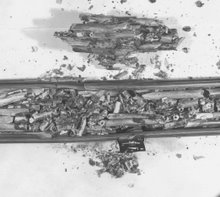
OK, I listened to the following item via the bridge line. I'll add to this when I read the transcript and that will be online in a week or so. Someone discussed 1200 degrees centigrade. THERE IS NO WAY THAT A REALISTIC SPECIMEN MAY BE PREPARED AT 1200DEGREES CENTIGRADE. What I heard was the production of yet more Regulation by Myth. I'll write more after I have the transcript.
AGENDA 584th ACRS MEETING June 8-10, 2011
WEDNESDAY, JUNE 8, 2011, CONFERENCE ROOM T-2B1, 11545 ROCKVILLE PIKE, ROCKVILLE, MD
1) 8:30 AM - 8:35 AM Opening Remarks by the ACRS Chairman (Open) (SAK/EMH)
1.1) Opening Statement
1.2) Items of Current Interest
2) 8:35 AM - 10:30 AM Draft Regulatory Guides DG-1261, "Conducting Periodic Testing for Breakaway Oxidation Behavior," DG-1262, "Testing for Postquench Ductility," and DG-1263, "Establishing Analytical Limits for Zirconium-Based Alloy Cladding" (Open) (JSA/CLB)
2.1) Remarks by the Subcommittee Chairman
2.2) Briefing by and discussions with representatives of the NRC staff and Electric Power Research Institute regarding draft Regulatory Guides DG-1261, "Conducting Periodic Testing for Breakaway Oxidation Behavior," DG-1262, "Testing for Postquench Ductility," and DG-1263, "Establishing Analytical Limits for Zirconium-Based Alloy Cladding"
Friday, June 10, 2011

Sunday, June 5, 2011
Thermal Hydraulics at NRC, ACRS and Elsewhere
Stephen M. Bajorek has been with the NRC as Senior Technical Advisor for Thermal-Hydraulics approximately ten years, where he is involved in development of the TRACE code, advanced reactor analysis, and the NRC's thermal-hydraulic test programs. Prior to joining the staff he was a member of the faculty at Kansas State University in the Department of Mechanical and Nuclear Engineering. He has 15 years of industrial experience at Westinghouse Electric Corp., where he was involved with the AP600 Design Certification, thermal-hydraulic code development and licensing of the Westinghouse Best Estimate LOCA methodology. Dr. Bajorek received his Ph. D. from Michigan State University, and M.S. and B.S. degrees in Mechanical Engineering from the University of Notre Dame.
Sanjoy Banerjee is Distinguished Professor of Chemical Engineering and Director of the Energy Institute at the City University of New York and publishes extensively on nuclear thermalhydraulics. Previously he was Professor of Chemical Engineering at the University of California - Santa Barbara. Member of the U.S. NRC Advisory Committee on Reactor Safeguards, ACRS. Earlier in Canada, he occupied the positions of Westinghouse Professor of Engineering Physics at McMaster University and of Acting Director of Applied Science in the Whiteshell Nuclear Research Establishment. He was a founding member of the Canadian Advisory Committee on Nuclear Safety. He has received the ASME Melville Medal, the IChemE (UK) Danckwerts Lecturership, the AIChE Kern Award, and the ASME Heat Transfer Memorial Award and ANS Technical Achievement Award in Thermal-hydraulics. Fellow of ANS.
Sama Bilbao y León is currently an Associate Professor and the Director of Nuclear Engineering Programs at Virginia Commonwealth University. While at Dominion Generation, she led the development and licensing of new methodologies in core thermal-hydraulics and nuclear safety analysis in support of Dominion's nuclear power stations. As Technical Head of the International Atomic Energy Agency Water Cooled Reactors Technology Development Unit, she was in charge of all IAEA activities in support of the development and near term deployment of advanced water cooled reactors and their associated fuels.
Christopher Boyd is a senior level advisor for computational fluid dynamics (CFD) within the Office of Nuclear Regulatory Research at the Nuclear Regulatory Commission (NRC). He carried out the program to bring CFD tools “in-house” for the NRC during the 1990s and has spent the past 15 years utilizing these tools for nuclear safety analyses. Previously, he spent 9 years working on instrumentation development and optimization for high-speed wind tunnel testing at the Naval Surface Warfare Center. He received his Ph.D. in Mechanical Engineering at the University of Maryland in the area of thermal-fluids behavior.
Michael L. Corradini is Chair and Wisconsin Distinguished Professor of Nuclear Engineering at the University of Wisconsin-Madison. He is also a member of the U.S. NRC Advisory Committee on Reactor Safeguards (ACRS), member of NRC safety review panels and of the DoE Generation IV Roadmap Project. He has published widely in areas related to vapour explosion and severe accident phenomena, jet spray dynamics and transport phenomena in multiphase systems. Member of the National Academy of Engineering and Fellow of ANS.
Thomas Downar received his Ph.D. from MIT in 1984 and from 1984-2006 was a Professor in the School of Nuclear Engineering at Purdue University. After a year as a Professor at University of California-Berkeley, he joined the faculty at the University of Michigan where he is currently a Professor and Graduate Chair in the Nuclear Engineering and Radiological Sciences Department. Professor Downar is a Fellow of the American Nuclear Society. The primary focus of his research is nuclear reactor physics and multiphysics computational methods in support of the U.S. NRC, the U.S. DoE, EPRI and several international agencies. He is the author of the U.S. NRC core neutronics simulator PARCS and has contributed to the development of the thermal-hydraulics codes TRACE and RELAP5. The coupled neutronics and thermal-hydraulics codes TRACE/PARCS and RELAP5/PARCS are used worldwide to perform the safety analysis of most every type of power reactor currently operating in the world.
Geoffrey F. Hewitt is Professor Emeritus of Chemical Engineering at Imperial College, London. Founder of the Heat Transfer and Fluid Flow Service (HTFS) at the Harwell Laboratory. He has authored and edited many books and published over 500 papers and reports. Former Editor of Multiphase Science and Technology and former Executive Editor of the Heat Exchanger Design Handbook. Recipient of the AIChE Donald Q. Kern, the ASME Max Jacob awards, the Nusselt Reynolds Prize, the Luikov Medal, the IChemE Council and Armstrong medals, the Senior Multiphase Flow Award and the Global Energy Prize. He has Honorary Doctorates from Louvain, UMIST and Heriot Watt Fellow of the Royal Academy of Engineering, Fellow of the Royal Society, and Foreign Associate of the US National Academy of Engineering.
George Yadigaroglu is Professor Emeritus of Nuclear Engineering, ETH-Zurich and President and co-founder of ASCOMP, an ETH spin-off company specializing in CMFD simulations. Was also Head of the Thermal-Hydraulics Laboratory at the Paul Scherrer Institute. Previously Professor of Nuclear Engineering at the University of California-Berkeley. Active in research and consulting and a member of several international high-level committees dealing with nuclear safety issues. ANS Technical Achievement Award. ANS and ASME Fellow. Former Associate Editor of the International Journal of Multiphase Flow.
Ghani Zigh is a Senior Technical Advisor in the U.S. NRC in the Office of Research, and is a registered PE (Professional Engineer) in the state of New York. He has been a USNRC staff member since August 2002, and involved in dry cask applications, BWR and PWR Zircaloy Fire (accident analysis), APWR advanced accumulators, fire analysis, and ultrasonic flow meters. Prior to the NRC, he worked at Parsons Brinkerhoff (PB) in Manhattan as an international consultant using CFD (Computational Fluid Dynamics) to model fire and emergency ventilation for tunnels and train stations as well as the effects of thermal pollution of power plants on oceans and rivers. He was also an adjunct professor at Stevens Institute of Technology in New Jersey where he taught undergraduate and graduate classes in Mechanical Engineering.
Sanjoy Banerjee is Distinguished Professor of Chemical Engineering and Director of the Energy Institute at the City University of New York and publishes extensively on nuclear thermalhydraulics. Previously he was Professor of Chemical Engineering at the University of California - Santa Barbara. Member of the U.S. NRC Advisory Committee on Reactor Safeguards, ACRS. Earlier in Canada, he occupied the positions of Westinghouse Professor of Engineering Physics at McMaster University and of Acting Director of Applied Science in the Whiteshell Nuclear Research Establishment. He was a founding member of the Canadian Advisory Committee on Nuclear Safety. He has received the ASME Melville Medal, the IChemE (UK) Danckwerts Lecturership, the AIChE Kern Award, and the ASME Heat Transfer Memorial Award and ANS Technical Achievement Award in Thermal-hydraulics. Fellow of ANS.
Sama Bilbao y León is currently an Associate Professor and the Director of Nuclear Engineering Programs at Virginia Commonwealth University. While at Dominion Generation, she led the development and licensing of new methodologies in core thermal-hydraulics and nuclear safety analysis in support of Dominion's nuclear power stations. As Technical Head of the International Atomic Energy Agency Water Cooled Reactors Technology Development Unit, she was in charge of all IAEA activities in support of the development and near term deployment of advanced water cooled reactors and their associated fuels.
Christopher Boyd is a senior level advisor for computational fluid dynamics (CFD) within the Office of Nuclear Regulatory Research at the Nuclear Regulatory Commission (NRC). He carried out the program to bring CFD tools “in-house” for the NRC during the 1990s and has spent the past 15 years utilizing these tools for nuclear safety analyses. Previously, he spent 9 years working on instrumentation development and optimization for high-speed wind tunnel testing at the Naval Surface Warfare Center. He received his Ph.D. in Mechanical Engineering at the University of Maryland in the area of thermal-fluids behavior.
Michael L. Corradini is Chair and Wisconsin Distinguished Professor of Nuclear Engineering at the University of Wisconsin-Madison. He is also a member of the U.S. NRC Advisory Committee on Reactor Safeguards (ACRS), member of NRC safety review panels and of the DoE Generation IV Roadmap Project. He has published widely in areas related to vapour explosion and severe accident phenomena, jet spray dynamics and transport phenomena in multiphase systems. Member of the National Academy of Engineering and Fellow of ANS.
Thomas Downar received his Ph.D. from MIT in 1984 and from 1984-2006 was a Professor in the School of Nuclear Engineering at Purdue University. After a year as a Professor at University of California-Berkeley, he joined the faculty at the University of Michigan where he is currently a Professor and Graduate Chair in the Nuclear Engineering and Radiological Sciences Department. Professor Downar is a Fellow of the American Nuclear Society. The primary focus of his research is nuclear reactor physics and multiphysics computational methods in support of the U.S. NRC, the U.S. DoE, EPRI and several international agencies. He is the author of the U.S. NRC core neutronics simulator PARCS and has contributed to the development of the thermal-hydraulics codes TRACE and RELAP5. The coupled neutronics and thermal-hydraulics codes TRACE/PARCS and RELAP5/PARCS are used worldwide to perform the safety analysis of most every type of power reactor currently operating in the world.
Geoffrey F. Hewitt is Professor Emeritus of Chemical Engineering at Imperial College, London. Founder of the Heat Transfer and Fluid Flow Service (HTFS) at the Harwell Laboratory. He has authored and edited many books and published over 500 papers and reports. Former Editor of Multiphase Science and Technology and former Executive Editor of the Heat Exchanger Design Handbook. Recipient of the AIChE Donald Q. Kern, the ASME Max Jacob awards, the Nusselt Reynolds Prize, the Luikov Medal, the IChemE Council and Armstrong medals, the Senior Multiphase Flow Award and the Global Energy Prize. He has Honorary Doctorates from Louvain, UMIST and Heriot Watt Fellow of the Royal Academy of Engineering, Fellow of the Royal Society, and Foreign Associate of the US National Academy of Engineering.
George Yadigaroglu is Professor Emeritus of Nuclear Engineering, ETH-Zurich and President and co-founder of ASCOMP, an ETH spin-off company specializing in CMFD simulations. Was also Head of the Thermal-Hydraulics Laboratory at the Paul Scherrer Institute. Previously Professor of Nuclear Engineering at the University of California-Berkeley. Active in research and consulting and a member of several international high-level committees dealing with nuclear safety issues. ANS Technical Achievement Award. ANS and ASME Fellow. Former Associate Editor of the International Journal of Multiphase Flow.
Ghani Zigh is a Senior Technical Advisor in the U.S. NRC in the Office of Research, and is a registered PE (Professional Engineer) in the state of New York. He has been a USNRC staff member since August 2002, and involved in dry cask applications, BWR and PWR Zircaloy Fire (accident analysis), APWR advanced accumulators, fire analysis, and ultrasonic flow meters. Prior to the NRC, he worked at Parsons Brinkerhoff (PB) in Manhattan as an international consultant using CFD (Computational Fluid Dynamics) to model fire and emergency ventilation for tunnels and train stations as well as the effects of thermal pollution of power plants on oceans and rivers. He was also an adjunct professor at Stevens Institute of Technology in New Jersey where he taught undergraduate and graduate classes in Mechanical Engineering.
Monday, May 30, 2011
Leyse at ACRS Fukushima Subcommittee, May 26, 2011
May 26, 2011
Advisory Committee on Reactor Safeguards (ACRS)
Fukushima Subcommittee Meeting
Via a bridge line telephone connection, I was allowed to briefly submit spoken comments to the subcommittee. I had no notes, in fact I was surprised that the Chairman invited public comments that were not requested in advance of the meeting.
I spoke very briefly, before the Chairman, apparently disturbed by the content of my remarks as well as my aggressive attitude, cut me off. As I recall, here is the substance of my remarks, and I will update this when the transcript of the meeting becomes available.
Items:
1. NRC and the ACRS have not addressed PRM-50-93 although the matter is of greater significance than Fukushima.
2. Although NRC had assigned a high priority to the review of PRM-50-93, the NRC has not followed through.
3. I found out that NRC had "extended" its deadline for reviewing PRM-50-93 during ACRS and NRC staff discussions at the meeting of the ACRS Thermal Hydraulics Subcommittee on October 18, 2011.
4. I cited earlier discussions by NEI at this May 26, 2011, meeting in which they suggested that Fukushima would be treated as a separate activity and that existing business would proceed without interference. Likewise, the NRC must not allow its Fukushima activities to have a higher priority than reviewing PRM-50-93.
5. The brief Leyse presentations at the October 18, 2011, meeting of the Thermal Hydraulics Subcommittee were the only worthy aspects of that meeting.
I'll update this with material copied from the transcript of the May 26, 2011, subcommittee meeting when that becomes available to the public.
OK, Today June 2, 2011, I noted that the transcript of the May 26, 2011, Fukushima meeting has been posted. The transcriber has rather thoroughly screwed up my verbal remarks, hence it is a good thing that I logged the above from memory. Anyway, the following is from the transcript. One thing that is accurate is the following: Instead
15 you listened to endless presentations from Penn State
16 and others that really don't bear on what's going on
17 today or was potentially going to go on.
Official Transcript of Proceedings
NUCLEAR REGULATORY COMMISSION
Title: Advisory Committee on Reactor Safeguards
Subcommittee on FukushimaDocket Number: (n/a)
Location: Rockville, Maryland
Date: Thursday, May 26, 20114 MR. LEYSE: Yes, this is Robert Leyse.
5 I've talked to you before.
6 CHAIR ABDEL-KHALIK: Mr. Leyse, please
7 hold off. We have some here in the room who is going
8 to make comments. So I will recognize you later.
9 MR. LEYSE: I will go to *6.
21 Okay. At this time, Mr. Leyse, if you'd
22 like to offer any comments.
23 MR. LEYSE: Just came back on. Quickly,
24 I want to say PRM 50.93 was around well ahead of
25 Fukushima and a predecessor to that was around since
1 the mid -- around 2002 or 2003. And nothing seems to
2 move.
Now today we heard NEI tell us that while
4 we take this Fukushima act on we don't ignore what
5 else is going on. I would advise ACRS to be get into
6 PRM 50.83 as well as the NRC. NRC once had it as a
7 high priority item until a rather otherwise useless
8 meeting back in October of the Thermohydraulic
9 Subcommittee, the only part really bragging, not
10 bragging.
11 But it's a fact that made any sense what
12 Mark Leyse and myself discussed. You went through the
13 whole thing and never got into zirconium or how it
14 would react in a loss of coolant accident. Instead
15 you listened to endless presentations from Penn State
16 and others that really don't bear on what's going on
17 today or was potentially going to go on.
18 CHAIR ABDEL-KHALIK: Mr. Leyse.
19 MR. LEYSE: End of comments. Thank you.
20 CHAIR ABDEL-KHALIK: Thank you very much.
Advisory Committee on Reactor Safeguards (ACRS)
Fukushima Subcommittee Meeting
Via a bridge line telephone connection, I was allowed to briefly submit spoken comments to the subcommittee. I had no notes, in fact I was surprised that the Chairman invited public comments that were not requested in advance of the meeting.
I spoke very briefly, before the Chairman, apparently disturbed by the content of my remarks as well as my aggressive attitude, cut me off. As I recall, here is the substance of my remarks, and I will update this when the transcript of the meeting becomes available.
Items:
1. NRC and the ACRS have not addressed PRM-50-93 although the matter is of greater significance than Fukushima.
2. Although NRC had assigned a high priority to the review of PRM-50-93, the NRC has not followed through.
3. I found out that NRC had "extended" its deadline for reviewing PRM-50-93 during ACRS and NRC staff discussions at the meeting of the ACRS Thermal Hydraulics Subcommittee on October 18, 2011.
4. I cited earlier discussions by NEI at this May 26, 2011, meeting in which they suggested that Fukushima would be treated as a separate activity and that existing business would proceed without interference. Likewise, the NRC must not allow its Fukushima activities to have a higher priority than reviewing PRM-50-93.
5. The brief Leyse presentations at the October 18, 2011, meeting of the Thermal Hydraulics Subcommittee were the only worthy aspects of that meeting.
I'll update this with material copied from the transcript of the May 26, 2011, subcommittee meeting when that becomes available to the public.
OK, Today June 2, 2011, I noted that the transcript of the May 26, 2011, Fukushima meeting has been posted. The transcriber has rather thoroughly screwed up my verbal remarks, hence it is a good thing that I logged the above from memory. Anyway, the following is from the transcript. One thing that is accurate is the following: Instead
15 you listened to endless presentations from Penn State
16 and others that really don't bear on what's going on
17 today or was potentially going to go on.
Official Transcript of Proceedings
NUCLEAR REGULATORY COMMISSION
Title: Advisory Committee on Reactor Safeguards
Subcommittee on FukushimaDocket Number: (n/a)
Location: Rockville, Maryland
Date: Thursday, May 26, 20114 MR. LEYSE: Yes, this is Robert Leyse.
5 I've talked to you before.
6 CHAIR ABDEL-KHALIK: Mr. Leyse, please
7 hold off. We have some here in the room who is going
8 to make comments. So I will recognize you later.
9 MR. LEYSE: I will go to *6.
21 Okay. At this time, Mr. Leyse, if you'd
22 like to offer any comments.
23 MR. LEYSE: Just came back on. Quickly,
24 I want to say PRM 50.93 was around well ahead of
25 Fukushima and a predecessor to that was around since
1 the mid -- around 2002 or 2003. And nothing seems to
2 move.
Now today we heard NEI tell us that while
4 we take this Fukushima act on we don't ignore what
5 else is going on. I would advise ACRS to be get into
6 PRM 50.83 as well as the NRC. NRC once had it as a
7 high priority item until a rather otherwise useless
8 meeting back in October of the Thermohydraulic
9 Subcommittee, the only part really bragging, not
10 bragging.
11 But it's a fact that made any sense what
12 Mark Leyse and myself discussed. You went through the
13 whole thing and never got into zirconium or how it
14 would react in a loss of coolant accident. Instead
15 you listened to endless presentations from Penn State
16 and others that really don't bear on what's going on
17 today or was potentially going to go on.
18 CHAIR ABDEL-KHALIK: Mr. Leyse.
19 MR. LEYSE: End of comments. Thank you.
20 CHAIR ABDEL-KHALIK: Thank you very much.
Friday, May 13, 2011
Closeout Memorandum, Leyse business at NSF
This is for my record and I'll elaborate when I get the Closeout Memorandum. Update, June 2, 2011, including the Closeout Memorandum.
Dear Mr. Leyse:
This acknowledges receipt of your Freedom of Information Act and/or Privacy Act request received on May 09, 2011. We have assigned NSF OIG tracking number FOIA 11-70 to your request and expect to respond not later than June 07, 2011 (20 working days after date of receipt of request). Please contact us at oig@nsf.gov for questions on status.
From: Bobleyse@aol.com [mailto:Bobleyse@aol.com]
Sent: Sunday, May 08, 2011 9:41 PM
To: OIG
Subject: Request for closeout memorandum
I request a copy of the closeout memorandum for OIG matter that is discussed in the e-mail that I received from Kenneth L. Busch on 07/16/2008 and that I have copied below.
Robert H. Leyse bobleyse@aol.com
Subject:
Case closure
Date:
7/16/2008 10:41:40 A.M. Mountain Daylight Time
From:
kbusch@nsf.gov
Reply To:
To:
BobLeyse@aol.com
Mr. Robert Leyse
Sun Valley, ID
Via email to BobLeyse@aol.com
Dear Mr. Leyse:
We opened a file in response to your email received in this office on April 17, 2008. We have determined that there is insufficient substance to an allegation of misconduct to proceed in this case. The case has been closed and no further action will be taken.
Attached to this message you will find guidance for “Obtaining a Closeout Memorandum or Investigation Report For An NSF OIG Case.” If you decide to make a FOIA request, please note that this case did not result in criminal prosecution, civil legal action, or government-wide debarment or voluntary exclusion of anyone.
Please respect CONFIDENTIAL information in this message.
Kenneth L. Busch
Office of Inspector General
4201 Wilson Boulevard
Arlington, VA 22230
Phone 703-292-4569 FAX 703-292-9159
kbusch@nsf.gov
OK, Today, June 2, 2011, I receved the followng response from NSF for a copy of the closeout memorandum. The date of the original closeout memorandum is June 23, 2008. Today there are more facts. Things take time! I'll have more to log as I coontinue my protest.
National Science Foundation Office of the Inspector General
4201 Wilson Boulevard, Suite II-705, Arlington, Virginia 22230
1 June 2011
VIA EMAIL
Robert H. Leyse
P.O. Box 2850
Sun Valley, ID 83353
Bobleyse@aol.com
Re: FOIA Request No. 11-70
Dear Mr. Leyse:
This letter responds to your Freedom of Information Act (FOIA, 5 U.S.C. § 552) request, which we received on 9 May 2011, for a copy of the closeout memorandum for an OIG matter referred to in correspondence from an OIG employee to you on 16 July 2008.
We enclose the responsive closeout memorandum. Under FOIA exemptions (b)(6) and (b)(7)(C), information that constitutes an unwarranted invasion of personal privacy is exempt from disclosure. To protect the privacy interests of individuals who were not, with respect to the matter or matters described in the requested records, subject to successful criminal prosecution, recent civil legal action, or debarment or voluntary exclusion government-wide, we have redacted the names, titles, and other identifying information for all such individuals other than yourself, pursuant to FOIA exemptions (b)(6) and (b)(7)(C).
If you are not satisfied with my decision, you may appeal to the Inspector General, Allison Lerner, by writing to her at the National Science Foundation, 4201 Wilson Boulevard, Arlington VA 22230. Alternatively, you may appeal directly to the General Counsel of the Foundation, at the same address.1 If you wish to appeal to either the
1 For appeals to NSF‟s General Counsel, note the requirements of 45 C.F.R. § 612.9(a): “You must make your appeal in writing and it must be received by the Office of the General Counsel within ten days of the receipt of the denial (weekends, legal holidays, and the date of receipt excluded). Clearly mark your appeal letter and the envelope „Freedom of Information Act
2
Inspector General or the General Counsel, you must file your appeal within ten business days of receipt of this letter. If you submit an appeal to the Inspector General and her decision is negative, you may then appeal to the General Counsel. All appeals will be acted on within 20 business days after receipt.
Sincerely,
Stephen W. Bross, J.D.
Investigative & FOIA Attorney
Enclosure
Appeal.‟ Your appeal letter must include a copy of your written request and the denial together with any written argument you wish to submit.”
NATIONAL
SCIENCE FOUNDATION OFFICE OF INSPECTOR GENERAL OFFICE OF INVESTIGATIONS MEMORANDUM OF INVESTIGATION
Page 1 of 1
Case Number: P08040064
We assessed multiple allegations ofmisconduct. An individual1 submitted, as sole PI, a proposal2 to NSF. This proposal was declined for funding. Subsequent allegations that the reviewer's comments were misconduct are without substance; reviewer comments (and their relevance and propriety) are a programmatic issue that could appropriately have been raised with the NSF Program Officer at the time of review. Misconduct is also alleged in NSF's refusal to release reviews ofa funded proposae to an individual not a PI or coPI on the proposal. NSF is abiding by the consistent policy of not releasing reviews of proposals to anyone but the PI and coPI and there is no substance here to an allegation of misconduct. Finally, misconduct is alleged in funding of a proposal revised and resubmitted after its fIrst declination.4 There is no substance to an allegation of misconduct here, as the work in the resubmission is properly attributed and the review process properly completed.
Accordingly, the case is closed.
1 Robert Leyse of Sun Valley, ID.
2 DMI-0127841 "SBIRlSTTRPhase 1: Sampling Microscale Turbulence."
3 Awarded proposal ***** This proposal is essentially a resubmission of ****** and coPI R. H Leyse.
4 Leyse's efforts in ****** were to be supported through a subaward of $10,000; this proposal was declined for funding. Leyse was not coPI or senior personnel on resubmission ***** which contains much ofthe same material (properly attributed to Leyse). ***** contains no funds for Leyse either as consultant or as subaward.
/ Lrit~.~Y .,;,
Investigator/ **** /1 / Date June 23, 2008
AW"
I····..'·J'~ ,
~
Print your name; insert date MOl completed.
NSF OrG Form 4 (1lI02)
Dear Mr. Leyse:
This acknowledges receipt of your Freedom of Information Act and/or Privacy Act request received on May 09, 2011. We have assigned NSF OIG tracking number FOIA 11-70 to your request and expect to respond not later than June 07, 2011 (20 working days after date of receipt of request). Please contact us at oig@nsf.gov for questions on status.
From: Bobleyse@aol.com [mailto:Bobleyse@aol.com]
Sent: Sunday, May 08, 2011 9:41 PM
To: OIG
Subject: Request for closeout memorandum
I request a copy of the closeout memorandum for OIG matter that is discussed in the e-mail that I received from Kenneth L. Busch on 07/16/2008 and that I have copied below.
Robert H. Leyse bobleyse@aol.com
Subject:
Case closure
Date:
7/16/2008 10:41:40 A.M. Mountain Daylight Time
From:
kbusch@nsf.gov
Reply To:
To:
BobLeyse@aol.com
Mr. Robert Leyse
Sun Valley, ID
Via email to BobLeyse@aol.com
Dear Mr. Leyse:
We opened a file in response to your email received in this office on April 17, 2008. We have determined that there is insufficient substance to an allegation of misconduct to proceed in this case. The case has been closed and no further action will be taken.
Attached to this message you will find guidance for “Obtaining a Closeout Memorandum or Investigation Report For An NSF OIG Case.” If you decide to make a FOIA request, please note that this case did not result in criminal prosecution, civil legal action, or government-wide debarment or voluntary exclusion of anyone.
Please respect CONFIDENTIAL information in this message.
Kenneth L. Busch
Office of Inspector General
4201 Wilson Boulevard
Arlington, VA 22230
Phone 703-292-4569 FAX 703-292-9159
kbusch@nsf.gov
OK, Today, June 2, 2011, I receved the followng response from NSF for a copy of the closeout memorandum. The date of the original closeout memorandum is June 23, 2008. Today there are more facts. Things take time! I'll have more to log as I coontinue my protest.
National Science Foundation Office of the Inspector General
4201 Wilson Boulevard, Suite II-705, Arlington, Virginia 22230
1 June 2011
VIA EMAIL
Robert H. Leyse
P.O. Box 2850
Sun Valley, ID 83353
Bobleyse@aol.com
Re: FOIA Request No. 11-70
Dear Mr. Leyse:
This letter responds to your Freedom of Information Act (FOIA, 5 U.S.C. § 552) request, which we received on 9 May 2011, for a copy of the closeout memorandum for an OIG matter referred to in correspondence from an OIG employee to you on 16 July 2008.
We enclose the responsive closeout memorandum. Under FOIA exemptions (b)(6) and (b)(7)(C), information that constitutes an unwarranted invasion of personal privacy is exempt from disclosure. To protect the privacy interests of individuals who were not, with respect to the matter or matters described in the requested records, subject to successful criminal prosecution, recent civil legal action, or debarment or voluntary exclusion government-wide, we have redacted the names, titles, and other identifying information for all such individuals other than yourself, pursuant to FOIA exemptions (b)(6) and (b)(7)(C).
If you are not satisfied with my decision, you may appeal to the Inspector General, Allison Lerner, by writing to her at the National Science Foundation, 4201 Wilson Boulevard, Arlington VA 22230. Alternatively, you may appeal directly to the General Counsel of the Foundation, at the same address.1 If you wish to appeal to either the
1 For appeals to NSF‟s General Counsel, note the requirements of 45 C.F.R. § 612.9(a): “You must make your appeal in writing and it must be received by the Office of the General Counsel within ten days of the receipt of the denial (weekends, legal holidays, and the date of receipt excluded). Clearly mark your appeal letter and the envelope „Freedom of Information Act
2
Inspector General or the General Counsel, you must file your appeal within ten business days of receipt of this letter. If you submit an appeal to the Inspector General and her decision is negative, you may then appeal to the General Counsel. All appeals will be acted on within 20 business days after receipt.
Sincerely,
Stephen W. Bross, J.D.
Investigative & FOIA Attorney
Enclosure
Appeal.‟ Your appeal letter must include a copy of your written request and the denial together with any written argument you wish to submit.”
NATIONAL
SCIENCE FOUNDATION OFFICE OF INSPECTOR GENERAL OFFICE OF INVESTIGATIONS MEMORANDUM OF INVESTIGATION
Page 1 of 1
Case Number: P08040064
We assessed multiple allegations ofmisconduct. An individual1 submitted, as sole PI, a proposal2 to NSF. This proposal was declined for funding. Subsequent allegations that the reviewer's comments were misconduct are without substance; reviewer comments (and their relevance and propriety) are a programmatic issue that could appropriately have been raised with the NSF Program Officer at the time of review. Misconduct is also alleged in NSF's refusal to release reviews ofa funded proposae to an individual not a PI or coPI on the proposal. NSF is abiding by the consistent policy of not releasing reviews of proposals to anyone but the PI and coPI and there is no substance here to an allegation of misconduct. Finally, misconduct is alleged in funding of a proposal revised and resubmitted after its fIrst declination.4 There is no substance to an allegation of misconduct here, as the work in the resubmission is properly attributed and the review process properly completed.
Accordingly, the case is closed.
1 Robert Leyse of Sun Valley, ID.
2 DMI-0127841 "SBIRlSTTRPhase 1: Sampling Microscale Turbulence."
3 Awarded proposal ***** This proposal is essentially a resubmission of ****** and coPI R. H Leyse.
4 Leyse's efforts in ****** were to be supported through a subaward of $10,000; this proposal was declined for funding. Leyse was not coPI or senior personnel on resubmission ***** which contains much ofthe same material (properly attributed to Leyse). ***** contains no funds for Leyse either as consultant or as subaward.
/ Lrit~.~Y .,;,
Investigator/ **** /1 / Date June 23, 2008
AW"
I····..'·J'~ ,
~
Print your name; insert date MOl completed.
NSF OrG Form 4 (1lI02)


Monday, March 28, 2011
More Obfuscation is Work in Progress
Obfuscation NRC NEWS U.S. NUCLEAR REGULATORY COMMISSION Office of Public Affairs Telephone: 301/415-8200 Washington, D.C. 20555-0001 E-mail: opa.resource@nrc.gov Site: www.nrc.gov Blog: http://public-blog.nrc-gateway.gov No. 11-055 March 23, 2011 NUCLEAR REGULATORY COMMISSION DIRECTS STAFF ON CONTINUING AGENCY RESPONSE TO JAPAN EVENTS; ADJUSTS COMMISSION SCHEDULE The Nuclear Regulatory Commission has voted to launch a two-pronged review of U.S. nuclear power plant safety in the aftermath of the March 11 earthquake and tsunami and the resulting crisis at a Japanese nuclear power plant. The Commission supported the establishment of an agency task force, made up of current senior managers and former NRC experts with relevant experience. The task force will conduct both short- and long-term analysis of the lessons that can be learned from the situation in Japan, and the results of their work will be made public. “Our focus is always on ensuring the health and safety of the American people through our licensing and oversight of plants and radioactive materials in this country,” Chairman Jaczko said. “Examining all the available information from Japan is essential to understanding the event’s implications for the United States. We will perform a systematic and methodical review to see if there are changes that should be made to our programs and regulations to ensure protection of public health and safety.” The Commission set an aggressive schedule for the task force to provide formal updates on the short-term effort in 30, 60 and 90 days. NRC senior technical staff provided the Commission a 90-minute briefing on Monday, as a first step. The staff reiterated their conclusions that the United States and its territories will avoid any harmful radiation levels as a result of the ongoing events at the Fukushima Daiichi plant damaged by the quake and subsequent tsunami. NRC inspectors who are posted at every U.S. nuclear power plant will also support the task force’s short-term effort, supplemented as necessary by experts from the agency’s regional and headquarters offices. “This work will help determine if any additional NRC responses, such as Orders requiring immediate action by U.S. plants, are called for, prior to completing an in-depth investigation of the information from events in Japan,” said NRC Executive Director for Operations Bill Borchardt. The longer-term review will inform any permanent NRC regulation changes determined to be necessary. The Commission said it hopes the task force can begin the long-term evaluation in no later than 90 days, and added that the task force should provide a report with recommended actions within six months of the beginning of that effort. The Commission also decided to revise its schedule for meetings and briefings to allow ample focus on the agency’s response to events in Japan. Open Commission meetings on the status of the NRC response to the Japan earthquake are scheduled for April 14 and 28, a meeting on the staff’s 30-day response is planned for May 3 and a meeting on the staff’s 60-day response is planned for June 16. A revised Commission meeting schedule will be posted shortly on the NRC website.
Monday, March 21, 2011
An e-mail to the NRC Commissioners Way Off Base
From: Bobleyse@aol.com
To: chairman@nrc.gov, cmrsvinicki@nrc.gov, cmrostendorff@nrc.gov, cmrmagwood@nrc.gov, cmrapostolakis@nrc.gov, stephen.burns@nrc.gov
Sent: 3/21/2011 11:47:38 A.M. Mountain Daylight Time
Subj: Way off base
So:
The Chairman asserts:
On behalf of the Commission, I want to thank all of our staff for maintaining their focus on our essential safety and security mission throughout these difficult days. I want to acknowledge their tireless efforts and their critical contributions to the U.S. response to assist Japan. In spite of the evolving situation, the long hours, and the intensity of efforts over the past week, staff has approached their responsibilities with dedication, determination and professionalism, and I am incredibly proud of their efforts.
Again, the Commissioners have wasted their time. The staff does not realize that hydrogen production began well below 2200 degrees Fahrenheit. As I have pointed out, the Staff defends Baker-Just without having studied it. So does NEI.
You guys should have instead spent your time studying PRM-50-93.
Also, it is unfortunate that you encouraged so many Americans to get out of Japan. That is another consequence of your useless codes including TRACE.
Bob Leyse bobleyse@aol.com
To: chairman@nrc.gov, cmrsvinicki@nrc.gov, cmrostendorff@nrc.gov, cmrmagwood@nrc.gov, cmrapostolakis@nrc.gov, stephen.burns@nrc.gov
Sent: 3/21/2011 11:47:38 A.M. Mountain Daylight Time
Subj: Way off base
So:
The Chairman asserts:
On behalf of the Commission, I want to thank all of our staff for maintaining their focus on our essential safety and security mission throughout these difficult days. I want to acknowledge their tireless efforts and their critical contributions to the U.S. response to assist Japan. In spite of the evolving situation, the long hours, and the intensity of efforts over the past week, staff has approached their responsibilities with dedication, determination and professionalism, and I am incredibly proud of their efforts.
Again, the Commissioners have wasted their time. The staff does not realize that hydrogen production began well below 2200 degrees Fahrenheit. As I have pointed out, the Staff defends Baker-Just without having studied it. So does NEI.
You guys should have instead spent your time studying PRM-50-93.
Also, it is unfortunate that you encouraged so many Americans to get out of Japan. That is another consequence of your useless codes including TRACE.
Bob Leyse bobleyse@aol.com
Monday, March 7, 2011
Donlan of Barron's, 2/28/2011, "It's a corrupting relationship, ..."
A quote from Donlan of Barron’s, February 28, 2011: “It’s a corrupting relationship, even when the partners stay within the law.” Of course, Donlan was not talking about nuclear power regulation.
In the game of regulation by myth we have corrupting relationships, and the participants survive by bending the law as they see fit.
In the game of regulation by myth we have corrupting relationships, and the participants survive by bending the law as they see fit.
Subscribe to:
Posts (Atom)