Saturday, August 10, 2013

Carbon-14, General Electric Test Reactor - Criminal Activity - Aluminum Nitride

Be careful what you say,

Don't give yourself away. 

On September 12, 1966, I documented my insight on a stupid move that the great GE staff was setting up for the production of Carbon 14. Somebody figured out that Carbon 14 could be produced for very little money by loading some unused space in the General Electric Test Reactor with aluminum nitride, and after several cycles of exposure somebody could get a nice bonus as the Carbon 14 would yield $$$.

 I wrote the following to my Manager, Kent Stratton:

Today I found out that four hollow filler pieces to be filled with aluminum nitride powder are being constructed for the GETR core. These are the four moon-shaped pieces for the periphery of the core. What if a leak develops in one of these pieces (intended for a 24 cycle life)? The aluminum nitride reacts with water to produce ammonia. Small amounts of water can leak in, ammonia gas can be produced and the filler piece can be filled with gas at about 150 psig (core operating pressure). Now, if there is an emergency cooling trip, the filler piece will deform substantially with the sudden decrease of surrounding pressure. Somebody should be looking into the consequences of such rapid deformation. One possibility is substantial release of a large C-14 inventory into the reactor water. Offhand, it doesn't appear likely that the control rods would bind, but is anyone certain of this? In summary,the plans need additional review. My guess is that further study will result in a finding of inadequate safety.

I discussed this with a member of the Nuclear Safety Group.  He then wrote a memorandum to the head of the Nuclear Safety group with distribution to six others plus me.  Here is his opening paragraph.

 September 23, 1966

 SUBJECT:  Irradiation of Aluminum Nitride in GETR Reactor Peripheral Filler Pieces

 Nuclear Safety has approved these assemblies for irradiation in GETR.  However, there is one hazard that still concerns us.  This is not expected to create any immediate problems, but might after any months.  For this reason we do not require an immediate answer but want your evaluation in the next four to six weeks. 

 There is lot more to reveal. The task proceeded without delay. Very fortunately, the capsules failed shortly after startup and the project was abandoned. It would have been hell if the capsules failed after a substantial C-14 inventory built up. I'm quite certain that the set of events was never reported to the AEC.

Here is a paragraph from my monthly report to Kent Stratton on September 30, 1966:

Aluminum Nitride Filler Pieces - On September 12 I wrote you a letter describing hazards associated with possible water in-leakage followed by an emergency cooling trip. My understanding is that this irradiation is being delayed indefinitely. The available safeguards analysis is not adequate for the depth of our hazards. This, of course is a problem that has been with us for several years.

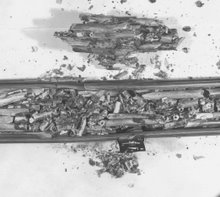
I do not have the dates or the photographs or copies from the log at the General Electric Test Reactor. The aluminum nitride capsules were placed in the core and failed shortly after startup of the reactor. I saw the capsules in the hot lab at Vallecitos Nuclear Center and there were extensive splits along edge welds. I do not have facts on the amount of powder that was lost from the capsules, but it was substantial based on the extensive damage to the capsules; this was no mere pin hole leak.

Sometime after September 30, 1966, my Manager, Kent Stratton was relieved of his duties. One of my co-workers, G. L. Davis, was appointed as my Acting Manager. On November 2, 1966, I wrote the following in my October monthly report to G, L, Davis, Acting Manager.

Safety Attitude Within IPO: The attitude of management within IPO is that safety is to be merely a spectator sport. For example: My recommendations on the aluminum nitride irradiations were not only ignored, they were arrogantly ignored, and after the whole show was over (and $100,000 was down the drain), there was an attitude of resentment when I dragged out my correspondence which showed that I predicted the occurrence before it happened. As you know, Management always accused us of Monday morning quarterbacking when we were in Nuclear Safety when in reality predictions like the one I just cited often held true at that time even though they weren't as well documented. I think Management should take another look at the need for having common sense in the safety program, especially with regard to experiments in the GETR.

Below is an illustration of a moon shaped piece.

Following shows the four filler pieces in the core of the General Elecric Test reactor.

Friday, July 26, 2013

Hardened vented containment in BWRs (and ice condensers).  Here is my latest e-mail to NRC:

Subject:Re: Please respond
Date:7/25/2013 2:16:00 P.M. Mountain Daylight Time
From:Bobleyse@aol.com
To:OPA.Resource@nrc.gov


Hello:
Thank you for promptly pointing out my error.
I prefer to leave the ball in your court, and I've extended the date for your response to Friday, August 9, 2013. 
The correct reference is ML13143A321, page 33 of 36.  On that page I read:
1.2 The HCVS shall include the following design features:
1.2.1 The HCVS shall have the capacity to vent the steam/energy equivalent of 1 percent of iicensed/rated thermal power (unless a lower value is justified by analyses), and be able to maintain containment pressure below the primary containment design pressure.

I've been trying to get NRC to provide a list of references that document the basis for 1.2.1.

Certainly, NRC should realize that the amount of hydrogen produced at Fukushima as well as the timing and rate of hydrogen production was not related to 1 percent of the operating power levels of those units. 

I've tried earlier to find this out, without success.  If I do not get a satisfactory answer from NRC by August 9, 2013, I'll forward this e-mail to my Idaho U. S. Senator Risch.

Robert H. Leyse   bobleyse@aol.com

Tuesday, July 16, 2013

BWR Hardened Vented Containment (Some repitition)

Hardened Vented Containment and the Boeing 787 Dreamliner

The Dreamliners were grounded until the batteries were contained and vented.

In contrast, the Fukushima sister BWRs in the USA continue operating without a glitch while our NRC ponders what to do about the lack of venting.  Of course there is a lot of activity and NRC now says that a hardened vent with the capacity to vent the steam/energy equivalent of one (1) percent of licensed/rated thermal power is adequate although a lower value may be justified by analysis.

ML13143A321 Hardened vents for BWRs

The pages are not numbered, but on page 33 of 36:

1.2 The HCVS shall include the following design features:

1.2.1 The HCVS shall have the capacity to vent the steam/energy equivalent of one
(1) percent
of licensed/rated thermal power (unless a lower value is justified by analyses), and be able to restore and then maintain containment pressure below the primary containment design pressure and the primary containment pressure limit.

And, the NRC is in no sweat.  Here is the schedule:

These Licensees shall promptly start implementation of the requirements in Attachment 2 to this Order upon issuance of the associated final interim staff guidance (ISG) for each phase, and shall complete the two phases of implementation by the following dates:

• Phase 1 (severe accident capable wetwell venting system): no later than startup
from the second refueling outage that begins after June 30, 2014, or
June 30, 2018, whichever comes first.

• Phase 2, (severe accident capable drywell venting system): no later than startup
from the first refueling outage that begins after June 30, 2017, or June 30, 2019,
whichever comes first.

Monday, July 15, 2013

Filtered vented containment - Leyse's Further Request -

Here is an e-mail that I sent to NRC, again seeking documents that must be in the public arena.

Subject:Re: REPLY: Memorandum of Understanding Between NRC and EPRI on Cooperative Nu...
Date:7/11/2013 3:19:42 P.M. Mountain Daylight Time
From:Bobleyse@aol.com
To:Brett.Rini@nrc.gov

Brett:
EPRI, NRC and DOE had a closed meeting on September 30, 2011.  Among matters discussed was addenda to the MOU between EPRI and NRC.  I have requeseted the addenda.  You sent ADAMS numbers for four, the most recent being ML101270008 that is dated April 26, 2010.
There must be more recent addenda that were discussed during the closed meeting.
In addition to matters discussed during the closed meeting of  September 30, 2011, there must be documents of activities between EPRI, NRC and perhaps others in the arena of hardened vents and filtered hardened vents.  I would also appreciate those references. 

Friday, July 5, 2013

NRC and EPRI Collaborations, Filtered Vent

Below are a series of e-mail exchanges between this blogger, Leyse, and the NRC as Leyse has sought and gained access to some of the documentation of activites between the NRC and the Electric Power Research Institute.  

Leyse is after more facts on the  collaborations in venting of BWR and Ice Condenser Containments.  Also Leyse wants more facts on Spent Fuel Pool research.


Thank you, Brett
In a message dated 6/24/2013 2:45:12 P.M. Mountain Daylight Time, Brett.Rini@nrc.gov writes:

Mr. Leyse,

We are still reviewing each of the addenda to determine releasability.  I wanted to inform you of some that are available to the public.

Addendum Title
ADAMS Accession Number
Probabilistic Risk Assessment
 ML071170164
Probabilistic Risk Assessment (renewal)
 ML101270008
Seismic Risk
 ML081300851
Seismic Risk (renewal)
 ML100060724

I should be able to provide another update in two weeks.  Thank you for your patience.

Regards,

Brett Rini


From: Bobleyse@aol.com [mailto:Bobleyse@aol.com]
Sent: Tuesday, June 11, 2013 1:25 AM
To: Rini, Brett
Subject: Re: REPLY: Memorandum of Understanding Between NRC and EPRI on Cooperative Nu...

Brett Rini:

I am in a sweat to get this stuff.

Bob Leyse

In a message dated 6/10/2013 2:33:05 P.M. Mountain Daylight Time, Brett.Rini@nrc.gov writes:
Mr. Leyse,

We are reviewing the addenda to ensure there is no information that should not be released to the public.  This may take a few weeks, as we have a handful of addenda with EPRI.  I will keep you informed of our progress.

The MOU with EPRI on cooperative research is owned by the NRC’s Office of Nuclear Regulatory Research (RES).  I will be your point of contact for this effort.

Regards,

Brett Rini

Brett A. Rini
Technical Assistant
Office of Nuclear Regulatory Research
U.S. Nuclear Regulatory Commission
(301)251-7615

From: Bobleyse@aol.com [mailto:Bobleyse@aol.com]
Sent: Thursday, June 06, 2013 5:24 PM
To: Rini, Brett
Subject: Re: REPLY: Memorandum of Understanding Between NRC and EPRI on Cooperative Nu...

Sir: 

Unfortunately  my request to t he Commissioners was incomplete.
Brett Rini

In ML113120182 I read:

(3) Identify progress made and any obstacles to making progress in tasks identified in the
addenda to the Memorandum of Understanding (MOU) between NRC and EPRI on
Cooperative Nuclear Safety Research (ADAMS Accession No. ML092290122).

I need the addenda.  Perhaps, in line with the spirit of the spirit of the Commissioners, you will promptly e-mail the addenda.

Please reply promptly.

Bob Leyse        bobleyse@aol.com


In a message dated 6/4/2013 12:02:16 P.M. Mountain Daylight Time, Brett.Rini@nrc.gov writes:
Mr. Leyse,

In response to your e-mail to the NRC Commissioners, dated April 23, 2013, the staff has reviewed the Memorandum of Understanding (MOU) between the Nuclear Regulatory Commission and the Electric Power Research Institute and decided to make it publically available.  You can now find the MOU in ADAMS at ML092290122.

Thank you for your interest in NRC research activities.

Brett Rini

Brett A. Rini
Technical Assistant
Office of Nuclear Regulatory Research
U.S. Nuclear Regulatory Commission
(301)251-7615


Chairman and Commissioners:
Please release ML092290122. 
ML092290122 is listed as non-public in internal ADAMS.
The attachment to this e-mail, spent fuel pool.doc, illustrates at least part of my direct and immediate interest in ML092290122.
Robert H. Leyse        bobleyse@aol.com


From: Bobleyse@aol.com
To: PDR.Resource@nrc.gov
Sent: 4/23/2013 8:29:21 A.M. Mountain Daylight Time
Subj: Re: Please, ML092290122

Mary:
Thank you for that prompt reply.
Bob
In a message dated 4/23/2013 6:32:46 A.M. Mountain Daylight Time, PDR.Resource@nrc.gov writes:

Hi Bob,

ML092290122 is listed as non-public in internal ADAMS.
-----------------------------------------------------------
Accession Number: ML092290122
Document Title: Memorandum of Understanding Between US NRC and Electric Power Research Institute on Cooperative Nuclear Safety Research.
Estimated Page Count: 6
 Document Date: Mar 14, 2007
 Document Type: "Legal-Memorandum of Agreement/Understanding"
  Author Name: "Modeen D J"; "Sheron B W"
 Author Affiliation: "Electric Power Research Institute (EPRI)"; "NRC/RES/DE"
Availability: Non-Publicly Available
----------------------------------------------------------


Sincerely,

Mary Mendiola
Technical Librarian
US NRC Public Document Room
301-415-4737
800-397-4209


From: Bobleyse@aol.com [mailto:Bobleyse@aol.com]
Sent: Monday, April 22, 2013 6:38 PM
To: PDR Resource
Subject: Please, ML092290122

Hello:

Please e-mail the Memorandum of Understanding (MOU) between NRC and EPRI on Cooperative Nuclear Safety Research (ADAMS Accession No. ML092290122).  It is identified as follows in ML113120182.  However, I have no luck in getting that.

3) Identify progress made and any obstacles to making progress in tasks identified in the addenda to the Memorandum of Understanding (MOU) between NRC and EPRI on Cooperative Nuclear Safety Research (ADAMS Accession No. ML092290122).

Thank you,

Bob       bobleyse@aol.com
=

Thursday, July 4, 2013

ML13143A321 Hardened vents for BWRs


I sent the following e-mail to NRC on June 20, 2013.  So far there is no reply.

ML13143A321 Hardened vents for BWRs
Date:6/20/2013 11:03:19 A.M. Mountain Daylight Time
From:Bobleyse@aol.com
To:Rajender.auluck@nrc.gov
Sir:
ORDER TO MODIFY LICENSES WITH REGARD TO RELIABLE HARDENED CONTAINMENT VENTS.
The pages are not numbered, but on page 33 of 36:
1.2 The HCVS shall include the following design features:
1.2.1 The HCVS shall have the capacity to vent the steam/energy equivalent of one
(1) percent
of licensed/rated thermal power (unless a lower value is justified by analyses), and be able to restore and then maintain containment pressure below the primary containment design pressure and the primary containment pressure limit.
Please e-mail a list of references that justify the one percent.
Bob Leyse   bobleyse@aol.com