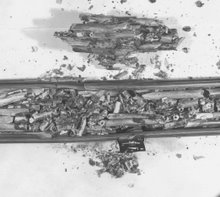
Yes, way back during the 1950's a big company was paid by the feds to engineer a mammoth test reactor. Not stupid, they smelled a market and cheaply built a miniature test reactor of their own in an exotic area where brainy folks liked to live. It was miniature only in the sense of core size, but power density and heat flux ultimately exceed that of the larger unit designed for the feds.
So, in the smaller machine they irradiated capsules for dollars. It was a fantastic machine with a power density exceeding that of the mammoth machine but in a much smaller overall volume.
Its long and narrow pressure vessel was in a much larger deep pool. For shutdown, emergency or otherwise, large valves above the core vented to the pool yielding fast depressurization from several atmospheres. The primary pump kept running until operators turned it off if they felt like it. Also, it is pertinent that normal flow was downward.
During plant shutdown there was an ingenious arrangement for decay heat removal to the surrounding pool. There were large check valves below the core and large solenoid valves above the core that so that with the system shut down and depressurized and the primary pump turned off, there was upward flow thorough the core by thermal convection. It was a neat, cheap and effective arrangement.
So, think about the following: The miniature test reactor ran at full power for several weeks when an automatic shutdown was initiated for some reason. Simultaneously a lot of stuff happened; poison rods dropped into the core to insure shutdown, the upper solenoid valves opened and depressurized the system, and more stuff took place. The primary pump was turned off. The lower
Now, it is not easy to imagine everything, but it was late at night or early morning, and human beings can do strange things. The game was to get the machine started up very soon because there were factors that could prevent startup for many hours if it was not promptly executed. So, with the primary pump still turned off, the game was to pressurize the system, turn the pump on, and then return to full power. Well, there were problems of sorts. Thus the system was pressurized for several minutes and then depressurized. This happened many times before the primary pump was turned on and the reactor was stated up.
A week or so later the reactor was shut down for normal core changes. Several capsules was found above the core. Imagine why that happened.
There is more fiction. There were battles among gangs about what to do about capsule shootout. One gang felt that the feds should immediately be informed. One non-involved sect leaked hints to the feds but their story was garbled, and besides, the feds did not want to hear stuff like that because their inspectors always knew what was going on.
Some insisted that the capsules should be locked in place with an upper fitting. That proposal led to fears that changes would have to be cleared with the feds who would ask why. And maybe the feds would ask about reactivity insertion via shot out capsules; like how many and how fast and maybe even how destructive and more.
One manager with substantially more authority than brains arranged for a viewing port on the top head of the reactor vessel and movies were taken while the primary pump was turned on and off. Of course, that revealed nothing. Little was written on the operating log. If the fed inspectors ever knew about this, they did not dig into it.
Time seems to heal a lot. So, after many months design changes led to the capsules being locked in place. The feds were conveniently disinterested.
Nobody ever suggested that the system should never be pressurized for extended times without the primary pump in operation. Somebody asked, "Even with the capsules locked in place, what would happen if the system was suddenly depressurized after an hour or more of pressurization without primary flow?" That was an inconvenient question that was not discussed. The feds never came close to considering such possibilities. I may extend this fiction to considering that, but I need a rest.
So, I'm not rested, but I am impatient.
Consider the heat transfer and temperature buildups in the arrangement that I have partially described. Following operation at power the unit shuts down. It is possible to maintain the unit at a pressure of several atmospheres with the primary pump turned off; and this is what happened. The decay heat at the time of shutdown is substantial and rapidity becomes less but still averages more than one megawatt over the next hour.
The flow coasts down and is zero in less than 10 seconds. After all, this is fiction so I need not perform even approximate calculations. The water within the narrow channels reaches the saturation temperature in less than one minute and then becomes steam. I don't feel like doing a lot of work, so I will suppose that the fuel plates never get to 1100 degrees Fahrenheit where they would melt. I won't even suppose that the plates will become weak and deform substantially.
Now, even with my most forceful imagination, I cannot conceive of significant natural circulation in the piping arrangement. Normally, the flow enters the top of the reactor vessel and flows downward. Flow exits the reactor vessel at its lower end and the piping is arranged so that flow is upward to the top end of the pool. At that point the piping is directed to the primary heat exchanger and then to the primary cooling pump, etc. There will be heat transfer from the reactor vessel and its discharge pipes to the surrounding pool, but this will not be sufficient to enable significant natural circulation.
So, what do I imagine is going on? I imagine that there is burping of steam and water into and out of both ends of the reactor core and that taxes my imagination, but otherwise I get into deformation and even melting and I do not want to imagine that hard. Top end burping is more easily visualized than lower end (anti-gravity) burping.
Having rested, it really takes a bit less imagination to visualize a shutdown heat flux of 12,000 British Thermal Units per square foot per hour. Also imagine an assembly of flat plates with spacing of about 0.01 feet that is the cooling channel for water flow. With no flow, how fast does that water heat up? That is easy. A square foot of the channel contains 0.01 times of about 62.5 or so pounds of water,or 0.6 pounds. Then, it heats up at a rate of 2X12,000/0.6=40,000 degrees Fahrenheit per hour or about 11 per second. That is pretty fast. (I doubled the heat flux because the narrow channel is heated from two sides.)
Suppose I pressurize this arrangement to around 10 atmospheres. Then the water boils at about 350 Fahrenheit where it takes about 870 Btu to convert one pound of water to steam. Things happen pretty fast. If I start at 100 F, it takes less than one-half minute to get to boiling. And when I start boiling, it takes only 24,000/0.6X870=46 seconds to boil all of the water in the channel. In about a minute, I have gone from a water-filled channel to a steam filled channel.
Now, I begin to increase the pressure of the system as I add energy. I'll imagine that I have a surge tank that is pressurized to 10 atmospheres with a gas space above. Even so, adding heat from the core will further pressurize this system.
Well, I will not even think about these possibilities when I license this rig with the feds. It is their job to know it all and if you don't believe that, ask them.
Anyway, I imagine that I have installed rupture discs set at a bit of overpressure, maybe 10 psi or more. Once in a while those burst during startup evolutions. At that time the decay heat fluxes will be substantially less than 12,000, but even at 1200, the time to boiling and steaming is less than 15 minutes, so there is not a lot of time for messing around with a bottled up system. Even at 600 I can have bad times. Even fiction can be troubling.
They say that readers will drop the book if it strays a lot. Too bad. Here we go further into this ridiculous stuff. It turns out that the miniature test reactor became a money-maker. To make more money it had to operate at a higher power. That meant that it was necessary to talk to the feds. And there were other problems. There were those rupture disks that were troublesome. There was the matter of the heat transfer correlation that was a barrier to power level increase. (An outsider had squeezed onto the payroll and he pointed out an error in that correlation, but it was not acceptable to challenge the corporate expert who was an economic asset in far bigger games.)
However, in time these matters and others were taken care of, and the increase in power level went ahead. Rupture discs were tolerated. Operation at heat fluxes in the range of
one million British Thermal Units per square foot per hour was now allowed.
Following a very meticulous power ascension game that lasted several months, the reactor resumed commercial operation at the increased power. Operation was not flawless, but profits and bonuses prevailed.
However, the rupture discs continued to delay startups. Unknown to those who operated the reactor and also to those who pursued analysis of its operating experience, a very secretive high level corporate panel determined that operation of the facility was beyond the level of risks that the corporation ought to tolerate. The panel's review of the rupture disc events led to a much larger scope of its investigations. Indeed, the reactor was located in an exotic area where brainy folks liked to live and that area was closing in on the site. The panel reported that operation of the reactor should cease. However, an abrupt action could lead to a whole set of business and public relations problems.
Nature came to the rescue. Earthquake faults, such as the New Madrid are widespread. Thus it was easy to get the feds to declare that the reactor was very close to the splay of the splay etc. The analysts immediately prepared responses to the orders from the feds. Much to their surprise, headquarters had no interest in fighting the feds, and the reactor has never again operated.
Wednesday, November 25, 2015

Defense Radioactive Waste and the Flow of Money
Defense
Radioactive Waste and the Flow of Money
Out here in Idaho we are stuck with 900,000 gallons of defense
radioactive waste. Assorted cleanup
contractors are well paid to stabilize that stuff, however it remains unchanged
and it will likely stay that way for a long time. Well over $600 million has been spent and payments
continue at $50 million per year according to recent press reports. All this flow of money continues even though
laboratory scale and larger pilot scale operations have been consistently
discouraging. There have been endless reviews of the project; all this has been
going on for well over ten years.
It would take deep investigations to expose this project that
our Department of Energy (DOE) calls the Integrated Waste Treatment Unit (IWTU). Following is from a fraction of the references
that the public may find via GOOGLE.
1. From the report by Defense
Nuclear Facility Safety Board (DNFSB), January 24, 2007.
The
Board has no significant safety issues with the project at this time (Critical
Decision 2/3B). The final design, however, is progressing and there remain a
number of items the Board believes must be addressed before the approval of
final design and construction of the project.
Further,
DOE convened an expert panel early in preliminary design to confirm that the
design of the facility could accommodate this mission. The Board is
encouraged by the project’s commitment to address this panel’s recommendations.
2. From the expert panel cited by DNSFB, September 11, 2006.
Recommendation
1.Thorough documentation, data reduction and analysis of the results from
pilot-scale testing carried out to date should be completed as soon as possible
and to the extent practical before initiating the planned next stage of
pilot-scale testing. Sufficient time and resources should be provided to
complete thorough documentation and analysis of all pilot-scale testing. … A
schedule should be developed for future pilot-scale testing, evaluation and
results documentation that includes integration of lessons learned in the
full-scale design.
3. From
the report by DNSFB, May
23, 2014.
Staff
Conclusion. The staff review team
believes that the scope and depth of the engineering actions required to
address the TSR violation, PISA, design changes, and transitions to steam and
non-radioactive simulant feeds indicate
a lack of assurance that the facility can safely proceed with nuclear
operations.
Therefore,
pursuant to 42 U.S.C. § 2286b(d), the Board requests a report and briefing
within 30 days, on DOE's evaluation of the need for additional independent
assessment at the completion of IWTU startup testing and prior to the
introduction of radioactive waste feed.
4. From
the 30 day report by DOE, June
20 , 2014.
…
DOE agrees that IWTU will benefit from an additional independent assessment at
the completion of startup testing and prior to the introduction of radioactive
waste feed as described in the enclosed report.
Today there is no facility that has the capability to stabilize those 900,000 gallons of defense radioactive waste. It is evident that hundreds of millions of dollars have been spent on the final design and construction of the IWTU. And, even under the surveillance of the DNFSB, all of that money flowed without addressing:
Recommendation
1.Thorough documentation, data reduction and analysis of the results from
pilot-scale testing carried out to date should be completed as soon as possible
and to the extent practical before initiating the planned next stage of
pilot-scale testing. Sufficient time and resources should be provided to
complete thorough documentation and analysis of all pilot-scale testing. … A
schedule should be developed for future pilot-scale testing, evaluation and
results documentation that includes integration of lessons learned in the
full-scale design.
Robert Leyse
lives in Sun Valley
Monday, November 9, 2015
FOIA and DNFSB
| Subject: |
FOIA
to DNFSB
|
Date: | 11/9/2015 9:36:02 A.M. Mountain Standard Time | From: | KatherineH@dnfsb.gov |
Mr. Leyse,
This is to notify you that a proper FOIA request has not been
received by the Defense Nuclear Facilities Safety Board (Board) per
§1703.105(b)(4) of the Board’s regulation which states:
No request shall be deemed to have been received until the
Board has:
(i) Received a statement of
willingness to pay, as indicated in §1703.105(b)(3)(i), or
(ii) Received and approved a request
for waiver or reduction of fees. However, the FOIA request shall be deemed to
have been received if the request for waiver or reduction of fees includes a
statement of willingness to pay the fee anticipated to be incurred in processing
the request under this section, or to pay that fee not to exceed a specific
amount, should the request for fee waiver or reduction be denied.
A copy of your email has been attached as a courtesy.
If you have any questions, please do not hesitate to call me
at (202) 694-7000, (800) 788-4016 (Toll Free), or e-mail me at KatherineH@dnfsb.gov providing
your assigned tracking number “FOIA 15-18” for reference.
Sincerely,
Katherine Herrera
Information/FOIA Officer
Defense Nuclear Facilities Safety Board
625 Indiana Ave., Suite 700
Washington, DC 20004
Catherine Findlay
From: Bobleyse@aol.com
Sent: Monday, November 02, 2015 12:26 PM
To: FOIA
Subject: My FOIA to DNFSB
This FOIA is from:
Robert H. Leyse P.O. Box 2850 Sun Valley, ID 83353
Telephone: (208-622-7740)
The DOE has already told me that I will receive no response to the following FOIA unless I
agree to pay a lot of money. I WILL PAY NOTHING. Of course, it is the business of the
DNFSB to be cognizant of this FOIA, and I want a prompt response.
Under this FOIA I am requesting all records that led to the decision to use the steam reforming
technology, the decision that is recorded in Reference 1.
Reference 1 DOE/EIS-0287 http://www.id.energy.gov/insideNEID/hlw_rod.pdf
Reference 2 INEEL/EXT-04-01493
http://www5vip.inl.gov/technicalpublications/documents/2553196.pdf
Reference 3 ICP/EXT-04-00172
http://www5vip.inl.gov/technicalpublications/Documents/2542723.pdf
Reference 1 is the RECORD OF DECISION For The Idaho High-Level Waste and Facilities
Disposition Final Environmental Impact Statement, December 2005. Following are four
sentences that are copied from Reference 1.
DOE has decided to treat SBW using the steam reforming technology. (page1)
DOE then issued a Federal Register Notice (70 FR 44598, August 3,2005) that announced steam
reforming as DOE's preferred treatment technology for SBW. (page 5)
DOE identified steam reforming as its preferred treatment technology for SBW after
consideration of public comment and the following factors: technical maturity, environment,
safety and health (ES&H), schedule, and programmatic risk, as presented in the Final EIS. DOE
also considered the cost of the various alternatives. ( page 14)
DOE believes steam reforming provides the best value to the Government and meets its need
for treatment flexibility, acceptable cost, and probability of success. (page 17)
From the above four sentences it is clear that DOE decided to treat SBW using the steam
reforming technology and it made that decision during 2005.
Moving to Reference 2, INEEL/EXT-04-01493, Phase 2 THOR Steam Reforming Tests for
Sodium-Bearing Waste Treatment , January 2004, the following is copied from page vii:
Recommendations
Several areas were identified where additional testing and technology
development/demonstration.
These areas are:
• Control of the carbonate bed particle size growth by incorporation of a particle size
management system to produce/introduce seed particles into the bed
• Improving the mineralized product density
• Improved reducing potential and NOx destruction while making a mineralized product
• Increasing retention of product in the bed particles and better solid carbon utilization by
recycling more fines than were captured and recycled by the cyclone used during the test series
• Improved performance of key system components, including the gas distributor, the bed drain,
and the feed nozzle
• Operation for longer periods of time to demonstrate long-term performance
Under this FOIA I am requesting all records that led to the decision to use the steam reforming
technology, the decision that is recorded in Reference 1.These records must include documents
that record the performance of additional testing and technology/demonstration as recommended
in Reference 2, especially the need for improved performance of key system components and the
need to demonstrate long-term performance.
Moving to Reference 3, ICP/EXT-04-00172, Converting Simulated Sodium-Bearing Waste into
a Single Solid Waste Form By Evaporation: Laboratory- and Pilot-Scale Test Results on
Recycling Evaporator Overheads, January 2004, the following is copied from page 48:
5. CONCLUSIONS
At full‐scale evaporator operations, handling of the bottoms product will be an issue as
demonstrated by the bottoms plugging incident during pilot‐scale tests.
And the following is copied from page 50:
6. RECOMMENDATIONS
• Full‐scale testing is recommended primarily to verify that the bottoms discharge system is
reliable when designing the production facility. It should not be assumed that components such
as valves, piping, or pumps would function reliably with a hot, viscous bottoms product material
whose properties change readily with temperature, concentration, and time.
Under this FOIA I am requesting all records that led to the decision to use the steam reforming
technology, the decision that is recorded in Reference 1.These records must include documents
that record the performance of additional testing and technology/demonstration as recommended
in Reference 3, especially the recommendation for full-scale testing to verify that the bottoms
discharge system is reliable.
Catherine Findlay
From: Bobleyse@aol.com
Sent: Monday, November 02, 2015 12:26 PM
To: FOIA
Subject: My FOIA to DNFSB
This FOIA is from:
Robert H. Leyse P.O. Box 2850 Sun Valley, ID 83353
Telephone: (208-622-7740)
The DOE has already told me that I will receive no response to the following FOIA unless I
agree to pay a lot of money. I WILL PAY NOTHING. Of course, it is the business of the
DNFSB to be cognizant of this FOIA, and I want a prompt response.
Under this FOIA I am requesting all records that led to the decision to use the steam reforming
technology, the decision that is recorded in Reference 1.
Reference 1 DOE/EIS-0287 http://www.id.energy.gov/insideNEID/hlw_rod.pdf
Reference 2 INEEL/EXT-04-01493
http://www5vip.inl.gov/technicalpublications/documents/2553196.pdf
Reference 3 ICP/EXT-04-00172
http://www5vip.inl.gov/technicalpublications/Documents/2542723.pdf
Reference 1 is the RECORD OF DECISION For The Idaho High-Level Waste and Facilities
Disposition Final Environmental Impact Statement, December 2005. Following are four
sentences that are copied from Reference 1.
DOE has decided to treat SBW using the steam reforming technology. (page1)
DOE then issued a Federal Register Notice (70 FR 44598, August 3,2005) that announced steam
reforming as DOE's preferred treatment technology for SBW. (page 5)
DOE identified steam reforming as its preferred treatment technology for SBW after
consideration of public comment and the following factors: technical maturity, environment,
safety and health (ES&H), schedule, and programmatic risk, as presented in the Final EIS. DOE
also considered the cost of the various alternatives. ( page 14)
DOE believes steam reforming provides the best value to the Government and meets its need
for treatment flexibility, acceptable cost, and probability of success. (page 17)
From the above four sentences it is clear that DOE decided to treat SBW using the steam
reforming technology and it made that decision during 2005.
Moving to Reference 2, INEEL/EXT-04-01493, Phase 2 THOR Steam Reforming Tests for
Sodium-Bearing Waste Treatment , January 2004, the following is copied from page vii:
Recommendations
Several areas were identified where additional testing and technology
development/demonstration.
These areas are:
• Control of the carbonate bed particle size growth by incorporation of a particle size
management system to produce/introduce seed particles into the bed
• Improving the mineralized product density
• Improved reducing potential and NOx destruction while making a mineralized product
• Increasing retention of product in the bed particles and better solid carbon utilization by
recycling more fines than were captured and recycled by the cyclone used during the test series
• Improved performance of key system components, including the gas distributor, the bed drain,
and the feed nozzle
• Operation for longer periods of time to demonstrate long-term performance
Under this FOIA I am requesting all records that led to the decision to use the steam reforming
technology, the decision that is recorded in Reference 1.These records must include documents
that record the performance of additional testing and technology/demonstration as recommended
in Reference 2, especially the need for improved performance of key system components and the
need to demonstrate long-term performance.
Moving to Reference 3, ICP/EXT-04-00172, Converting Simulated Sodium-Bearing Waste into
a Single Solid Waste Form By Evaporation: Laboratory- and Pilot-Scale Test Results on
Recycling Evaporator Overheads, January 2004, the following is copied from page 48:
5. CONCLUSIONS
At full‐scale evaporator operations, handling of the bottoms product will be an issue as
demonstrated by the bottoms plugging incident during pilot‐scale tests.
And the following is copied from page 50:
6. RECOMMENDATIONS
• Full‐scale testing is recommended primarily to verify that the bottoms discharge system is
reliable when designing the production facility. It should not be assumed that components such
as valves, piping, or pumps would function reliably with a hot, viscous bottoms product material
whose properties change readily with temperature, concentration, and time.
Under this FOIA I am requesting all records that led to the decision to use the steam reforming
technology, the decision that is recorded in Reference 1.These records must include documents
that record the performance of additional testing and technology/demonstration as recommended
in Reference 3, especially the recommendation for full-scale testing to verify that the bottoms
discharge system is reliable.
Saturday, November 7, 2015
The Rules of Public Participation
| ||||||||||
Mr. Leyse, my name is Bob Pence. I am the Federal
Coordinator forthe INL EM CAB. My responsibility is to provide support to Jack Zimmerman and the INL EM CAB. As such I am responding to your request for time to present a slide presentation at our next Boardmeeting in Sun Valley on October 29th. Pursuant to the Federal Advisory Committee Act (FACA), 41 CFR and the DOE Manual onadvisory committee activities, “any member of the public may speak to or otherwise address the advisory committee, if the agency guidelines permit, to include filing a written statement with the committee.” In accordance with these regulations and guidelines and our procedures and charter, we provide for a 15 minute Public Involvement opportunity, at all of our public meetings. During the October 29th meeting in Sun Valley, that opportunity is in the afternoon from 1530 to 1545. You will be required to sign up in order to make a statement during the PublicInvolvement Period. There are 15 minutes available for this comment period. The time will be shared, on an equal basis, between all those signing up. This is an opportunity to make a public statement, but it is not an opportunity to make a slide presentation. However, you can alternatively choose to file a copy of your slides with the Board. Your comments will be part of the public record for this meeting. As detailed in the afore referenced regulations, you can make a statement,but it is NOT an open forum for questions and answers, by the Board and or other participants.
Please feel free to contact me if there are additional
questions
that youhave in this regard. We look forward to your participation with us during the upcoming meeting.
Thank You.
Bob Pence, Federal Coordinator
INL EM CAB
DOE-ICP
| ||||||||||
Sunday, November 1, 2015
Spent Fuel Storage in New Mexico
Plan to Store Spent Nuclear Fuel in New Mexico Takes
Major Step
04/29/2015 | Gail Reitenbach
Print
Mode : OFF
With plans for a “permanent”
solution for storing waste from nuclear power generating plants permanently
stalled, some are hoping that an “interim” site can be developed that would
enable the removal of spent nuclear fuel from plant sites. Today, Holtec
International and two New Mexico counties announced a memorandum of agreement
to build such a facility in the southeast corner of the state.
POWER
reported on the groundwork plans for the project yesterday. They included the involvement of New Mexico Governor
Susana Martinez (R).
The agreement between Holtec and the
Eddy Lea Energy Alliance has Holtec responsible for the design, licensing,
construction, and operation of an interim used fuel storage facility modeled on
Holtec’s
HI-STORM UMAX storage system, according to a press release by the
Nuclear Energy Institute (NEI). That storage system stores high-level
radioactive waste in steel and concrete containers below ground. The agreement
would develop an interim site “to store all of the used nuclear fuel produced
in the United States and all canisters currently licensed in dry storage in the
country.”
NEI Senior Vice President for
Governmental Affairs Alex Flint told those present at the Albuquerque
announcement: “The nuclear industry has tremendous respect for the political
leaders in New Mexico, who for years have been at the forefront of
understanding nuclear issues. Where others see challenges, they see
opportunities. That has been New Mexico’s history since the beginning of the
nuclear era. This is one more example of New Mexicans who see an opportunity to
lead by creating a valuable business.
The Albuquerque Journal quoted Holtec President and CEO Kris Singh as saying the
site is an ideal location for the project: “New Mexico has excellent terrain, a
dry climate, and a very deep water table,” Singh said. “There’s not a blade of
grass growing in that area. It’s a great place for a safe and secure storage
facility.”
New Mexico is home to two national
laboratories with long histories of nuclear technology work, Los Alamos and
Sandia, as well as the currently closed Waste Isolation Pilot Plant, which
stores waste from the nation’s military nuclear sector.
—Gail Reitenbach, PhD, is POWER’s editor (@GailReit, @POWERmagazine)
Tuesday, October 27, 2015
DNFSB EVALUATIONS OF IWTU
LEYSE
STATEMENT DISCLOSING DNFSB EVALUATIONS OF IWTU
Hello, I am Robert Leyse of Sun
Valley, Idaho and I want the public to know that I have found the following via
GOOGLE. I am including the links so that
others may check my findings.
Link 1: http://www.dnfsb.gov/sites/default/files/Board%20Activities/Reports/Staff%20Issue%20Reports/Idaho%20National%20Laboratory/2014/sir_2014523_24466_37.pdf DNFSB investigated the status of the IWTU and
reported its findings to DOE May 23, 2014. It reported “…a lack of
assurance that the facility can safely proceed with nuclear operations.” “Therefore,
pursuant to 42 U.S.C. § 2286b(d), the Board requests a report and briefing within 30 days, on DOE's evaluation of the need for additional independent assessment
at the completion of IWTU startup testing and prior to the introduction of
radioactive waste feed.”
Link 2: http://www.dnfsb.gov/sites/default/files/Board%20Activities/Letters/2014/ltr_2014620_24626.pdf This is the 30 day reply letter from
DOE to DNFSB and it reports agreement that “…IWTU
will benefit from an additional independent assessment…”
Link 3:
http://thortt.azurewebsites.net/docs/DNFSB%20Letter.pdf This
documents a DNSFB review, January 24, 2007. “The
Board has no significant safety issues with the project at this time (Critical
Decision 2/3B).
The final design, however, is progressing and there remain a number of items the Board believes must be addressed
before the approval of final design and construction of the project.” …
“The
Board commends DOE for considering a potential future mission in this facility.
Further, DOE convened an expert panel early
in preliminary design to confirm that the design of the facility could
accommodate this mission. The Board is encouraged by the project’s
commitment to address this panel’s recommendations.”
Link 4: http://www.cresp.org/crespII/CRESPII_Report/E_attachment/INLreview_complete_9_11_06.pdf This is the report of the expert panel that is praised in 4. The report lists 17 findings and associated
recommendations. Here is the first of 17:
“Finding 1. Documentation, data reduction and
analysis are incomplete for the pilot-scale studies carried out to date at
Hazen Laboratories. … Insufficient attention to these aspects of pilot-testing
has been a cause of other DOE program failures.” ”Recommendation
1. Thorough documentation, data reduction and analysis of the results from
pilot scale testing carried out to date should be completed as soon as possible
and to the extent practical before initiating the planned next stage of
pilot-scale testing.”
LEYSE CLOSING STATEMENT
Others may download the above links and also
search for other links regarding the IWTU.
Subscribe to:
Posts (Atom)