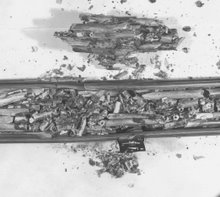
Of course, in today's world it would not be allowed to drive up in the family car and take pictures. In those days (1992) this spot was also on the access to the launching ramp for recreational boats into Lake Michigan.
Saturday, July 21, 2007
Speaks for Itself
Of course, in today's world it would not be allowed to drive up in the family car and take pictures. In those days (1992) this spot was also on the access to the launching ramp for recreational boats into Lake Michigan.
Sunday, July 8, 2007
Software terrorists are everywhere!
Forget about TRACE until the last example of this brief note.
Example 1. Engineer Accused of Taking Codes to Iran (Copied from AOL)
Engineer Accused of Taking Codes to IranAP April 21, 2007PHOENIX (AP) - A former engineer at the nation's largest nuclear power plant has been charged with taking computer access codes and software to Iran and using it to download details of plant control rooms and reactors, authorities said. The FBI said there's no indication the plant employee had any terrorist connections.Mohammad Alavi, who worked at the triple-reactor Palo Verde power plant west of Phoenix, was arrested April 9 at Los Angeles International Airport when he arrived on a flight from Iran, authorities said.
Alavi, 49, is a U.S. citizen and denies any wrongdoing, said his attorney, Milagros Cisneros of the Federal Defender's Office in Phoenix.He is charged with a single count of violating a trade embargo that prohibits Americans from exporting goods and services to Iran. If convicted, he would face up to 21 months in prison.According to court records, the software is used only for training plant employees, but allowed users access to details on the Palo Verde control rooms and the plant layout.
In October, authorities alleged, the software was used to download training materials from Tehran, using a Palo Verde user identification.The FBI said there was no evidence to suggest the software access was linked to the Iranian government, which has clashed with the West over attempts to develop its own nuclear program. "The investigation has not led us to believe this information was taken for the purpose of being used by a foreign government or terrorists to attack us," said Deborah McCarley, a spokeswoman for the FBI in Phoenix.Officials of Arizona Public Service Co., the Phoenix-based utility company that operates the Palo Verde Nuclear Generation Station, said the software does not pose a security risk because it doesn't control any of the nuclear plant's operating systems.
However, the utility said it has changed software security procedures since Alavi quit in August after working there for 16 years. "The health and safety of the public was never compromised and there was no threat to the security of Palo Verde," APS spokesman Jim McDonald said Saturday.
A federal judge in Phoenix denied him bail at a hearing on Friday, saying Alavi had more ties to Iran than the United States and could easily flee. Alavi, who was born in Tehran, has family, a house and a job lined up in Iran, Judge Neil Wake said.Palo Verde has been plagued by outages and equipment problems for the past several years. The plant, located about 50 miles west of downtown Phoenix, supplies electricity to some 4 million customers in Arizona, New Mexico, Texas and California.
Example 2. Of course, the first example is not trivial. It is hardcore stuff, but here is more. Quoting from THE LEX COLUMN in the July 2, 2007, Financial Times, "Add to this the anxiety over the widely expected ratings downgrades and the fact that no one can vouch for the relevance of computer models that value so many CDOs." Very interesting, NO ONE CAN VOUCH FOR THE RELEVANCE.
Example 3. The supreme software terrorists serve the rackets of licensing nuclear power reactors. These are the countless "experts" who repeatedly vouch for the relevance of their rigged computer models. These real culprits are free to spread their wares while relatively innocent men like Bernie Ebbers will die in prison! TRACE is only one of their games.
Example 1. Engineer Accused of Taking Codes to Iran (Copied from AOL)
Engineer Accused of Taking Codes to IranAP April 21, 2007PHOENIX (AP) - A former engineer at the nation's largest nuclear power plant has been charged with taking computer access codes and software to Iran and using it to download details of plant control rooms and reactors, authorities said. The FBI said there's no indication the plant employee had any terrorist connections.Mohammad Alavi, who worked at the triple-reactor Palo Verde power plant west of Phoenix, was arrested April 9 at Los Angeles International Airport when he arrived on a flight from Iran, authorities said.
Alavi, 49, is a U.S. citizen and denies any wrongdoing, said his attorney, Milagros Cisneros of the Federal Defender's Office in Phoenix.He is charged with a single count of violating a trade embargo that prohibits Americans from exporting goods and services to Iran. If convicted, he would face up to 21 months in prison.According to court records, the software is used only for training plant employees, but allowed users access to details on the Palo Verde control rooms and the plant layout.
In October, authorities alleged, the software was used to download training materials from Tehran, using a Palo Verde user identification.The FBI said there was no evidence to suggest the software access was linked to the Iranian government, which has clashed with the West over attempts to develop its own nuclear program. "The investigation has not led us to believe this information was taken for the purpose of being used by a foreign government or terrorists to attack us," said Deborah McCarley, a spokeswoman for the FBI in Phoenix.Officials of Arizona Public Service Co., the Phoenix-based utility company that operates the Palo Verde Nuclear Generation Station, said the software does not pose a security risk because it doesn't control any of the nuclear plant's operating systems.
However, the utility said it has changed software security procedures since Alavi quit in August after working there for 16 years. "The health and safety of the public was never compromised and there was no threat to the security of Palo Verde," APS spokesman Jim McDonald said Saturday.
A federal judge in Phoenix denied him bail at a hearing on Friday, saying Alavi had more ties to Iran than the United States and could easily flee. Alavi, who was born in Tehran, has family, a house and a job lined up in Iran, Judge Neil Wake said.Palo Verde has been plagued by outages and equipment problems for the past several years. The plant, located about 50 miles west of downtown Phoenix, supplies electricity to some 4 million customers in Arizona, New Mexico, Texas and California.
Example 2. Of course, the first example is not trivial. It is hardcore stuff, but here is more. Quoting from THE LEX COLUMN in the July 2, 2007, Financial Times, "Add to this the anxiety over the widely expected ratings downgrades and the fact that no one can vouch for the relevance of computer models that value so many CDOs." Very interesting, NO ONE CAN VOUCH FOR THE RELEVANCE.
Example 3. The supreme software terrorists serve the rackets of licensing nuclear power reactors. These are the countless "experts" who repeatedly vouch for the relevance of their rigged computer models. These real culprits are free to spread their wares while relatively innocent men like Bernie Ebbers will die in prison! TRACE is only one of their games.
Wednesday, June 27, 2007
The NRC's Mythologists are well entrenched. Look out!
And even more are in the pipeline!
"Possessing a cadre of new, well-trained judges, we are far more prepared to handle new license applications than we were just a few short years ago."
NRC Commissioner Jeffrey S. Merrifield
Presentation at NRC's Regulatory Information Conference
March 13-15, 2007
Merrifield asserted, "... I believe our mandatory hearing process is broken. ... I believe Congress should repeal the requirement for a mandatory hearing. Absent this change, the commission should take direct responsibility for these reviews. ... I believe the requirements for a mandatory hearing could be fulfilled by a single three to four hour meeting of the commission."
"Possessing a cadre of new, well-trained judges, we are far more prepared to handle new license applications than we were just a few short years ago."
NRC Commissioner Jeffrey S. Merrifield
Presentation at NRC's Regulatory Information Conference
March 13-15, 2007
Merrifield asserted, "... I believe our mandatory hearing process is broken. ... I believe Congress should repeal the requirement for a mandatory hearing. Absent this change, the commission should take direct responsibility for these reviews. ... I believe the requirements for a mandatory hearing could be fulfilled by a single three to four hour meeting of the commission."
Saturday, June 23, 2007
Fouling and Reactivity Insertion Accidents
On Tuesday, April 3, 2007, the ACRS Subcommittee on Fuels considered several aspects of Reactivity Insertion Accidents. However, they continued to ignore the impact of heavy fouling (crud). As I've mentioned many times in this blog, fouling is ubiquitous among the worldwide fleet of LWRs. And I've presented the following slide previously; the heavy textured crud is clearly a very significant thermal resistance.


Sunday, June 10, 2007
I've been in this business since 1950
Robert H. Leyse in One Minute
I've been in this business since 1950 on several tasks
including the FLECHT tests that are referenced in
Appendix K. If you check ADAMS under Leyse, you will
find at least 172 entries. These include documents that I
have submitted to the NRC, related public comments, NRC
evaluations, and other matters.
My succinct discussion of fouling in the range of light water reactors over the decades may be found on GOOGLE by entering unmet relap. That is
U-N-M-E-T space R-E-L-A-P. You will find my slide presentation to the 2003 RELAP5 Users Conference under the title Unmet Challenges for SCDAP/RELAP5.
The impact of fouling on LOCAs or reactivity insertion accidents has not been evaluated although extensive fouling of fuel elements is widespread in the U.S.A. and elsewhere. In the U.S.A., ultrasonic fuel cleaning has been applied at some units. In Europe, chemical cleaning has been applied.
The impact of fouling has not been included in the wide range of international test
programs that address reactor accidents. The U.S.A. FLECHT Program never covered this, LOFT did not, and the present day work at Penn State does not.
I may update the 2003 presentation and call it Unmet Challenges for TRACE. Anyway, there are more examples that I would cite in such an update; however,
the bottom line is unchanged.
I've been in this business since 1950 on several tasks
including the FLECHT tests that are referenced in
Appendix K. If you check ADAMS under Leyse, you will
find at least 172 entries. These include documents that I
have submitted to the NRC, related public comments, NRC
evaluations, and other matters.
My succinct discussion of fouling in the range of light water reactors over the decades may be found on GOOGLE by entering unmet relap. That is
U-N-M-E-T space R-E-L-A-P. You will find my slide presentation to the 2003 RELAP5 Users Conference under the title Unmet Challenges for SCDAP/RELAP5.
The impact of fouling on LOCAs or reactivity insertion accidents has not been evaluated although extensive fouling of fuel elements is widespread in the U.S.A. and elsewhere. In the U.S.A., ultrasonic fuel cleaning has been applied at some units. In Europe, chemical cleaning has been applied.
The impact of fouling has not been included in the wide range of international test
programs that address reactor accidents. The U.S.A. FLECHT Program never covered this, LOFT did not, and the present day work at Penn State does not.
I may update the 2003 presentation and call it Unmet Challenges for TRACE. Anyway, there are more examples that I would cite in such an update; however,
the bottom line is unchanged.
Saturday, June 2, 2007
Upper Head Injection: ULTRA HIGH RISK (Update on May 3, 2008)
Following is an old NRC Information Notice. The history and risks of Upper Head Injection is extensive and I'll have a lot to say about this in future entries. Duke did not immediately abandon its UHI, but it did so in due time. TVA kept its system but ultimately got rid of it. The Japanese kept theirs at OHI for a long time, but they also got rid of it.
Upper Head Injection was installed at Westinghouse Ice Condenser Plants to provide a rapid injection of cooling water in the event of a large break LOCA. Ice condenser plants have a lower back pressure and UHI compensates for this. American electric Power never bought into this for its Cook units.
In Simpson's book, "Nuclear Power from Underseas to Outer Space," he spends one line on UHI on apge 199, "Where this couldn't be done or wasn't enough we proposed an upper head injection system,"
This is my opening salvo that will include my close involvement in a long and interesting history, please stay tuned.
PolInformation Notices > 1985 > IN 85-02
SSINS No.: 6835
IN 85-02
UNITED STATES
NUCLEAR REGULATORY COMMISSION
OFFICE OF INSPECTION AND ENFORCEMENT
WASHINGTON, D.C. 20555
January 11, 1985
Information Notice No. 85-02: IMPROPER INSTALLATION AND TESTING OF DIFFERENTIAL PRESSURE TRANSMITTERS
Addressees:
All nuclear power reactor facilities holding an operating license (OL) or a
construction permit (CP).
Purpose:
This information notice provides notification of a potentially significant
problem pertaining to the improper installation and inadequate functional
testing of differential pressure transmitters.
Such conditions occurred at the McGuire Nuclear Station, Unit 1, when the Barton differential pressure switches utilized to control the isolation valves of the upper head injection (UHI) system were replaced with Rosemont differential pressure transmitters. It is expected that recipients will review the information contained in this notice for applicability to their facilities and consider actions, if appropriate, to preclude similar problems from occurring at their facilities. However, suggestions contained in this notice do not constitute NRC requirements; therefore, no specific action or written response is required.
Description of Circumstances:
On November 1, 1984, Duke Power Company informed the NRC that the UHI isolation valves failed to close when the UHI water accumulator was drained at its McGuire Nuclear Station, Unit 1. At that time, the plant was shut down because the nitrogen content of the water in the UHI accumulator exceeded the limit permitted by its technical specifications. Subsequent
investigations revealed that the four differential pressure transmitters used to sense the level of water in the UHI accumulator and initiate automatic closure of the isolation valves on a predetermined level had been improperly installed. As a result, the isolation valves did not automatically close when the water level in the UFII accumulator reached the set point.
The McGuire UHI system design includes a separate nitrogen accumulator that supplies pressurized nitrogen to force the water from the UHI water accumulator into the reactor vessel during the initial phase of a design-basis loss-of-coolant accident (LOCA). Thus, if the UHI isolation valves fail to close during the course of a design-basis LOCA, nitrogen could be injected into the reactor vessel. To prevent such an event, the differential pressure transmitters are designed to initiate automatic closure of the UHI isolation valves when the water in the UHI accumulator reaches a predetermined level.
8501080502
.
IN 85-02
January 11, 1985
Page 2 of 2
During April of 1984, the McGuire Nuclear Station, Unit 1, Barton
reverse-acting differential pressure switches were replaced with Rosemont
direct-acting differential pressure transmitters to improve the accuracy and
repeatability of the UHI water accumulator level sensing system. However,
the Rosemont differential pressure transmitters were not properly installed
in that the impulse lines were not connected to the appropriate transmitter
ports.
Several factors contributed to the improper installation, including
inadequate installation instructions. The major contributor was inadequate
functional testing of the UHI system after it had been modified in that the
post-modification tests were limited to calibration tests of the differential pressure transmitters. These calibration tests were performed with the transmitters isolated from the impulse lines. Consequently, the tests only verified that the transmitters would provide the required output
signal for a given differential pressure, but they lid not demonstrate that
the transmitters sensed the differential pressures associated with water
level changes in the UHI water accumulator. Thus, the differential pressure
transmitters were not only improperly installed, but the error was not
detected until this event. If a design-basis LOCA had occurred during this
period, the UHI system would have been actuated, but the UHI isolation
valves would not have closed when the water in the UHI water accumulator had
been depleted and nitrogen gas could have been injected into the reactor
vessel during the course of the LOCA.
Similar installation errors have been addressed in Information Notice No. No.
84-45, "Reversed-Differential Pressure Instrument Lines." However, the
majority of events described in that information notice occurred in boiling
water reactors during plant construction and were detected by functional
tests performed before commencing power operation.
In contrast, the event described in this infomation notice occurred at a pressurized water reactor and was undetected during approximately 5 months of power operation.
No specific action or written response is required by this information notice; however, if you have any question regarding this notice, please contact the Regional Administrator of the appropriate NRC regional office or the technical contact listed below.
Edward L. Jordan Director
Division of Emergency Preparedness
and Engineering Response
Office of Inspection and Enforcement
Technical Contact: I. Villalva, IE
(301) 492-9007
F. R. McCoy, RII
(404) 221-2689
Attachment:
List of Recently Issued IE Information Notices
Today, May 3, 2008, I found the following via GOOGLE. This is another example of loads of dollars that have gone into useless thermal hydraulic testing. These tests were reported during 1979 and apparently the reporting system caught up with this during 2001. The investigators recommend higher temperature for the UHI water. Of course, UHI has been abandoned, however, the recommendation came in 1979 and was never adopted. It is another matter that could drive plant operators nuts.
ROSA (Rig Of Safety Assessment)
Title
Performance test of the upper head injection system at the ROSA-II test facility
Creator/Author
Tasaka, K. ; Adachi, H. ; Sobajima, M. ; Soda, K. ; Suzuki, M. ; Okazaki, M. ; Shiba, M.
Publication Date
1979 Sep 01
OSTI Identifier
OSTI ID: 5425745
Other Number(s)
CODEN: NUTYB
Resource Type
Journal Article
Resource Relation
Nucl. Technol. ; Vol/Issue: 45:2
Research Org
Japan Atomic Energy Research Inst., Tokai, Ibaraki
Subject
220900 -- Nuclear Reactor Technology-- Reactor Safety ;210200 -- Power Reactors, Nonbreeding, Light-Water Moderated, Nonboiling Water Cooled; ;ECCS-- PERFORMANCE TESTING;PWR TYPE REACTORS-- ECCS; HYDRODYNAMICS;TEST FACILITIES
Related Subject
ENGINEERED SAFETY SYSTEMS;FLUID MECHANICS;MECHANICS;REACTOR PROTECTION SYSTEMS;REACTORS;TESTING;WATER COOLED REACTORS;WATER MODERATED REACTORS
Description/Abstract
To evaluate upper head injection system (UHIS) performance during a postulated loss-of-coolant accident (LOCA) in a pressurized water reactor (PWR), ten UHIS tests were conducted at the ROSA-II test facility.^The experimental results were different from the expected UHIS performance in the following points.^First, flashing took place in the upper head and a mixture level was formed before UHIS actuation.^Second, emptying of the upper head was observed immediately after UHIS shut off.^Third, part of the water which flowed down from the upper head, penetrated into the core and contributed to core cooling at the top part of the core, however, most of the water flowed out through the broken loop hot leg.^In the case of higher injection water temperature (approx.^120/sup 0/C), the fluid behavior in the pressure vessel differed significantly from the results for the low injection water temperature (approx.^20/sup 0/C), and the core cooling was remarkably improved.^Therefore, high-temperature UHIS water is recommended for effective core cooling.^The results described above are due to the following physical phenomena: (1) fluid mixing in the upper head is not good; (2) subcooled water, which flows into places such as the upper plenum where steam exists, causes strong condensation-depressurization which affects the flow behavior and core cooling.^Although the magnitude of the thermal-hydraulic effects observed in the ROSA-II/UHI tests may be unique to this facility, the above two physical phenomena observed are applicable to all PWRs with a UHIS.^Therefore, these two phenomena must be included in a LOCA analysis of a PWR with a UHIS.
Country of Publication
United States
Language
English
Format
Pages: 121-139
System Entry Date
2001 May 13
Upper Head Injection was installed at Westinghouse Ice Condenser Plants to provide a rapid injection of cooling water in the event of a large break LOCA. Ice condenser plants have a lower back pressure and UHI compensates for this. American electric Power never bought into this for its Cook units.
In Simpson's book, "Nuclear Power from Underseas to Outer Space," he spends one line on UHI on apge 199, "Where this couldn't be done or wasn't enough we proposed an upper head injection system,"
This is my opening salvo that will include my close involvement in a long and interesting history, please stay tuned.
PolInformation Notices > 1985 > IN 85-02
SSINS No.: 6835
IN 85-02
UNITED STATES
NUCLEAR REGULATORY COMMISSION
OFFICE OF INSPECTION AND ENFORCEMENT
WASHINGTON, D.C. 20555
January 11, 1985
Information Notice No. 85-02: IMPROPER INSTALLATION AND TESTING OF DIFFERENTIAL PRESSURE TRANSMITTERS
Addressees:
All nuclear power reactor facilities holding an operating license (OL) or a
construction permit (CP).
Purpose:
This information notice provides notification of a potentially significant
problem pertaining to the improper installation and inadequate functional
testing of differential pressure transmitters.
Such conditions occurred at the McGuire Nuclear Station, Unit 1, when the Barton differential pressure switches utilized to control the isolation valves of the upper head injection (UHI) system were replaced with Rosemont differential pressure transmitters. It is expected that recipients will review the information contained in this notice for applicability to their facilities and consider actions, if appropriate, to preclude similar problems from occurring at their facilities. However, suggestions contained in this notice do not constitute NRC requirements; therefore, no specific action or written response is required.
Description of Circumstances:
On November 1, 1984, Duke Power Company informed the NRC that the UHI isolation valves failed to close when the UHI water accumulator was drained at its McGuire Nuclear Station, Unit 1. At that time, the plant was shut down because the nitrogen content of the water in the UHI accumulator exceeded the limit permitted by its technical specifications. Subsequent
investigations revealed that the four differential pressure transmitters used to sense the level of water in the UHI accumulator and initiate automatic closure of the isolation valves on a predetermined level had been improperly installed. As a result, the isolation valves did not automatically close when the water level in the UFII accumulator reached the set point.
The McGuire UHI system design includes a separate nitrogen accumulator that supplies pressurized nitrogen to force the water from the UHI water accumulator into the reactor vessel during the initial phase of a design-basis loss-of-coolant accident (LOCA). Thus, if the UHI isolation valves fail to close during the course of a design-basis LOCA, nitrogen could be injected into the reactor vessel. To prevent such an event, the differential pressure transmitters are designed to initiate automatic closure of the UHI isolation valves when the water in the UHI accumulator reaches a predetermined level.
8501080502
.
IN 85-02
January 11, 1985
Page 2 of 2
During April of 1984, the McGuire Nuclear Station, Unit 1, Barton
reverse-acting differential pressure switches were replaced with Rosemont
direct-acting differential pressure transmitters to improve the accuracy and
repeatability of the UHI water accumulator level sensing system. However,
the Rosemont differential pressure transmitters were not properly installed
in that the impulse lines were not connected to the appropriate transmitter
ports.
Several factors contributed to the improper installation, including
inadequate installation instructions. The major contributor was inadequate
functional testing of the UHI system after it had been modified in that the
post-modification tests were limited to calibration tests of the differential pressure transmitters. These calibration tests were performed with the transmitters isolated from the impulse lines. Consequently, the tests only verified that the transmitters would provide the required output
signal for a given differential pressure, but they lid not demonstrate that
the transmitters sensed the differential pressures associated with water
level changes in the UHI water accumulator. Thus, the differential pressure
transmitters were not only improperly installed, but the error was not
detected until this event. If a design-basis LOCA had occurred during this
period, the UHI system would have been actuated, but the UHI isolation
valves would not have closed when the water in the UHI water accumulator had
been depleted and nitrogen gas could have been injected into the reactor
vessel during the course of the LOCA.
Similar installation errors have been addressed in Information Notice No. No.
84-45, "Reversed-Differential Pressure Instrument Lines." However, the
majority of events described in that information notice occurred in boiling
water reactors during plant construction and were detected by functional
tests performed before commencing power operation.
In contrast, the event described in this infomation notice occurred at a pressurized water reactor and was undetected during approximately 5 months of power operation.
No specific action or written response is required by this information notice; however, if you have any question regarding this notice, please contact the Regional Administrator of the appropriate NRC regional office or the technical contact listed below.
Edward L. Jordan Director
Division of Emergency Preparedness
and Engineering Response
Office of Inspection and Enforcement
Technical Contact: I. Villalva, IE
(301) 492-9007
F. R. McCoy, RII
(404) 221-2689
Attachment:
List of Recently Issued IE Information Notices
Today, May 3, 2008, I found the following via GOOGLE. This is another example of loads of dollars that have gone into useless thermal hydraulic testing. These tests were reported during 1979 and apparently the reporting system caught up with this during 2001. The investigators recommend higher temperature for the UHI water. Of course, UHI has been abandoned, however, the recommendation came in 1979 and was never adopted. It is another matter that could drive plant operators nuts.
ROSA (Rig Of Safety Assessment)
Title
Performance test of the upper head injection system at the ROSA-II test facility
Creator/Author
Tasaka, K. ; Adachi, H. ; Sobajima, M. ; Soda, K. ; Suzuki, M. ; Okazaki, M. ; Shiba, M.
Publication Date
1979 Sep 01
OSTI Identifier
OSTI ID: 5425745
Other Number(s)
CODEN: NUTYB
Resource Type
Journal Article
Resource Relation
Nucl. Technol. ; Vol/Issue: 45:2
Research Org
Japan Atomic Energy Research Inst., Tokai, Ibaraki
Subject
220900 -- Nuclear Reactor Technology-- Reactor Safety ;210200 -- Power Reactors, Nonbreeding, Light-Water Moderated, Nonboiling Water Cooled; ;ECCS-- PERFORMANCE TESTING;PWR TYPE REACTORS-- ECCS; HYDRODYNAMICS;TEST FACILITIES
Related Subject
ENGINEERED SAFETY SYSTEMS;FLUID MECHANICS;MECHANICS;REACTOR PROTECTION SYSTEMS;REACTORS;TESTING;WATER COOLED REACTORS;WATER MODERATED REACTORS
Description/Abstract
To evaluate upper head injection system (UHIS) performance during a postulated loss-of-coolant accident (LOCA) in a pressurized water reactor (PWR), ten UHIS tests were conducted at the ROSA-II test facility.^The experimental results were different from the expected UHIS performance in the following points.^First, flashing took place in the upper head and a mixture level was formed before UHIS actuation.^Second, emptying of the upper head was observed immediately after UHIS shut off.^Third, part of the water which flowed down from the upper head, penetrated into the core and contributed to core cooling at the top part of the core, however, most of the water flowed out through the broken loop hot leg.^In the case of higher injection water temperature (approx.^120/sup 0/C), the fluid behavior in the pressure vessel differed significantly from the results for the low injection water temperature (approx.^20/sup 0/C), and the core cooling was remarkably improved.^Therefore, high-temperature UHIS water is recommended for effective core cooling.^The results described above are due to the following physical phenomena: (1) fluid mixing in the upper head is not good; (2) subcooled water, which flows into places such as the upper plenum where steam exists, causes strong condensation-depressurization which affects the flow behavior and core cooling.^Although the magnitude of the thermal-hydraulic effects observed in the ROSA-II/UHI tests may be unique to this facility, the above two physical phenomena observed are applicable to all PWRs with a UHIS.^Therefore, these two phenomena must be included in a LOCA analysis of a PWR with a UHIS.
Country of Publication
United States
Language
English
Format
Pages: 121-139
System Entry Date
2001 May 13
Friday, June 1, 2007
An adulterated McAdams burnout correlation and the Reactor of Sorts ( Updated May 3, 2008)
I've discussed the Reactor of Sorts (ROS) in today's prior entry. And as I mention there, Orwellian False Memories plague the universe. Nevertheless, please consider the following brief discussion.
It is a fact that McAdams of MIT published a straightforward correlation for burnout heat flux in relatively cold flowing water.
(Q/A)* = [400.000 + 4800(Tsat – Tlocal)] [cube root of V]
Where
(Q/A)*is burnout heat flux Btu/(square foot)(hr)
Tsat is water saturation temperature, degrees Fahrenheit, at local pressure
Tlocal is water temperature, degrees Fahrenheit, at location of burnout
V is water velocity, feet/second, at location of burnout
Now, in my world of false memories I began work at the ROS during January 1960. It was a very interesting machine. However, the corporate heat transfer experts may have published a paper that discussed burnout heat flux for the plate type fuel of the ROS. They might have taken the McAdams correlation and multiplied it by 1/3 to get the burnout heat flux for the ROS. I might have read their report and after a while I could have checked a bit further with one of the corporate heat transfer experts. The paper showed a rectangular heat transfer assembly that was electrically heated. In all cases the burnouts occurred in a corner. Looking at the square geometry of the corner, it became apparent, that the local heat flux was substantially greater than the average around the test section.
If I indeed was promoting a power level increase for the ROS, then I had to expose this error. In my wildest imagination, I succeeded in that, and this obstacle to power level increase was removed. And today, April 27, 2007, I am disclosing that if I succeeded in the power level increase (for which the GEnii would have gotten bonuses if indeed it happened) I would have used the unadulterated McAdams correlation and also posted results using the Bernath correlation, if indeed a licensing report was submitted somewhere.
And now, here are the pages from GETR licensing report, APED-5000-A,Class 1, July 1965. Bernath is there as well as the unadulterated McAdms and also Mirshak. Click these pages for enlargement.


So, that is the documentation added on May 3, 2008. Maybe I'll say more later.
It is a fact that McAdams of MIT published a straightforward correlation for burnout heat flux in relatively cold flowing water.
(Q/A)* = [400.000 + 4800(Tsat – Tlocal)] [cube root of V]
Where
(Q/A)*is burnout heat flux Btu/(square foot)(hr)
Tsat is water saturation temperature, degrees Fahrenheit, at local pressure
Tlocal is water temperature, degrees Fahrenheit, at location of burnout
V is water velocity, feet/second, at location of burnout
Now, in my world of false memories I began work at the ROS during January 1960. It was a very interesting machine. However, the corporate heat transfer experts may have published a paper that discussed burnout heat flux for the plate type fuel of the ROS. They might have taken the McAdams correlation and multiplied it by 1/3 to get the burnout heat flux for the ROS. I might have read their report and after a while I could have checked a bit further with one of the corporate heat transfer experts. The paper showed a rectangular heat transfer assembly that was electrically heated. In all cases the burnouts occurred in a corner. Looking at the square geometry of the corner, it became apparent, that the local heat flux was substantially greater than the average around the test section.
If I indeed was promoting a power level increase for the ROS, then I had to expose this error. In my wildest imagination, I succeeded in that, and this obstacle to power level increase was removed. And today, April 27, 2007, I am disclosing that if I succeeded in the power level increase (for which the GEnii would have gotten bonuses if indeed it happened) I would have used the unadulterated McAdams correlation and also posted results using the Bernath correlation, if indeed a licensing report was submitted somewhere.
And now, here are the pages from GETR licensing report, APED-5000-A,Class 1, July 1965. Bernath is there as well as the unadulterated McAdms and also Mirshak. Click these pages for enlargement.


So, that is the documentation added on May 3, 2008. Maybe I'll say more later.
Subscribe to:
Posts (Atom)