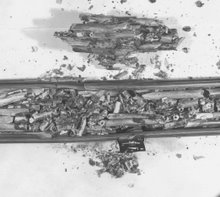
Yes, here is Regulation by Myth
http://www.physics.wisc.edu/vod/2010/05/07.html
Saturday, May 22, 2010

Wednesday, May 5, 2010
The "merit" of simulators
NRC has had this stuff for a long time. It is likely misleading in its LOCA training.
The caption below refers to a photograph from today's (May 5, 2010) NRC web page.
NRC Commissioner William Ostendorff (center) recently toured the agency’s Technical Training Center, established in 1980, in Chattanooga, Tenn. where nuclear plant simulators, like the one shown here, provide hands-on training for NRC engineers.
Of course, I wonder about the quality of that hands-on training for NRC engineers. Baker-Just and Cathcart-Pawel are alive and likely the 2200 Fahrenheit game is in the NRC's simulator.
The NRC engineers' time would be better spent in a study of PRM-50-93 and its associated public comments.
The above caption says the Technical Training Center was established during 1980. Following is my experience with that Center during 1984. Click to enlarge; your return arrow gets you back.

 Here is an additional entry to this blog on June 29, 2010: Flying magazine, June 2010, page 38 discusses flight simulators in a discussion of a fatal crash. Anther one of the usual suspects was the lack of realism 0f flight simulators, especially at the edges of the flight envelope, and the misleading quality of flight training that emphasizes the approach to stall, but not the stall itself or the post-stall gyrations. Indeed, pilots who are trained from the onset in simulators and in turbine aircraft have very little experience with, or sense of, the natural evolution of a stall. To further mislead those pilots, one criterion of a proper recovery from an impending stall is minimum loss of altitude, whereas, as light aircraft pilots know, the essential considerations are angle of attack and airspeed. A significant loss of altitude is willingly accepted in the name of avoiding a dangerous secondary stall.
The caption below refers to a photograph from today's (May 5, 2010) NRC web page.
NRC Commissioner William Ostendorff (center) recently toured the agency’s Technical Training Center, established in 1980, in Chattanooga, Tenn. where nuclear plant simulators, like the one shown here, provide hands-on training for NRC engineers.
Of course, I wonder about the quality of that hands-on training for NRC engineers. Baker-Just and Cathcart-Pawel are alive and likely the 2200 Fahrenheit game is in the NRC's simulator.
The NRC engineers' time would be better spent in a study of PRM-50-93 and its associated public comments.
The above caption says the Technical Training Center was established during 1980. Following is my experience with that Center during 1984. Click to enlarge; your return arrow gets you back.

 Here is an additional entry to this blog on June 29, 2010: Flying magazine, June 2010, page 38 discusses flight simulators in a discussion of a fatal crash. Anther one of the usual suspects was the lack of realism 0f flight simulators, especially at the edges of the flight envelope, and the misleading quality of flight training that emphasizes the approach to stall, but not the stall itself or the post-stall gyrations. Indeed, pilots who are trained from the onset in simulators and in turbine aircraft have very little experience with, or sense of, the natural evolution of a stall. To further mislead those pilots, one criterion of a proper recovery from an impending stall is minimum loss of altitude, whereas, as light aircraft pilots know, the essential considerations are angle of attack and airspeed. A significant loss of altitude is willingly accepted in the name of avoiding a dangerous secondary stall.
Tuesday, May 4, 2010
Pure oxygen instead of steam for a justification to apply Baker-Just
Subject:
RE: WCAP-12610, Appendix E, August, 1990
Date:
5/4/2010 9:06:10 A.M. Mountain Daylight Time
From:
PDR.Resource@nrc.gov
Reply To:
To:
Bobleyse@aol.com
Robert H. Leyse,
I am responding to your inquiry, which was recently received by the Nuclear Regulatory Commission's Public Document Room (NRC/PDR).
The document you have inquired about, WCAP-12610, Appendix E, is not available either on the NRC Web site or in the public version of ADAMS, NRC's Agencywide Documents Access and Management System, because it has a "Non-Publicly Available" status:
Accession Number
9009130156
Document Date
8/31/1990
Estimated Page Count
18
Document Type
REPORTS-TOPICAL (BY MANUFACTURERS-VENDORS ETC)
TEXT-SAFETY REPORT
Title
Proprietary WCAP-12610,App E, "ZIRLO High Temp Oxidation Tests." Withheld.
Availability
Non-Publicly Available
Microfiche Address
97837:040-97837:059
Sensitivity
Sensitive
Package Number
9009130145B
You can file a Freedom of Information Act (FOIA) request to try and get the document's contents released. Contact information for NRC's FOIA office follows:
U.S. Nuclear Regulatory Commission
FOIA/Privacy Officer
Mail Stop: T-5F11
Washington, DC 20555-0001
(301) 415-7169
(301) 415-5130 (FAX)
FOIA.resource@nrc.gov
http://www.nrc.gov/reading-rm/foia/foia-privacy.html
I hope you will find this information to be useful.
Adam Glazer
Technical Librarian
Public Document Room
Nuclear Regulatory Commission
(301) 415-4737
(800) 397-4209
(301) 415-3548 (FAX)
PDR.Resource@nrc.gov
http://www.nrc.gov/reading-rm/pdr.html
[8:00am - 4:00pm, Eastern Time, Monday - Friday]
The next ADAMS User Group meeting will be held on May 5, 2010 from 2:00pm - 3:00pm Eastern Time
http://www.nrc.gov/reading-rm/adams/users-group.html
The PDR uses a private contractor, Best Copy and Printing Incorporated (BCPI), to reproduce documents. On October 1, 2009, BCPI increased its prices. Reproductions from microfiche to paper increased from $0.30 per page to $0.40 per page. Additional information about fees and turnaround times is available at http://www.nrc.gov/reading-rm/pdr/fee-schedule.html.
ADAMS PUBLIC, available at http://www.nrc.gov/reading-rm/adams/adams-public.html, made its debut on February 1, 2010, replacing Citrix-based ADAMS. ADAMS PUBLIC users can now search the ADAMS Legacy Library via a Web interface. The original Web-based ADAMS, available at http://www.nrc.gov/reading-rm/adams/web-based.html, is still available for searching and retrieving current ADAMS documents.
From: Bobleyse@aol.com [mailto:Bobleyse@aol.com] Sent: Tuesday, May 04, 2010 10:38 AMTo: PDR ResourceSubject: WCAP-12610, Appendix E, August, 1990
Attention Mary Mandiola and Adam Glazer:
Thank you Mary and Adam,
Next, I am trying to retrace my steps of several years ago. Following is a letter that is in the system. Thus I need WCAP-12610, Appendix E, August, 1990, but I have not been able to find that. Again, please help.
Bob
DOCKET(6 1 F 511 s3 )December 14, 2002Petitioner's Responses to Comments by Wstinghouse and NEIDOCKETEDUSNRCDecember 16, 2002 (4:30PM)OFFICE OF SECRETARY RULEMAKINGS AND ADJUDICATIONS STAFFOn page 2 of the attachment to its comments dated October 22, 2002, Westinghouse states, "More recently, Westinghouse conducted tests with pure oxygen instead of steam." With difficulty, the Petitioner located a reference that apparently describes this work, WCAP-12610, Appendix E, August, 1990. Only a limited portion of the report is available to the public and it is classified by Westinghouse as a proprietary report. The high temperature oxidation tests were performed by Nuclear Electric, plc in the United Kingdom. Twenty four ZIRLO alloy and six Zr-4 samples were tested at temperatures ranging from 1832F to 2372F. The cylindrical tubing specimens were approximately 0.6 inches long and were from production grade 17x1 7 tubing.Appendix E candidly discloses: "Since, particularly at high temperatures, the self heating of the specimen results in its being at a higher temperature than its surroundings, any temperature measured will be equal to or lower than that of the test specimen." In other words, in order for the investigators at Nuclear Electric to prevent runaway from the heat of reaction at high temperatures (self heating) it was necessary to maintain the surroundings at a substantially lower temperature than the specimen. In this manner, the heat loss by radiation to the relatively cold surroundings compensated for the heat produced by chemical reaction with the pure oxygen. This then leads to the question: What if Nuclear Electric had conducted the investigation with a 17x 17 arrangement of ZIRLO or Zr-2 tubes captured within a Zircaloy-4 structural grid with ZIRLO thimbles as depicted in FIGURE 2-1 of WCAP-12610? The answer is that the assembly would have rapidly been destroyed in runaway if a sufficient flow of oxygen had been maintained.The oxidation tests of the ZIRLO alloy and Zr-4 samples were conducted within a very "quiet" oxygen atmosphere. The apparatus was extremely delicate. The investigators reported, "Pure oxygen gas was used as the oxidant rather than steam. It is believed that, if steam were used, condensation on the suspension wire could invalidate the weight gain measurements." From this it may be inferred that the apparatus was certainly insufficiently robust to accommodate the turbulent thermal hydraulic conditions of LOCA. The oxygen supply system and flow rates are not disclosed in Appendix E, but it must have been a very tender application of oxygen to not upset the suspension wire and the weight gain apparatus.Next the Petitioner responds to comments from Westinghouse and NEI that cover another matter. In its October 22, 2002, set of remarks Westinghouse asserts, "The conditions of FLECHT Run 9573 were extremely severe and from a LOCA standpoint should be considered beyond the design basis for ECCS. Despite the severity of the conditions and the observed extensive zirconium water reaction, the oxidation was within the expected range and runaway oxidation occurred beyond 2300F." The comments from NEI dated October 25, 2002, also refer to FLECHT Run 9573 and runaway as follows, "The test, FLECHT Run 9573, has not been ignored. The test was performed under very severe, beyond design basis conditions. Post test evaluations showed that oxidation was withinTˇmeIOˇSCCYu..O67Sec' I ,-OCz);4.the expected range and "runaway" oxidation did not occur until the temperature was well beyond 2300F."Westinghouse asserts that the temperature of the cladding at start of reflood was excessive in Run 9573. Westinghouse says nothing about the impact of the severe fouling on fuel elements that has been observed at several nuclear power reactors. Of course, severe fouling means that the fuel cladding will likely reach substantially higher temperatures during LOCA than was the case in Run 9573. Run 9573 was designed with no allowance for the severe fouling that characterizes today's nuclear power plant operations within technical specifications.Westinghouse submitted the report WCAP-1261 0 to the NRC with a two page cover letter (NS-NRC-90-3519) on June 13, 1990. The opening sentence is, "Westinghouse has developed an advanced fuel assembly design which provides increased corrosion resistance (allowing for increased flexibility in coolant chemistry operations), enhanced fuel reliability, and the capability to support discharge bumups up to a lead rod average bumup of 75,000 MWD/MTU." The so-called increased flexibility in coolant chemistry operations is likely among the sources of the mindset that severe fouling of nuclear fuel elements is an acceptable operating condition that is well within technical specifications. As the Petitioner has already stated: Run 9573 was designed with no allowance for the severe fouling that characterizes today's nuclear power plant operations within technical specifications.So:What actions should the Commission pursue that would provide a rational basis for the regulation of emergency core cooling systems?One required action is the performance of more experiments with zircaloy cladding on the scale necessary to overcome (or confirm) the impression left from run 9573. The experiments must include the severe fouling that has characterized the operations of several LWRs.Robert H. LeyseP.O. Box 2850Sun Valley, ID 83353
RE: WCAP-12610, Appendix E, August, 1990
Date:
5/4/2010 9:06:10 A.M. Mountain Daylight Time
From:
PDR.Resource@nrc.gov
Reply To:
To:
Bobleyse@aol.com
Robert H. Leyse,
I am responding to your inquiry, which was recently received by the Nuclear Regulatory Commission's Public Document Room (NRC/PDR).
The document you have inquired about, WCAP-12610, Appendix E, is not available either on the NRC Web site or in the public version of ADAMS, NRC's Agencywide Documents Access and Management System, because it has a "Non-Publicly Available" status:
Accession Number
9009130156
Document Date
8/31/1990
Estimated Page Count
18
Document Type
REPORTS-TOPICAL (BY MANUFACTURERS-VENDORS ETC)
TEXT-SAFETY REPORT
Title
Proprietary WCAP-12610,App E, "ZIRLO High Temp Oxidation Tests." Withheld.
Availability
Non-Publicly Available
Microfiche Address
97837:040-97837:059
Sensitivity
Sensitive
Package Number
9009130145B
You can file a Freedom of Information Act (FOIA) request to try and get the document's contents released. Contact information for NRC's FOIA office follows:
U.S. Nuclear Regulatory Commission
FOIA/Privacy Officer
Mail Stop: T-5F11
Washington, DC 20555-0001
(301) 415-7169
(301) 415-5130 (FAX)
FOIA.resource@nrc.gov
http://www.nrc.gov/reading-rm/foia/foia-privacy.html
I hope you will find this information to be useful.
Adam Glazer
Technical Librarian
Public Document Room
Nuclear Regulatory Commission
(301) 415-4737
(800) 397-4209
(301) 415-3548 (FAX)
PDR.Resource@nrc.gov
http://www.nrc.gov/reading-rm/pdr.html
[8:00am - 4:00pm, Eastern Time, Monday - Friday]
The next ADAMS User Group meeting will be held on May 5, 2010 from 2:00pm - 3:00pm Eastern Time
http://www.nrc.gov/reading-rm/adams/users-group.html
The PDR uses a private contractor, Best Copy and Printing Incorporated (BCPI), to reproduce documents. On October 1, 2009, BCPI increased its prices. Reproductions from microfiche to paper increased from $0.30 per page to $0.40 per page. Additional information about fees and turnaround times is available at http://www.nrc.gov/reading-rm/pdr/fee-schedule.html.
ADAMS PUBLIC, available at http://www.nrc.gov/reading-rm/adams/adams-public.html, made its debut on February 1, 2010, replacing Citrix-based ADAMS. ADAMS PUBLIC users can now search the ADAMS Legacy Library via a Web interface. The original Web-based ADAMS, available at http://www.nrc.gov/reading-rm/adams/web-based.html, is still available for searching and retrieving current ADAMS documents.
From: Bobleyse@aol.com [mailto:Bobleyse@aol.com] Sent: Tuesday, May 04, 2010 10:38 AMTo: PDR ResourceSubject: WCAP-12610, Appendix E, August, 1990
Attention Mary Mandiola and Adam Glazer:
Thank you Mary and Adam,
Next, I am trying to retrace my steps of several years ago. Following is a letter that is in the system. Thus I need WCAP-12610, Appendix E, August, 1990, but I have not been able to find that. Again, please help.
Bob
DOCKET(6 1 F 511 s3 )December 14, 2002Petitioner's Responses to Comments by Wstinghouse and NEIDOCKETEDUSNRCDecember 16, 2002 (4:30PM)OFFICE OF SECRETARY RULEMAKINGS AND ADJUDICATIONS STAFFOn page 2 of the attachment to its comments dated October 22, 2002, Westinghouse states, "More recently, Westinghouse conducted tests with pure oxygen instead of steam." With difficulty, the Petitioner located a reference that apparently describes this work, WCAP-12610, Appendix E, August, 1990. Only a limited portion of the report is available to the public and it is classified by Westinghouse as a proprietary report. The high temperature oxidation tests were performed by Nuclear Electric, plc in the United Kingdom. Twenty four ZIRLO alloy and six Zr-4 samples were tested at temperatures ranging from 1832F to 2372F. The cylindrical tubing specimens were approximately 0.6 inches long and were from production grade 17x1 7 tubing.Appendix E candidly discloses: "Since, particularly at high temperatures, the self heating of the specimen results in its being at a higher temperature than its surroundings, any temperature measured will be equal to or lower than that of the test specimen." In other words, in order for the investigators at Nuclear Electric to prevent runaway from the heat of reaction at high temperatures (self heating) it was necessary to maintain the surroundings at a substantially lower temperature than the specimen. In this manner, the heat loss by radiation to the relatively cold surroundings compensated for the heat produced by chemical reaction with the pure oxygen. This then leads to the question: What if Nuclear Electric had conducted the investigation with a 17x 17 arrangement of ZIRLO or Zr-2 tubes captured within a Zircaloy-4 structural grid with ZIRLO thimbles as depicted in FIGURE 2-1 of WCAP-12610? The answer is that the assembly would have rapidly been destroyed in runaway if a sufficient flow of oxygen had been maintained.The oxidation tests of the ZIRLO alloy and Zr-4 samples were conducted within a very "quiet" oxygen atmosphere. The apparatus was extremely delicate. The investigators reported, "Pure oxygen gas was used as the oxidant rather than steam. It is believed that, if steam were used, condensation on the suspension wire could invalidate the weight gain measurements." From this it may be inferred that the apparatus was certainly insufficiently robust to accommodate the turbulent thermal hydraulic conditions of LOCA. The oxygen supply system and flow rates are not disclosed in Appendix E, but it must have been a very tender application of oxygen to not upset the suspension wire and the weight gain apparatus.Next the Petitioner responds to comments from Westinghouse and NEI that cover another matter. In its October 22, 2002, set of remarks Westinghouse asserts, "The conditions of FLECHT Run 9573 were extremely severe and from a LOCA standpoint should be considered beyond the design basis for ECCS. Despite the severity of the conditions and the observed extensive zirconium water reaction, the oxidation was within the expected range and runaway oxidation occurred beyond 2300F." The comments from NEI dated October 25, 2002, also refer to FLECHT Run 9573 and runaway as follows, "The test, FLECHT Run 9573, has not been ignored. The test was performed under very severe, beyond design basis conditions. Post test evaluations showed that oxidation was withinTˇmeIOˇSCCYu..O67Sec' I ,-OCz);4.the expected range and "runaway" oxidation did not occur until the temperature was well beyond 2300F."Westinghouse asserts that the temperature of the cladding at start of reflood was excessive in Run 9573. Westinghouse says nothing about the impact of the severe fouling on fuel elements that has been observed at several nuclear power reactors. Of course, severe fouling means that the fuel cladding will likely reach substantially higher temperatures during LOCA than was the case in Run 9573. Run 9573 was designed with no allowance for the severe fouling that characterizes today's nuclear power plant operations within technical specifications.Westinghouse submitted the report WCAP-1261 0 to the NRC with a two page cover letter (NS-NRC-90-3519) on June 13, 1990. The opening sentence is, "Westinghouse has developed an advanced fuel assembly design which provides increased corrosion resistance (allowing for increased flexibility in coolant chemistry operations), enhanced fuel reliability, and the capability to support discharge bumups up to a lead rod average bumup of 75,000 MWD/MTU." The so-called increased flexibility in coolant chemistry operations is likely among the sources of the mindset that severe fouling of nuclear fuel elements is an acceptable operating condition that is well within technical specifications. As the Petitioner has already stated: Run 9573 was designed with no allowance for the severe fouling that characterizes today's nuclear power plant operations within technical specifications.So:What actions should the Commission pursue that would provide a rational basis for the regulation of emergency core cooling systems?One required action is the performance of more experiments with zircaloy cladding on the scale necessary to overcome (or confirm) the impression left from run 9573. The experiments must include the severe fouling that has characterized the operations of several LWRs.Robert H. LeyseP.O. Box 2850Sun Valley, ID 83353
Thursday, April 29, 2010
Baker-Just background reports are now in NRC's ADAMS ML100950085
It took a while, but the essential references to Baker-Just are now in the NRC's files. Amazing! After decades of use in licensing of nuclear power plants the Baker-Just key references were never reviewed by anyone! Click on each of the following four pages to enlarge and use your back arrow to get back here.


 The above four pages are also in ADAMS as follows:
G20100104/LTR-10-0073/LTR-10-0074/EDATS: SECY-2010-0115 - Ltr. Timothy J. McGinty Re: Release of Documents Referenced in SECY-05-0113.
ML100950085
2010-04-16
 In the third paragraph of the above page you will read: "The NRC decided to remove the references to the above two documents in the final FRN because (1) they did not constitute a significant part of the basis for denying the petition and (2) the reports were not then available in the NRC's files." Of course that leads to the question: Since the NRC did not have the reports, how could they conclude that they did not constitute a signifcant part of the basis for denying the petition?


 The above four pages are also in ADAMS as follows:
G20100104/LTR-10-0073/LTR-10-0074/EDATS: SECY-2010-0115 - Ltr. Timothy J. McGinty Re: Release of Documents Referenced in SECY-05-0113.
ML100950085
2010-04-16
Monday, April 19, 2010
Nukiyama was first and best (a repeat for emphasis)
Here is a copy of key sentences from the last paragraph of my December 26. 2009 aubmittal: So, about 74 years after Nukiyama's pioneering work, the Berkeley crowd and others cited Nukiyama's work, however they did not cite Nukiyama. Instead, the Nukiyama work was attributed to a document published during 1992 by one of their own.
Saturday, December 26, 2009
Nukiyama was first and best
During the early 1930's Professor Shiro Nukiyama discovered a lot with a platinum wire that simultaneously served as a heat transfer element and a resistance thermometer when he explored heat transfer to water at one atmosphere. He recalled his 50 years of experience in an article in the 1984 issue of the International Journal of Heat and Mass Transfer. Click on the page below that has portions of Nukiyama's recollections in 1984 and note the reference to his work that was published in 1934. Click on the following to enlarge.

So, about 74 years after Nukiyama's pioneering work, the Berkeley crowd and others cited Nukiyama's work, however they did not cite Nukiyama. Instead, the Nukiyama work was attributed to a document published during 1992 by one of their own. One of the authors, Majumdar, is now with the Obama gang as he runs the new ARPA-E (EARPA). Again, click to enlarge.

Posted by Robert H. Leyse at 8:57 AM 1 comments
Saturday, December 26, 2009
Nukiyama was first and best
During the early 1930's Professor Shiro Nukiyama discovered a lot with a platinum wire that simultaneously served as a heat transfer element and a resistance thermometer when he explored heat transfer to water at one atmosphere. He recalled his 50 years of experience in an article in the 1984 issue of the International Journal of Heat and Mass Transfer. Click on the page below that has portions of Nukiyama's recollections in 1984 and note the reference to his work that was published in 1934. Click on the following to enlarge.

So, about 74 years after Nukiyama's pioneering work, the Berkeley crowd and others cited Nukiyama's work, however they did not cite Nukiyama. Instead, the Nukiyama work was attributed to a document published during 1992 by one of their own. One of the authors, Majumdar, is now with the Obama gang as he runs the new ARPA-E (EARPA). Again, click to enlarge.

Posted by Robert H. Leyse at 8:57 AM 1 comments
Sunday, April 18, 2010
For Emphasis: Single rod tests do not cut it!
Oxidation tests where single rod or tubing specimens are inductively heated do not yield conservative data for the temperature at which runaway is initiated.
The opening statement in PMR-50-93 is founded on sound science, “Petitioner requests that the United States Nuclear Regulatory Commission ("NRC") revise 10 C.F.R. § 50.46(b)(1) to require that the calculated maximum fuel element cladding temperature not exceed a limit based on data from multi-rod (assembly) severe fuel damage experiments.”
Petitioner is submitting this petition, dated November 17, 2009, because
Petitioner is aware that data from multi-rod (assembly) severe fuel damage experiments (e.g., the LOFT LP-FP-2 experiment) indicates that the current 10 C.F.R. § 50.46(b)(1) PCT limit of 2200 degrees Fahrenheit is non-conservative. Data from such experiments also indicates that the Baker-Just and Cathcart-Pawel equations are both non-conservative for calculating the temperature at which an autocatalytic (runaway) oxidation reaction of Zircaloy would occur in the event of a LOCA. This, in turn, indicates that the Baker-Just and Cathcart-Pawel equations are both non-conservative for calculating the metal-water reaction ratesthat would occur in the event of a LOCA.
The opening statement in PMR-50-93 is founded on sound science, “Petitioner requests that the United States Nuclear Regulatory Commission ("NRC") revise 10 C.F.R. § 50.46(b)(1) to require that the calculated maximum fuel element cladding temperature not exceed a limit based on data from multi-rod (assembly) severe fuel damage experiments.”
Petitioner is submitting this petition, dated November 17, 2009, because
Petitioner is aware that data from multi-rod (assembly) severe fuel damage experiments (e.g., the LOFT LP-FP-2 experiment) indicates that the current 10 C.F.R. § 50.46(b)(1) PCT limit of 2200 degrees Fahrenheit is non-conservative. Data from such experiments also indicates that the Baker-Just and Cathcart-Pawel equations are both non-conservative for calculating the temperature at which an autocatalytic (runaway) oxidation reaction of Zircaloy would occur in the event of a LOCA. This, in turn, indicates that the Baker-Just and Cathcart-Pawel equations are both non-conservative for calculating the metal-water reaction ratesthat would occur in the event of a LOCA.
Saturday, April 17, 2010
PRM-50-93 is a wake-up call
Would you believe that the NRC has never reviewed the cornerstone technical reports that are the primary basis for Baker-Just? The Baker Just report , Studies of Metal water Reactions at High Temperature, ANL-6548, May 1962, NRC ADAMS accession number ML050550198, is a required reference under which nuclear power plants are licensed. Appendix K to 10 CFR part 50, "ECCS Evaluation Models,'' requires, among other items, that the rate of energy release, hydrogen generation, and cladding oxidation from the metal/water reaction shall be calculated using the Baker-Just equation.
The cornerstone reference reports that yield the Baker-Just equation are, The High Temperature Oxidation of Zircaloy in Water, WAPD-104, March 19,1954, accession number ML100900446, and Studies Relating to the Reaction Between Zirconium and Water at High Temperatures, BMI-1154, January 1957, accession number ML 100570218. It is important to note that WAPD-104 and BMI-1154 have only recently been made available to the NRC staff and the accession numbers are recent entries.
The following is a comment that I have submitted to the NRC's rulemaking site. As of May 2, 2010, it is not yet in the NRC's rulemaking site, however, it is in ADAMS as follows:
2010/04/13-Comment (17) of Robert H. Leyse, on Petition for Rulemaking PRM-50-93 Regarding "NRC revise its regulations based on data from multi-rod (assembly) severe fuel damage experiments".
ML101040679
2010-04-13
PRM-50-93 is a Wake-up Call
There are two parts to this comment.
1. NRC has applied Baker-Just in recent actions.
2. Commissioners must wake-up.
1. NRC applied Baker-Just in recent actions.
In its posted denial of PRM-50-76, the NRC states, “The remaining data from Bostrum ("The High Temperature Oxidation of Zircaloy in Water,'' W. A. Bostrum, WAPD-104 March 1954) and Lemmon ("Studies Relating to the Reaction Between Zirconium and Water at High Temperatures,'' A. W. Lemmon, Jr., BMI-1154, January 1957), at more relevant zirconium cladding conditions, were used by Baker and Just in the derivation of their equation.” However, it is unlikely that the authors of NRC’s technical safety analysis, ML041210109, ever looked at either WAPD-104 or BMI-1154. It is more likely that those authors merely lifted the description of those references from the Baker-Just report, ML050550198. Thus the authors of ML041210109 were not aware that Bostrom and Lemmon each used induction heating in their investigations. Furthermore, those authors also were likely unaware of FZKA 5846, the Hofmann and Noack report. Recently NRC has placed reports in ADAMS: WAPD-104 is ML100900446 and BMI-1154 is ML100570218.
NRC reviewers have not been aware that single rod tests with induction heating do not yield conservative values for the temperature at which runaway oxidation proceeds. Thus several nuclear power plant licensees have been allowed to install lead assemblies with alloys such as M-5. One typical example is:
1. (80) San Onofre, Units 2 and 3 - Temporary Exemption from the Requirement of 10 CFR Part 50, Section 50.46 and Appendix K for Lead Fuel Assemblies.
ML090860429
2009-12-17
7
In the above we read:
Metal-water reaction tests performed on M5 alloy material by AREVA NP (as discussed in topical report BAW-10227P-A) demonstrate conservative reaction rates relative to the Baker-Just equation.
Here is the reference to the safety evaluation of topical report BAW-10227P-A:
5. (80) REVISED SAFETY EVALUATION BY THE OFFICE OF NUCLEAR REACTOR REGULATION FOR TOPICAL REPORT BAW-10227P, "EVALUATION OF ADVANCED CLADDING AND STRUCTURAL MATERIAL (M5) IN PWR REACTOR FUEL."
ML003681490
2000-02-04
34
The safety evaluation tells us:
Evaluation -FCF uses approved LOCA evaluation models along with the Baker-Just correlation, as required by 10 CFR Part 50 Appendix K, for demonstrating compliance with the 2200 OF PCT and 17 percent oxidation criteria for the fuel cladding during a LOCA. FCF has performed high-temperature oxidation tests for M5 cladding (Appendix D of Reference 1) to confirm that the Baker-Just oxidation correlation remains conservative in relation to M5 high-temperature oxidation. The FCF high temperature oxidation tests were performed in super heated flowing steam where the sample (both M5 and Zr-4) was inductively heated to temperatures of 1050, 1150, and 1250oC for various times. The measured oxidation rates for the M5 samples were significantly lower than those for the Zr-4 samples at 1050oC; however, at 1150 and 1250oC the oxidation rates were nearly identical. A comparison of M5 measured values to Baker-Just predictions demonstrated that the Baker-Just correlation remained conservative for temperatures typically calculated for LOCA. The staff asked FCF (Reference 4) to provide Arrehenius plots of the high-temperature oxidation data in order to provide a measure of bias and uncertainty in the data. FCF provided these plots (Reference 6) which demonstrated only small uncertainties and essentially no biases in the data. The FCF data demonstrates that high-temperature oxidation of the M5 alloy is bounded by the Baker-Just correlation and that the Appendix K requirement for the use of Baker-Just remains conservative in relation to the use of M5.
Oxidation tests where single rod or tubing specimens are inductively heated do not yield conservative data for the temperature at which runaway is initiated. Clearly, the NRC staff’s review and approval of topical report BAW-10227P-A, “Evaluation of Advanced Cladding and Structural Material (M5) in PWR Reactor Fuel,” dated February 4, 2000 (ADAMS Accession Nos. ML003681479 and ML003681490), has not been based on sound science.
2. Commissioners must wake-up.
The Commissioners should not blindly follow the staff recommendations and findings as they did in the case of PRM-50-76. The Commissioners must have an awareness of what is going on as the review proceeds instead of casually reviewing a completed set of recommendations. Furthermore, the Commissioners should not tolerate undue delays in the review.
For example, the Commissioners did not do their homework in their unanimous approval of the staff recommendation to deny PRM-50-76. They had no awareness of the staff activities as the staff review proceeded from the date of docketing, May 8, 2002, until they received the following on June 29, 2005; a duration of almost 38 months.
RULEMAKING ISSUE
NOTATION VOTE
SECY-05-0113
June 29, 2005
FOR: The Commissioners
FROM: Luis A. Reyes
Executive Director for Operations
SUBJECT: DENIAL OF A PETITION FOR RULEMAKING TO REVISE APPENDIX K TO 10 CFR PART 50 AND ASSOCIATED GUIDANCE DOCUMENTS (PRM-50-76)
The proposed federal register document was Attachment 1 to the above.
Authorized Fed Register Attachment to above Attachment 1
[7590-01-P]
NUCLEAR REGULATORY COMMISSION
10 CFR Part 50
[Docket No. PRM-50-76]
Robert H. Leyse; Denial of Petition for Rulemaking
AGENCY: Nuclear Regulatory Commission
ACTION: Petition for Rulemaking; Denial
This proposed federal register document included a list of references including the two keystone references, WAPD-104 and BMI-1154 that are cited in Baker –Just;
“The High Temperature Oxidation of Zircaloy in Water,” W. A. Bostrum, WAPD-104 (March 1954)
“Studies Relating to the Reaction Between Zirconium and Water at High Temperatures,”
A. W. Lemmon, Jr., BMI-1154, (January 1957)
The document that appeared in the Federal Register on September 6, 2005, ACTION: Petition for rulemaking; denial, had a list of references; however the vital reports, WAPD-104 and BMI-1154 were not listed.
On August 5, 2005, the voting record was released:
UNITED STATES NUCLEAR REGULATORY COMMISSION
WASHINGTON, D.C. 20555-0001
August 5, 2005
SECRETARY
COMMISSION VOTING RECORD
DECISION ITEM: SECY-05-0113
TITLE: DENIAL OF A PETITION FOR RULEMAKING TO REVISE
APPENDIX K TO 10 CFR PART 50 AND ASSOCIATED
GUIDANCE DOCUMENTS (PRM-50-76)
The voting record includes a signed note from each of the four Commissioners. In each case the opening sentence is: “I approve …”
Commissioner Lyons wrote:
I approve the staffs recommendation to deny the petition for rulemaking and concur with the comments of Commissioner Merrifield. The staff needs to address the following comments in both the Federal Register Notice and the denial letter to the petitioner:
1. The following sentence contained on page 2, lines 4 and 5 of the letter to the petitioner and page 21, lines 8 and 9 of the Federal Register Notice needs to be modified to clarify how these experiments relate to the denial of the petition. 'The NRC funded more than 50 Zircaloy clad bundle reflood experiments at the National Research Universal (NRU) reactor."
2. The following sentence contained on page 2, lines 5 through 10 of the letter to the
petitioner and page 21, lines 10 through 13 of the Federal Register Notice needs to be
modified to clarify how these programs relate to the denial of the petition. 'The NRC is
currently conducting and evaluating experimental and analytical programs on fuel
cladding behavior ..... to evaluate the adequacy of current 50.46 oxidation-related criteria and models."
3. The following paragraph on page 2 of the letter to the petitioner and page 22 of the
Federal Register Notice needs to be modified to clarify how this information relates to
the denial of the petition.
"The NRC applied the Cathcart-Pawel oxygen uptake and ZRO2 thickness equations to the four FLECHT Zircaloy experiments ......... [start new paragraph] The NRC applied the Cathcart-Pawel oxide thickness equation to 15 of their transient temperature experiments ..... This result is consistent with the application of the Cathcart-Pawel equations, which are intended for use in best-estimate LOCA calculations in accordance with RG 1.157."
However, the denial was effected and published in the Federal Register on September 6, 2005, and the requirements listed by Commissioner Lyons were never met. Those requirements are met among the well documented teachings of PRM-50-93.
Comment submitted by
Robert H. Leyse*
Chemical Engineer and Nuclear Engineer
P. O. Box 2850
Sun Valley, ID 83353
*Experience:
Career to date: Commenter’s ongoing career spans several decades: General Electric at Hanford Works (1950), Argonne, DuPont Savannah River Plant, General Electric Vallecitos, Westinghouse Pittsburgh, Scandpower Norway, Consulting with Westinghouse at TMI-2, EPRI Nuclear Safety Analysis Center, EPRI Exploratory Research, and now self employed (2010).
Selected Experience pertinent to this comment on PRM-50-93:
PWR FLECHT: Test design, discoveries and reporting as referenced in PRM-50-93.
Presentation at 2003 RELAP5 International Users Seminar, West Yellowstone, Montana
Unmet Challenges for SCDAP/RELAP5-3D. Analysis of Severe Accidents for Light Water Nuclear Reactors with Heavily Fouled Cores. Robert H. Leyse,
www.inl.gov/relap5/rius/yellowstone/leyse.pdf
Comment NEI PETITION FOR RULEMAKING: PRM-50-78 (Cladding Materials) September 9, 2002
The petition should be denied because the evaluations of cladding materials do not account for the realities of plant operation under so-called normal conditions as well as the LOCA environment.
PETITION FOR RULEMAKING: PRM-50-76 May 8, 2002
Petitioner is aware of deficiencies in Appendix K. 1. A. 5. The Baker-Just equation does not include any consideration of the complex thermal hydraulic conditions during LOCA including the potential for very high fluid temperatures. Likewise, petitioner is aware of deficiencies in Regulatory Guide 1.157, BESTESTIMATE CALCULATIONS OF ECCS PERFORMANCE, Paragraph 3.2.5.1. The report NUREG-17 does not include any consideration of the complex thermal hydraulic conditions during LOCA including the potential for very high fluid temperatures.
PETITION FOR RULEMAKING: PRM-50-73 September 04, 2001
The specific issue is that 50.46 and Appendix K do not address the impact of crud on coolability during a fast moving (large break) LOCA.
PETITION FOR RULEMAKING: PRM-50-78 September 9, 2002
Regulations are needed to address the impact of fouling on the performance of heat transfer surfaces throughout licensed nuclear power plants.
Current field is microscale heat transfer to pressurized water at ultra-high heat fluxes.
Microscale Heat Transfer to Subcooled Water
LEYSE: MICROSCALE HEAT TRANSFER
doi.wiley.com/10.1111/j.1749-6632.2002.tb05912.x
Or go to: http://www3.interscience.wiley.com/journal/118947467/abstract
MICROSCALE PHASE CHANGE HEAT TRANSFER AT HIGH HEAT FLUX. Robert H. Leyse. Inz, Inc. Phani K. Meduri, Gopinath R. Warrier and Vijay K. Dhir ...
boiling.seas.ucla.edu/Publications/Conf_LMWD2003
The cornerstone reference reports that yield the Baker-Just equation are, The High Temperature Oxidation of Zircaloy in Water, WAPD-104, March 19,1954, accession number ML100900446, and Studies Relating to the Reaction Between Zirconium and Water at High Temperatures, BMI-1154, January 1957, accession number ML 100570218. It is important to note that WAPD-104 and BMI-1154 have only recently been made available to the NRC staff and the accession numbers are recent entries.
The following is a comment that I have submitted to the NRC's rulemaking site. As of May 2, 2010, it is not yet in the NRC's rulemaking site, however, it is in ADAMS as follows:
2010/04/13-Comment (17) of Robert H. Leyse, on Petition for Rulemaking PRM-50-93 Regarding "NRC revise its regulations based on data from multi-rod (assembly) severe fuel damage experiments".
ML101040679
2010-04-13
PRM-50-93 is a Wake-up Call
There are two parts to this comment.
1. NRC has applied Baker-Just in recent actions.
2. Commissioners must wake-up.
1. NRC applied Baker-Just in recent actions.
In its posted denial of PRM-50-76, the NRC states, “The remaining data from Bostrum ("The High Temperature Oxidation of Zircaloy in Water,'' W. A. Bostrum, WAPD-104 March 1954) and Lemmon ("Studies Relating to the Reaction Between Zirconium and Water at High Temperatures,'' A. W. Lemmon, Jr., BMI-1154, January 1957), at more relevant zirconium cladding conditions, were used by Baker and Just in the derivation of their equation.” However, it is unlikely that the authors of NRC’s technical safety analysis, ML041210109, ever looked at either WAPD-104 or BMI-1154. It is more likely that those authors merely lifted the description of those references from the Baker-Just report, ML050550198. Thus the authors of ML041210109 were not aware that Bostrom and Lemmon each used induction heating in their investigations. Furthermore, those authors also were likely unaware of FZKA 5846, the Hofmann and Noack report. Recently NRC has placed reports in ADAMS: WAPD-104 is ML100900446 and BMI-1154 is ML100570218.
NRC reviewers have not been aware that single rod tests with induction heating do not yield conservative values for the temperature at which runaway oxidation proceeds. Thus several nuclear power plant licensees have been allowed to install lead assemblies with alloys such as M-5. One typical example is:
1. (80) San Onofre, Units 2 and 3 - Temporary Exemption from the Requirement of 10 CFR Part 50, Section 50.46 and Appendix K for Lead Fuel Assemblies.
ML090860429
2009-12-17
7
In the above we read:
Metal-water reaction tests performed on M5 alloy material by AREVA NP (as discussed in topical report BAW-10227P-A) demonstrate conservative reaction rates relative to the Baker-Just equation.
Here is the reference to the safety evaluation of topical report BAW-10227P-A:
5. (80) REVISED SAFETY EVALUATION BY THE OFFICE OF NUCLEAR REACTOR REGULATION FOR TOPICAL REPORT BAW-10227P, "EVALUATION OF ADVANCED CLADDING AND STRUCTURAL MATERIAL (M5) IN PWR REACTOR FUEL."
ML003681490
2000-02-04
34
The safety evaluation tells us:
Evaluation -FCF uses approved LOCA evaluation models along with the Baker-Just correlation, as required by 10 CFR Part 50 Appendix K, for demonstrating compliance with the 2200 OF PCT and 17 percent oxidation criteria for the fuel cladding during a LOCA. FCF has performed high-temperature oxidation tests for M5 cladding (Appendix D of Reference 1) to confirm that the Baker-Just oxidation correlation remains conservative in relation to M5 high-temperature oxidation. The FCF high temperature oxidation tests were performed in super heated flowing steam where the sample (both M5 and Zr-4) was inductively heated to temperatures of 1050, 1150, and 1250oC for various times. The measured oxidation rates for the M5 samples were significantly lower than those for the Zr-4 samples at 1050oC; however, at 1150 and 1250oC the oxidation rates were nearly identical. A comparison of M5 measured values to Baker-Just predictions demonstrated that the Baker-Just correlation remained conservative for temperatures typically calculated for LOCA. The staff asked FCF (Reference 4) to provide Arrehenius plots of the high-temperature oxidation data in order to provide a measure of bias and uncertainty in the data. FCF provided these plots (Reference 6) which demonstrated only small uncertainties and essentially no biases in the data. The FCF data demonstrates that high-temperature oxidation of the M5 alloy is bounded by the Baker-Just correlation and that the Appendix K requirement for the use of Baker-Just remains conservative in relation to the use of M5.
Oxidation tests where single rod or tubing specimens are inductively heated do not yield conservative data for the temperature at which runaway is initiated. Clearly, the NRC staff’s review and approval of topical report BAW-10227P-A, “Evaluation of Advanced Cladding and Structural Material (M5) in PWR Reactor Fuel,” dated February 4, 2000 (ADAMS Accession Nos. ML003681479 and ML003681490), has not been based on sound science.
2. Commissioners must wake-up.
The Commissioners should not blindly follow the staff recommendations and findings as they did in the case of PRM-50-76. The Commissioners must have an awareness of what is going on as the review proceeds instead of casually reviewing a completed set of recommendations. Furthermore, the Commissioners should not tolerate undue delays in the review.
For example, the Commissioners did not do their homework in their unanimous approval of the staff recommendation to deny PRM-50-76. They had no awareness of the staff activities as the staff review proceeded from the date of docketing, May 8, 2002, until they received the following on June 29, 2005; a duration of almost 38 months.
RULEMAKING ISSUE
NOTATION VOTE
SECY-05-0113
June 29, 2005
FOR: The Commissioners
FROM: Luis A. Reyes
Executive Director for Operations
SUBJECT: DENIAL OF A PETITION FOR RULEMAKING TO REVISE APPENDIX K TO 10 CFR PART 50 AND ASSOCIATED GUIDANCE DOCUMENTS (PRM-50-76)
The proposed federal register document was Attachment 1 to the above.
Authorized Fed Register Attachment to above Attachment 1
[7590-01-P]
NUCLEAR REGULATORY COMMISSION
10 CFR Part 50
[Docket No. PRM-50-76]
Robert H. Leyse; Denial of Petition for Rulemaking
AGENCY: Nuclear Regulatory Commission
ACTION: Petition for Rulemaking; Denial
This proposed federal register document included a list of references including the two keystone references, WAPD-104 and BMI-1154 that are cited in Baker –Just;
“The High Temperature Oxidation of Zircaloy in Water,” W. A. Bostrum, WAPD-104 (March 1954)
“Studies Relating to the Reaction Between Zirconium and Water at High Temperatures,”
A. W. Lemmon, Jr., BMI-1154, (January 1957)
The document that appeared in the Federal Register on September 6, 2005, ACTION: Petition for rulemaking; denial, had a list of references; however the vital reports, WAPD-104 and BMI-1154 were not listed.
On August 5, 2005, the voting record was released:
UNITED STATES NUCLEAR REGULATORY COMMISSION
WASHINGTON, D.C. 20555-0001
August 5, 2005
SECRETARY
COMMISSION VOTING RECORD
DECISION ITEM: SECY-05-0113
TITLE: DENIAL OF A PETITION FOR RULEMAKING TO REVISE
APPENDIX K TO 10 CFR PART 50 AND ASSOCIATED
GUIDANCE DOCUMENTS (PRM-50-76)
The voting record includes a signed note from each of the four Commissioners. In each case the opening sentence is: “I approve …”
Commissioner Lyons wrote:
I approve the staffs recommendation to deny the petition for rulemaking and concur with the comments of Commissioner Merrifield. The staff needs to address the following comments in both the Federal Register Notice and the denial letter to the petitioner:
1. The following sentence contained on page 2, lines 4 and 5 of the letter to the petitioner and page 21, lines 8 and 9 of the Federal Register Notice needs to be modified to clarify how these experiments relate to the denial of the petition. 'The NRC funded more than 50 Zircaloy clad bundle reflood experiments at the National Research Universal (NRU) reactor."
2. The following sentence contained on page 2, lines 5 through 10 of the letter to the
petitioner and page 21, lines 10 through 13 of the Federal Register Notice needs to be
modified to clarify how these programs relate to the denial of the petition. 'The NRC is
currently conducting and evaluating experimental and analytical programs on fuel
cladding behavior ..... to evaluate the adequacy of current 50.46 oxidation-related criteria and models."
3. The following paragraph on page 2 of the letter to the petitioner and page 22 of the
Federal Register Notice needs to be modified to clarify how this information relates to
the denial of the petition.
"The NRC applied the Cathcart-Pawel oxygen uptake and ZRO2 thickness equations to the four FLECHT Zircaloy experiments ......... [start new paragraph] The NRC applied the Cathcart-Pawel oxide thickness equation to 15 of their transient temperature experiments ..... This result is consistent with the application of the Cathcart-Pawel equations, which are intended for use in best-estimate LOCA calculations in accordance with RG 1.157."
However, the denial was effected and published in the Federal Register on September 6, 2005, and the requirements listed by Commissioner Lyons were never met. Those requirements are met among the well documented teachings of PRM-50-93.
Comment submitted by
Robert H. Leyse*
Chemical Engineer and Nuclear Engineer
P. O. Box 2850
Sun Valley, ID 83353
*Experience:
Career to date: Commenter’s ongoing career spans several decades: General Electric at Hanford Works (1950), Argonne, DuPont Savannah River Plant, General Electric Vallecitos, Westinghouse Pittsburgh, Scandpower Norway, Consulting with Westinghouse at TMI-2, EPRI Nuclear Safety Analysis Center, EPRI Exploratory Research, and now self employed (2010).
Selected Experience pertinent to this comment on PRM-50-93:
PWR FLECHT: Test design, discoveries and reporting as referenced in PRM-50-93.
Presentation at 2003 RELAP5 International Users Seminar, West Yellowstone, Montana
Unmet Challenges for SCDAP/RELAP5-3D. Analysis of Severe Accidents for Light Water Nuclear Reactors with Heavily Fouled Cores. Robert H. Leyse,
www.inl.gov/relap5/rius/yellowstone/leyse.pdf
Comment NEI PETITION FOR RULEMAKING: PRM-50-78 (Cladding Materials) September 9, 2002
The petition should be denied because the evaluations of cladding materials do not account for the realities of plant operation under so-called normal conditions as well as the LOCA environment.
PETITION FOR RULEMAKING: PRM-50-76 May 8, 2002
Petitioner is aware of deficiencies in Appendix K. 1. A. 5. The Baker-Just equation does not include any consideration of the complex thermal hydraulic conditions during LOCA including the potential for very high fluid temperatures. Likewise, petitioner is aware of deficiencies in Regulatory Guide 1.157, BESTESTIMATE CALCULATIONS OF ECCS PERFORMANCE, Paragraph 3.2.5.1. The report NUREG-17 does not include any consideration of the complex thermal hydraulic conditions during LOCA including the potential for very high fluid temperatures.
PETITION FOR RULEMAKING: PRM-50-73 September 04, 2001
The specific issue is that 50.46 and Appendix K do not address the impact of crud on coolability during a fast moving (large break) LOCA.
PETITION FOR RULEMAKING: PRM-50-78 September 9, 2002
Regulations are needed to address the impact of fouling on the performance of heat transfer surfaces throughout licensed nuclear power plants.
Current field is microscale heat transfer to pressurized water at ultra-high heat fluxes.
Microscale Heat Transfer to Subcooled Water
LEYSE: MICROSCALE HEAT TRANSFER
doi.wiley.com/10.1111/j.1749-6632.2002.tb05912.x
Or go to: http://www3.interscience.wiley.com/journal/118947467/abstract
MICROSCALE PHASE CHANGE HEAT TRANSFER AT HIGH HEAT FLUX. Robert H. Leyse. Inz, Inc. Phani K. Meduri, Gopinath R. Warrier and Vijay K. Dhir ...
boiling.seas.ucla.edu/Publications/Conf_LMWD2003
Subscribe to:
Posts (Atom)