Thursday, August 15, 2013

Upper Head Injection and Sinister Stuff

I've covered a lot the territory regarding Upper Head Injection in prior entries. NSAC management was directed by EPRI management to "investigate" my assertions.  I cooperated.  After the "investigation" was completed, NSAC produced the following two pages.  Of course, I was not expected to ever see these, but somehow I acquired these.

What is so revealing is the NSAC collaboration with the NRC; I was never aware of that game.  In the following memorandum NSAC apologizes to NRC for Leyse's communication with the NRC following a complaint by NRC.  There is a lot more to the situation under which Leyse communicated with the NRC.  More later on this, but in a nutshell, NSAC had given Leyse his walking papers and Leyse was looking for work.

NSAC was nuts to issue this memorandum.  There are several adjectives that describe the games; sinister covers the ground.

Click on the page to see the entire page, and then use the back arrow to get back.


Monday, August 12, 2013

Hardened Vent at BWRs, Request to Senator Risch

Here is a letter that I have sent to Senator Risch.


Robert H. Leyse
P. O. Box 2850
222 Elkhorn Road
Sun Valley, ID 83353

 August 11, 2013

The Honorable James E. Risch United States Senator
1411 Falls Avenue E Suite 2
Twin Falls, ID 83301

Dear Senator Risch:

Without success, I have been trying to get documents from the NRC in the arena of hardened venting systems such as would apply to Idaho’s neighboring Columbia Generating Station and other boiling water nuclear power reactors.

Here is what I need:

On page 33 of 36 of reference ML13143A321, I read:
1.2 The HCVS shall include the following design features:
1.2.1 The HCVS shall have the capacity to vent the steam/energy equivalent of 1 percent of iicensed/rated thermal power (unless a lower value is justified by analyses), and be able to maintain containment pressure below the primary containment design pressure.

I need the list of references that document the basis for 1.2.1. This request is specific, concise and vital. Please tell NRC to respond promptly with the list of references.


Robert H. Leyse

Saturday, August 10, 2013

HiTBiT Assembly

THIS IS FROM DESERT STORM DAYS, BUT IT HAS NOTHING TO DO WITH DESERT STORM.
here is a related publication.
http://boiling.seas.ucla.edu/BOILING/Publications/Conf_LMWD2003


ABSTRACT

Phase change heat transfer phenomena have been discovered with a micron-sized heat transfer element operating in subcooled (20oC) degassed, de-ionized water over a wide pressure range (200 – 6000 Psia) at ultra-high heat fluxes up to 4000 W/cm2. The platinum heat transfer element (diameter 7.5 microns, length 1.14 mm) is mounted horizontally within a 0.6 cm internal diameter stainless steel tube. The platinum element is simultaneously a resistance thermometer. Sealed electrical terminals effect direct current heating of the platinum element. Pressure is applied pneumatically. The adiabatic heating rate of the element is 6 oC per microsecond at 3700 W/cm2; therefore, response is essentially instantaneous for the procedures described herein. Two distinct procedures have been employed. In the first procedure, power (heat flux) is maintained substantially constant as pressure is reduced. In the second procedure, pressure is held constant while the heat flux is increased smoothly,

The first procedure: 1) Pressurize the water-filled stainless steel chamber to 6000 Psia 2) Apply substantially constant power (fixed heat flux). 3) Maintain constant heat flux as pressure is reduced smoothly from 6000 Psia to 200 Psia over a period of about 20 seconds. Record voltage, amperage, and pressure at 0.1 second intervals.

The second (Nukiyama) procedure: 1) Pressurize the water-filled stainless steel chamber to a fixed pressure. 2) Apply smoothly increasing power. 3) Maintain constant pressure while the heat flux is increased from very low values to several thousand W/cm2. Record voltage, amperage, and pressure at 0.1 second intervals.

The test results reveal a very high level of consistency among sets of runs conducted by INZ and more recent runs conducted by the Boiling Heat Transfer Laboratory at UCLA.


Carbon-14, General Electric Test Reactor - Criminal Activity - Aluminum Nitride

Be careful what you say,

Don't give yourself away. 

On September 12, 1966, I documented my insight on a stupid move that the great GE staff was setting up for the production of Carbon 14. Somebody figured out that Carbon 14 could be produced for very little money by loading some unused space in the General Electric Test Reactor with aluminum nitride, and after several cycles of exposure somebody could get a nice bonus as the Carbon 14 would yield $$$.

 I wrote the following to my Manager, Kent Stratton:

Today I found out that four hollow filler pieces to be filled with aluminum nitride powder are being constructed for the GETR core. These are the four moon-shaped pieces for the periphery of the core. What if a leak develops in one of these pieces (intended for a 24 cycle life)? The aluminum nitride reacts with water to produce ammonia. Small amounts of water can leak in, ammonia gas can be produced and the filler piece can be filled with gas at about 150 psig (core operating pressure). Now, if there is an emergency cooling trip, the filler piece will deform substantially with the sudden decrease of surrounding pressure. Somebody should be looking into the consequences of such rapid deformation. One possibility is substantial release of a large C-14 inventory into the reactor water. Offhand, it doesn't appear likely that the control rods would bind, but is anyone certain of this? In summary,the plans need additional review. My guess is that further study will result in a finding of inadequate safety.

I discussed this with a member of the Nuclear Safety Group.  He then wrote a memorandum to the head of the Nuclear Safety group with distribution to six others plus me.  Here is his opening paragraph.

 September 23, 1966

 SUBJECT:  Irradiation of Aluminum Nitride in GETR Reactor Peripheral Filler Pieces

 Nuclear Safety has approved these assemblies for irradiation in GETR.  However, there is one hazard that still concerns us.  This is not expected to create any immediate problems, but might after any months.  For this reason we do not require an immediate answer but want your evaluation in the next four to six weeks. 

 There is lot more to reveal. The task proceeded without delay. Very fortunately, the capsules failed shortly after startup and the project was abandoned. It would have been hell if the capsules failed after a substantial C-14 inventory built up. I'm quite certain that the set of events was never reported to the AEC.

Here is a paragraph from my monthly report to Kent Stratton on September 30, 1966:

Aluminum Nitride Filler Pieces - On September 12 I wrote you a letter describing hazards associated with possible water in-leakage followed by an emergency cooling trip. My understanding is that this irradiation is being delayed indefinitely. The available safeguards analysis is not adequate for the depth of our hazards. This, of course is a problem that has been with us for several years.

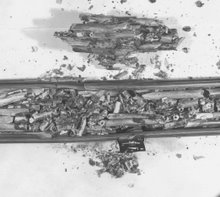
I do not have the dates or the photographs or copies from the log at the General Electric Test Reactor. The aluminum nitride capsules were placed in the core and failed shortly after startup of the reactor. I saw the capsules in the hot lab at Vallecitos Nuclear Center and there were extensive splits along edge welds. I do not have facts on the amount of powder that was lost from the capsules, but it was substantial based on the extensive damage to the capsules; this was no mere pin hole leak.

Sometime after September 30, 1966, my Manager, Kent Stratton was relieved of his duties. One of my co-workers, G. L. Davis, was appointed as my Acting Manager. On November 2, 1966, I wrote the following in my October monthly report to G, L, Davis, Acting Manager.

Safety Attitude Within IPO: The attitude of management within IPO is that safety is to be merely a spectator sport. For example: My recommendations on the aluminum nitride irradiations were not only ignored, they were arrogantly ignored, and after the whole show was over (and $100,000 was down the drain), there was an attitude of resentment when I dragged out my correspondence which showed that I predicted the occurrence before it happened. As you know, Management always accused us of Monday morning quarterbacking when we were in Nuclear Safety when in reality predictions like the one I just cited often held true at that time even though they weren't as well documented. I think Management should take another look at the need for having common sense in the safety program, especially with regard to experiments in the GETR.

Below is an illustration of a moon shaped piece.

Following shows the four filler pieces in the core of the General Elecric Test reactor.

Friday, July 26, 2013

Hardened vented containment in BWRs (and ice condensers).  Here is my latest e-mail to NRC:

Subject:Re: Please respond
Date:7/25/2013 2:16:00 P.M. Mountain Daylight Time
From:Bobleyse@aol.com
To:OPA.Resource@nrc.gov


Hello:
Thank you for promptly pointing out my error.
I prefer to leave the ball in your court, and I've extended the date for your response to Friday, August 9, 2013. 
The correct reference is ML13143A321, page 33 of 36.  On that page I read:
1.2 The HCVS shall include the following design features:
1.2.1 The HCVS shall have the capacity to vent the steam/energy equivalent of 1 percent of iicensed/rated thermal power (unless a lower value is justified by analyses), and be able to maintain containment pressure below the primary containment design pressure.

I've been trying to get NRC to provide a list of references that document the basis for 1.2.1.

Certainly, NRC should realize that the amount of hydrogen produced at Fukushima as well as the timing and rate of hydrogen production was not related to 1 percent of the operating power levels of those units. 

I've tried earlier to find this out, without success.  If I do not get a satisfactory answer from NRC by August 9, 2013, I'll forward this e-mail to my Idaho U. S. Senator Risch.

Robert H. Leyse   bobleyse@aol.com

Tuesday, July 16, 2013

BWR Hardened Vented Containment (Some repitition)

Hardened Vented Containment and the Boeing 787 Dreamliner

The Dreamliners were grounded until the batteries were contained and vented.

In contrast, the Fukushima sister BWRs in the USA continue operating without a glitch while our NRC ponders what to do about the lack of venting.  Of course there is a lot of activity and NRC now says that a hardened vent with the capacity to vent the steam/energy equivalent of one (1) percent of licensed/rated thermal power is adequate although a lower value may be justified by analysis.

ML13143A321 Hardened vents for BWRs

The pages are not numbered, but on page 33 of 36:

1.2 The HCVS shall include the following design features:

1.2.1 The HCVS shall have the capacity to vent the steam/energy equivalent of one
(1) percent
of licensed/rated thermal power (unless a lower value is justified by analyses), and be able to restore and then maintain containment pressure below the primary containment design pressure and the primary containment pressure limit.

And, the NRC is in no sweat.  Here is the schedule:

These Licensees shall promptly start implementation of the requirements in Attachment 2 to this Order upon issuance of the associated final interim staff guidance (ISG) for each phase, and shall complete the two phases of implementation by the following dates:

• Phase 1 (severe accident capable wetwell venting system): no later than startup
from the second refueling outage that begins after June 30, 2014, or
June 30, 2018, whichever comes first.

• Phase 2, (severe accident capable drywell venting system): no later than startup
from the first refueling outage that begins after June 30, 2017, or June 30, 2019,
whichever comes first.